Nissan Sentra B18 (2020-2025) Owner's Manual: Vehicle-to-vehicle distance control mode limitations
WARNING
Listed below are the system limitations for the Intelligent Cruise Control (ICC) system. Failure to operate the Nissan Sentra in accordance with these system limitations could result in serious injury or death.
- The ICC system is primarily intended for use on straight, dry, open roads with light traffic. It is not recommended to use the ICC system in city driving, dense urban traffic, or congested areas where frequent stops occur.
- The ICC system does not automatically adapt to changing road conditions. This system should be used only in smoothly flowing traffic. Do not use the ICC system on roads with sharp curves, on icy or slippery surfaces, or during heavy rain or fog.
- Because there are performance limits to the distance control function, never rely solely on the ICC system. This system does not compensate for careless, inattentive, or distracted driving, nor can it overcome poor visibility caused by rain, fog, or other adverse weather conditions. Always decelerate the Nissan Sentra by pressing the brake pedal as needed to maintain a safe distance from the vehicle ahead, taking surrounding traffic conditions into account.
- If the vehicle ahead comes to a complete stop, the Nissan Sentra will
decelerate to a standstill within the operational limits of the system.
The ICC system will then cancel automatically once it determines that the vehicle has stopped and will sound a warning chime. To prevent unintended vehicle movement, the driver must firmly depress the brake pedal.
- Always remain attentive to vehicle operation and be prepared to manually control speed and following distance. Under certain conditions, the ICC system may not be able to maintain the selected following distance or the set vehicle speed.
- The ICC system may fail to detect the vehicle ahead under certain road
or weather conditions. To reduce the risk of an accident, never use the ICC
system under the following conditions:
- On roads with heavy traffic or sharp curves
- On slippery road surfaces such as ice or snow
- During adverse weather conditions including rain, fog, or snow
- When rain, snow, mud, or dirt accumulates on the bumper area around the distance sensor
- On steep downhill roads, where the Nissan Sentra may exceed the set speed and repeated braking could lead to brake overheating
- On roads with frequent uphill and downhill sections
- When traffic conditions make it difficult to maintain a consistent following distance due to repeated acceleration and deceleration
- When interference from other radar sources is present
- Do not use the ICC system while towing a trailer. The system may not correctly detect a vehicle ahead when additional load or trailer dynamics are present.
- In certain road or traffic situations, a vehicle or object may unexpectedly enter the sensor detection zone, causing unintended automatic braking. Always stay alert and avoid using the ICC system in situations where it is not recommended in this warning section.
The radar sensor used by the ICC system in the Nissan Sentra will not detect the following objects:
- Stationary or very slow-moving vehicles
- Pedestrians or objects located in the roadway
- Oncoming vehicles traveling in the same lane
- Motorcycles traveling offset within the lane
The sensor primarily detects radar signals reflected from a vehicle ahead. If sufficient signal reflection is not received, the ICC system may not be able to maintain the selected following distance.
The following conditions may prevent the sensor from properly detecting a vehicle ahead, causing the ICC system to operate incorrectly or be unavailable:
- When snow, heavy rain, or road spray from other vehicles interferes with sensor detection
- When the Nissan Sentra is towing a trailer or similar load
- When excessively heavy cargo is loaded in the rear seat or cargo area
The ICC system is designed to automatically monitor sensor operation within the limits of the system.
If the radar sensor becomes dirty or obstructed, the ICC system will cancel automatically. If the sensor is covered with ice or transparent or translucent materials, such as vinyl film or plastic coverings, the ICC system may not properly recognize the obstruction.
In these situations, the vehicle-to-vehicle distance control mode may fail to cancel and may not be able to maintain the selected following distance from the vehicle ahead.
Regularly inspect and clean the radar sensor to ensure proper operation.
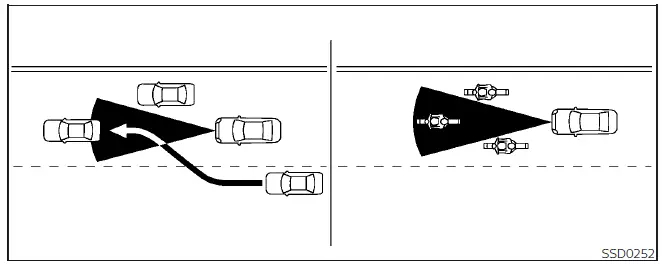
The detection zone of the radar sensor is limited. For the ICC system to maintain the selected following distance, the vehicle ahead must remain within the sensor’s detection zone.
A vehicle ahead may temporarily move outside the detection zone depending on its position within the same lane. Motorcycles may not be detected if they are traveling offset from the lane center. Likewise, a vehicle entering the lane ahead may not be detected until it is fully positioned within the lane.
If this occurs, the Intelligent Cruise Control (ICC) system in the Nissan Sentra may alert the driver by blinking the system indicator and sounding an audible chime. In such situations, the driver may need to manually control the vehicle speed and maintain an appropriate following distance from the vehicle traveling ahead.
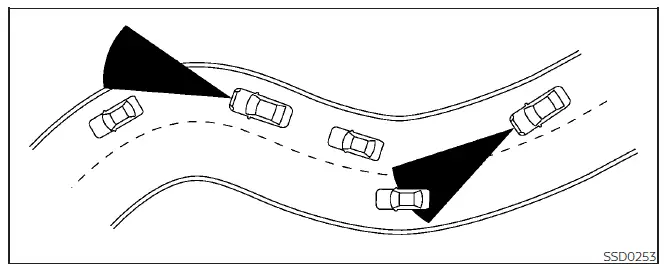
When driving the Nissan Sentra on certain types of roads—such as winding, hilly, curved, narrow roads, or roads under construction—the front radar sensor may detect vehicles in adjacent lanes or may temporarily fail to detect a vehicle traveling ahead. This can cause the ICC system to unexpectedly decelerate or accelerate the vehicle.
Vehicle detection may also be influenced by vehicle operation, including steering input, lane position, or overall vehicle condition, which can affect how the radar sensor interprets surrounding traffic.
If this occurs, the ICC system may unexpectedly warn the driver by blinking the system indicator and sounding a chime. The driver must then manually adjust speed and maintain a safe distance from the vehicle ahead to ensure safe operation of the Nissan Sentra.
Other materials:
B1000-49 Air Bag Diagnosis Sensor Unit
Dtc Description
DTC Description
DTC DETECTION LOGIC
DTC No.
CONSULT screen items
(Trouble diagnosis
content)
DTC Detection Condition
...
Intake Camshaft Position Sensor
Component Inspection
Component Inspection
CHECK INTAKE CAMSHAFT POSITION SENSOR
-1
Turn ignition switch OFF.
Loosen the fixing bolt of the
sensor.
Disconnect intake camshaft positio ...
Rear Axle. Precaution. Precautions. Precaution for Supplemental Restraint System (srs) "air Bag" and "seat Belt Pre-Tensioner"
Precautions. Precaution for Supplemental Restraint System (srs) "air Bag" and "seat Belt Pre-Tensioner"
Precaution for Supplemental Restraint System (srs) "air Bag" and "seat Belt Pre-Tensioner"
Precaution for Supplemental Restraint System (SRS) "AIR BAG" an ...