
Nissan Sentra B18 (2020-2025) Service Manual: Work Flow
OVERALL SEQUENCE
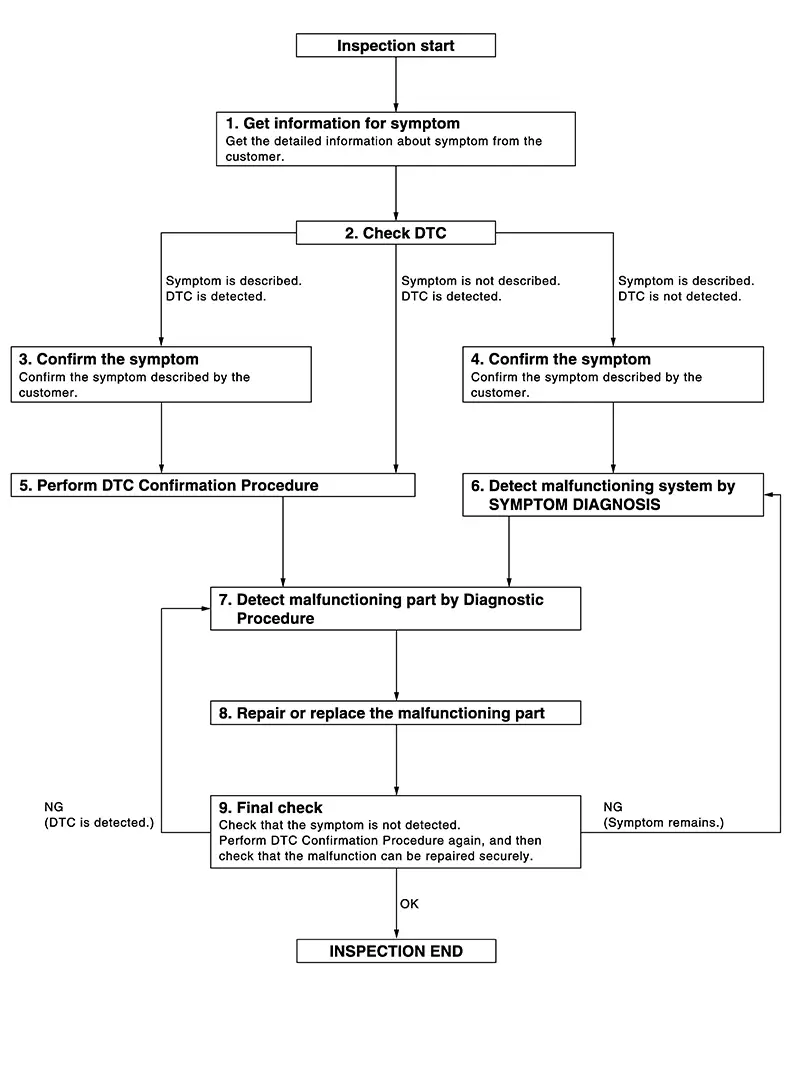
DETAILED FLOW
-
GET INFORMATION FOR SYMPTOM
-
Get detailed information from the customer about the symptom (the condition and the environment when the incident/malfunction occurred).
GO TO 2.
-
-
CHECK DTC
-
 CONSULT
-
Check DTC.
-
Perform the following procedure if DTC is displayed:
-
Record DTC and freeze frame data. (print them out.)
-
Erase DTC.
-
Study the relationship between the cause detected by DTC and the symptom described by the customer.
-
-
Check related service bulletins for information.
-
Is any symptom described and any DTC detected?
Symptom is described, DTC is displayed>>GO TO 3.
Symptom is described, DTC is not displayed>>GO TO 4.
Symptom is not described, DTC is displayed>>GO TO 5.
-
-
CONFIRM THE SYMPTOM
-
CONSULT
Confirm the symptom described by the customer.
Select "Data Monitor" mode of "BCM(REAR DEFOGGER)" and check real-time diagnosis results.
Verify relation between the symptom and the condition when the symptom is detected.
GO TO 5.
-
-
CONFIRM THE SYMPTOM
-
CONSULT
Confirm the symptom described by the customer.
Select "Data Monitor" mode of "BCM(REAR DEFOGGER)" and check real-time diagnosis results.
Verify relation between the symptom and the condition when the symptom is detected.
GO TO 6.
-
-
PERFORM DTC CONFIRMATION PROCEDURE
-
CONSULT
Perform DTC Confirmation Procedure for the displayed DTC, and then check that DTC is detected again.
At this time, always connect CONSULT to the Nissan Sentra vehicle, and check diagnostic results in real time.
If two or more DTCs are detected, refer to DTC Inspection Priority Chart and determine trouble diagnosis order.
Note:
-
Freeze frame data is useful if the DTC is not detected.
-
Perform Component Function Check if DTC Confirmation Procedure is not included in Service Manual. This simplified check procedure is an effective alternative though DTC cannot be detected during this check.
If the result of Component Function Check is NG, it is the same as the detection of DTC by DTC Confirmation Procedure.
-
Is DTC detected?
YES >>GO TO 6.
NO >>Refer to Intermittent Incident.
-
-
DETECT MALFUNCTIONING SYSTEM BY SYMPTOM DIAGNOSIS
-
Detect malfunctioning system according to System Description based on the confirmed symptom in step 4, and determine the trouble diagnosis order based on possible causes and symptom.
GO TO 7.
-
-
DETECT MALFUNCTIONING PART BY DIAGNOSTIC PROCEDURE
-
CONSULT
Inspect according to Diagnostic Procedure of the system.
Note:
The Diagnostic Procedure described is based on open circuit inspection. A short circuit inspection is also required for the circuit check in the Diagnostic Procedure.
Is malfunctioning part detected?
YES >>GO TO 8.
NO >>Check voltage of related BCM terminals.
-
-
REPAIR OR REPLACE THE MALFUNCTIONING PART
-
CONSULT
-
Repair or replace the malfunctioning part.
-
Reconnect parts or connectors disconnected during Diagnostic Procedure after repair and replacement.
-
Check DTC. If DTC is displayed, erase it.
-
GO TO 9.
-
-
FINAL CHECK
-
When DTC was detected in step 2, perform DTC Confirmation Procedure or Component Function Check again, and then check that the malfunction has been repaired.
When symptom was described by the customer, refer to confirmed symptom in step 3 or 4, and check that the symptom is not detected.
Does the symptom reappear?
YES >>(DTC is detected) GO TO 7.
YES >>(Symptom remains) GO TO 6.
NO >>Inspection End.
-


Other materials:
System description
Component parts
Nissan vehicle immobilizer system-nats
Nissan vehicle immobilizer systemnats
: component parts location
Bcm
(view with instrument panel removed)
Dongle unit (canada only)
(behind instrument panel lh)
Ignition switch
Nats antenna amp.
(Inside steering column) ...
Exploded View
Exploded View
1.
Accelerator pedal
assembly
2.
Brake pedal bracket
A.
...
How to use this manual
Description
This volume explains “Removal, Disassembly, Installation, Inspection and
Adjustment” and “Trouble Diagnoses”.
Terms
The captions WARNING and CAUTION warn you of steps that must be followed
to prevent personal injury
and/or damage to some part of the vehi ...
