Nissan Sentra B18 (2020-2025) Owner's Manual: Tire pressure
Tire Pressure Monitoring System (TPMS)
WARNING
Radio waves emitted by the Tire Pressure Monitoring System (TPMS) may adversely affect certain types of electronic medical equipment.
Individuals who use a pacemaker or other implanted medical devices should contact the medical equipment manufacturer to determine possible effects before operating the vehicle.
This Nissan Sentra is equipped with a Tire Pressure Monitoring System (TPMS) designed to monitor the air pressure in all road tires, excluding the spare tire.
When the low tire pressure warning light illuminates and a warning message appears in the odometer or the vehicle information display—such as "Tire Pressure Low – Add Air"—one or more tires are significantly under-inflated and require immediate attention.
The TPMS activates only when the Nissan Sentra is driven at speeds above 16 mph (25 km/h). In addition, the system may not detect a sudden or rapid loss of tire pressure, such as a puncture occurring while driving.
Tire inflation pressure
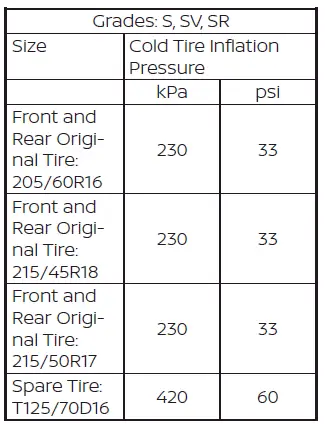
Check tire pressures frequently, including the spare tire, and always before long-distance driving. Proper tire inflation is essential for safe handling, ride comfort, fuel efficiency, and tire longevity.
The recommended tire pressure specifications are listed on the F.M.V.S.S./C.M.V.S.S. certification label or the Tire and Loading Information label under the heading "Cold Tire Pressure". This label is located on the driver-side center pillar of the Nissan Sentra.
Tire pressures should be checked regularly because:
- All tires naturally lose air over time, even under normal driving conditions.
- Tires may lose air suddenly when driven over potholes, road debris, or when striking a curb during parking.
The tire pressure should be checked when the tires are cold. Tires are considered COLD when the vehicle has been parked for 3 hours or more, or driven less than 1 mile (1.6 km) at moderate speeds.
The TPMS with Easy-Fill Tire Alert provides both visual and audible signals outside the Nissan Sentra to assist in inflating tires accurately to the recommended COLD tire pressure.
Incorrect tire pressure, including under-inflation or over-inflation, can negatively affect tire wear, braking performance, and overall vehicle handling.
WARNING
- Improperly inflated tires may fail suddenly and increase the risk of a serious accident.
- The Gross Vehicle Weight Rating (GVWR) is listed on the F.M.V.S.S./C.M.V.S.S.
certification label, while vehicle load capacity information is provided on
the Tire and Loading Information label.
Do not exceed the specified load capacity. Overloading the Nissan Sentra may result in reduced tire life, unstable handling, premature tire failure, and may lead to a serious collision.
Exceeding the recommended load limits may also cause damage to other vehicle components.
- Before long trips or when carrying heavy loads, always verify tire pressure using an accurate tire pressure gauge.
- For additional tire safety details, refer to "Important Tire Safety Information" (U.S.) or "Tire Safety Information" (Canada) in the Warranty Information Booklet.
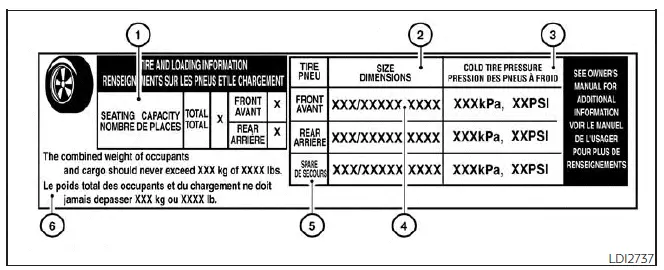
Tire and Loading Information label
- Seating capacity: Indicates the maximum number of occupants that can be safely seated in the vehicle.
- Original tire size: Displays the factory-installed tire size for the Nissan Sentra.
- Cold tire pressure: The recommended inflation pressure for cold tires, established by the manufacturer to provide optimal balance of handling, ride comfort, tire wear, and noise, up to the vehicle’s GVWR.
- Tire size: Refer to the section titled "Tire labeling" for detailed size information.
- Spare tire size.
- Vehicle load limit: Refer to "Vehicle loading information".
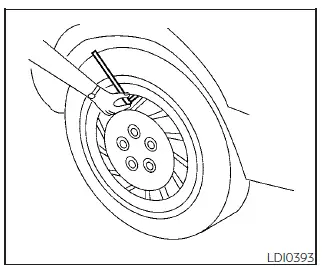
Checking tire pressure
1. Remove the valve stem cap from the tire.
2. Press the tire pressure gauge squarely onto the valve stem. Avoid pressing too hard or forcing the valve sideways, as air may escape.
If a hissing sound is heard while measuring pressure, reposition the gauge to ensure a proper seal.
3. Remove the gauge.
4. Read the tire pressure shown on the gauge and compare it with the specification listed on the Tire and Loading Information label.
5. Add air if necessary. If too much air is added, briefly press the valve core with the gauge tip to release excess pressure. Recheck and adjust as needed.
6. Reinstall the valve stem cap securely.
7. Repeat this procedure for all remaining tires, including the spare tire.
Other materials:
P0078 Evt Control Solenoid Valve
Dtc Description
DTC Description
DTC DETECTION LOGIC
DTC
CONSULT screen terms
(Trouble diagnosis
content)
DTC detection
condition
...
Accelerator Control System. Removal and Installation. Accelerator Control System
Accelerator Control System
Exploded View
Exploded View
1.
Accelerator pedal
assembly
2.
Brake pedal bracket
...
Power Outlet. Preparation. Preparation. Special Service Tool
Preparation. Special Service Tool
Special Service Tool
Special Service Tool
The actual shape of the tools may differ from those
illustrated here.
Tool number
(TechMate No.)
Tool name
&nb ...