Nissan Sentra B18 (2020-2025) Owner's Manual: Tire labeling
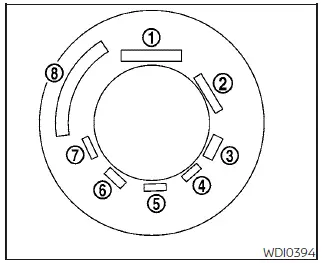
Example
Federal law requires tire manufacturers to place standardized and clearly readable information on the sidewall of all tires installed on vehicles such as the Nissan Sentra.
This information identifies and explains the fundamental characteristics of the tire and also includes the Tire Identification Number (TIN), which is used for safety standard certification and recall identification purposes.
The TIN is especially important, as it allows owners and manufacturers to identify specific tires in the event of a safety recall or service campaign.
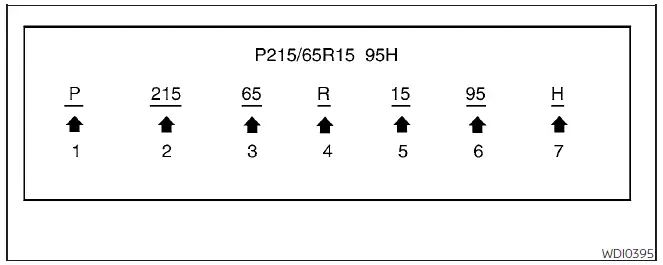
Example
- Tire size (example: P215/65R15 95H)
1. P: The letter “P� indicates that the tire is designed for passenger vehicles, including the Nissan Sentra. Not all tires include this designation.
2. Three-digit number (215): This value represents the tire width in millimeters, measured from sidewall edge to sidewall edge.
3. Two-digit number (65): Known as the aspect ratio, this number expresses the ratio of the tire’s sidewall height to its width.
4. R: The letter “R� designates radial construction, which is the standard tire structure used on modern vehicles.
5. Two-digit number (15): This number indicates the diameter of the wheel rim in inches.
6. Two- or three-digit number (95): This is the tire’s load index, which specifies the maximum load-carrying capacity of each tire.
7. H: The speed rating indicates the maximum speed capability of the tire. The Nissan Sentra should never be driven at speeds exceeding the tire’s rated limit.
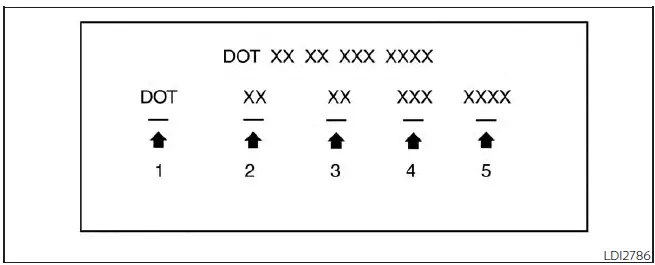
Example (Type A) (if so equipped)
- TIN (Tire Identification Number) for a new tire (example: DOT XX XX XXX XXXX)
1. DOT: Abbreviation for the “Department of Transportation.� This symbol may appear above, below, or to either side of the Tire Identification Number.
2. Two-digit code: Manufacturer’s identification code.
3. Two-digit code: Tire size code.
4. Three-digit code: Tire type code (optional).
5. Four-digit date code: Indicates the week and year the tire was manufactured.
For example, the number 3103 means the tire was built in the 31st week of 2003.
If this date code is not visible, inspect the opposite sidewall of the tire.
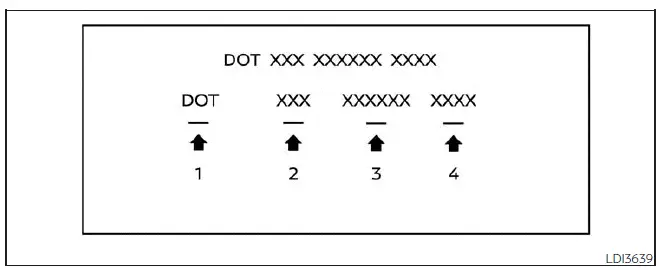
Example (Type B) (if so equipped)
- TIN (Tire Identification Number) for a new tire (example: DOT XXX XXXXXX XXXX)
1. DOT: Department of Transportation designation.
2. Three-digit code: Manufacturer’s identification mark.
3. Six-digit code: Descriptive code identifying significant tire characteristics.
4. Four-digit date code: Identifies the week and year the tire was manufactured.
For example, 3103 indicates production during the 31st week of 2003.
- Tire ply composition and material
This information describes the number of layers, or plies, of rubber-coated fabric used in the tire. Manufacturers must also list the materials used, such as steel, nylon, polyester, or other reinforcing components.
- Maximum permissible inflation pressure
This value represents the maximum air pressure that should ever be inflated into the tire. Never exceed this pressure, even temporarily.
- Maximum load rating
This rating shows the maximum load the tire can safely carry, expressed in both kilograms and pounds. When replacing tires on a Nissan Sentra, always select tires with the same load rating as the original factory-installed tires.
- Term of "tubeless" or "tube type"
This marking indicates whether the tire is designed for use without an inner tube (“tubeless�) or requires an inner tube (“tube type�).
- The word "radial"
The word “radial� confirms that the tire has radial construction.
- Manufacturer or brand name
The tire manufacturer’s brand name is displayed on the sidewall.
Other Tire-related Terminology
In addition to the terms defined above, Intended Outboard Sidewall refers to: (1) the sidewall that contains white lettering, whitewall styling, or raised manufacturer, brand, or model markings; or (2) the outward-facing sidewall of an asymmetrical tire that must always face outward when mounted on a vehicle such as the Nissan Sentra.
Other materials:
Accelerator Control System. Removal and Installation. Accelerator Control System
Accelerator Control System
Exploded View
Exploded View
1.
Accelerator pedal
assembly
2.
Brake pedal bracket
...
Preparation. Preparation
Preparation
Special Service Tool
Special Service Tool
The actual shape of the tools may differ from those
illustrated here.
Tool number
(TechMate No.)
Tool name
...
P1197 Out of Gas
Dtc Description
DTC Description
This diagnosis result is detected when the fuel level of the fuel
tank is extremely low and the engine does not run normally.
DTC DETECTION LOGIC
DTC
...