Nissan Sentra B18 (2020-2025) Service Manual: Rear Suspension :: Periodic Maintenance
Rear Suspension Assembly. Inspection. Inspection
Inspection
COMPONENT PART
Check the mounting conditions (looseness, backlash) of each component.
Verify component conditions (wear, damage) are normal.
Oil Leakage Inspection
-
If oil (A) does not extend beyond the spring seat (B) or upper half (C) of strut/shock absorber (1), this is slight oil seepage and the strut/shock absorber should not be replaced.
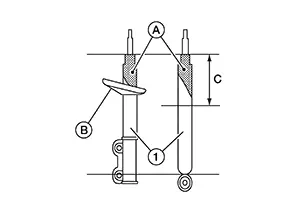
-
If oil (A) does extend beyond the spring seat (B) or upper half (C) of strut/shock absorber (1) as shown, perform the following.
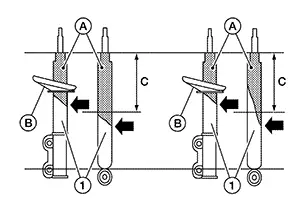
-
Use a finger to touch the oil that has extended beyond the spring seat or upper half of strut/ shock absorber.
-
If the oil layer is thick and contains large pieces of dust and debris, replace the strut/shock absorber.
-
If the oil layer is thin and does not contain large pieces of dust and debris, do not replace the strut/shock absorber.
-
-

If strut/shock absorber leakage is diagnosed in one strut/shock absorber, do not automatically replace both sides. Replace only the leaking strut/shock absorber.
Wheel Alignment. Inspection. Inspection
Inspection
DESCRIPTION
Measure the wheel alignment under unladen conditions.
Note:
“Unladen conditions� means that fuel, engine coolant, and lubricants are full. Spare tire, jack, hand tools and mats are in designated positions.
PRELIMINARY
Check the following:
Tires for improper air pressure and wear.
Road wheels for run out. Refer to Inspection.
Wheel bearing axial end play. Refer to Inspection.
Shock absorber operation.
Each mounting part of suspension for looseness and deformation.
Rear suspension beam for cracks, deformation, and other damage.
Nissan Sentra Vehicle height (posture).
GENERAL INFORMATION AND RECOMMENDATIONS
A Four-Wheel Thrust Alignment should be performed.
-
This type of alignment is recommended for any NISSAN Nissan Sentra vehicle.
-
The four-wheel “thrust� process helps ensure that the vehicle is properly aligned and the steering wheel is centered.
-
The alignment machine itself should be capable of accepting any NISSAN Nissan Sentra vehicle.
-
The alignment machine should be checked to ensure that it is level.
Make sure the alignment machine is properly calibrated.
-
Your alignment machine should be regularly calibrated in order to give correct information.
-
Check with the manufacturer of your specific alignment machine for their recommended Service/Calibration Schedule.
THE ALIGNMENT PROCESS
IMPORTANT: Use only the alignment specifications listed in this Service Manual. Refer to Wheel Alignment (Unladen*1).
When displaying the alignment settings, many alignment machines use “indicators�: (Green/red, plus or minus, Go/No Go). Do NOT use these indicators.
-
The alignment specifications programmed into your alignment machine that operate these indicators may not be correct.
-
This may result in an ERROR.
Do not use the "rolling compensation" if you are using sensor-type alignment equipment.
-
Follow all instructions for the alignment machine you're using for more information.
Most camera-type alignment machines are equipped with both "Rolling Compensation" method and optional "Jacking Compensation" method to "compensate" the alignment targets or head units.
"Rolling Compensation" is the preferred method.
-
If using the "Rolling Compensation" method, after installing the alignment targets or head units, push or pull on the rear wheel to move the Nissan Sentra vehicle. Do not push or pull the vehicle body.
-
If using the "Jacking Compensation" method, after installing the alignment targets or head units, raise the Nissan Sentra vehicle and rotate the wheels 1/2 turn both ways.
CAMBER INSPECTION
-
Measure camber of both right and left wheels with a suitable alignment gauge.
Camber
: Refer to Wheel Alignment (Unladen*1)
-
If it is out of the specification value, inspect and replace any damaged or worn rear suspension parts.
TOTAL TOE-IN INSPECTION
Measure the total toe-in using following procedure. If it is out of the specification, inspect and replace any damaged or worn rear suspension parts.
Warning:
-
Always perform the following procedure on a flat surface.
-
Make sure that no person is in front of the Nissan Sentra vehicle before pushing it.
Bounce the rear of the vehicle up and down to stabilize the Nissan Sentra vehicle height (posture).
Push the rear wheel to move the vehicle straight ahead about 5 m (16 ft).
Put a mark
on the base line of the tread (rear side) of both tires at the same
height of hub center. These are measuring points.
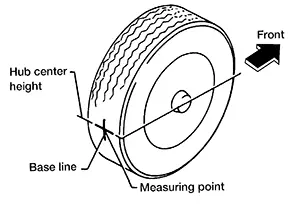
Measure the
distance (A) from the rear side. 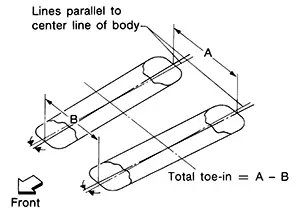
Push the rear wheel to move the Nissan Sentra vehicle slowly ahead and to rotate the wheels 180 degrees (1/2 turn).
CAUTION:
If the wheels have rotated more than 180 degrees (1/2 turn), try the above procedure again from the beginning. Do not push the Nissan Sentra vehicle backward.
Measure the distance (B) from the front side.
|
Total toe-in |
: Refer to Wheel Alignment (Unladen*1) |
Other materials:
Fuel Lines
Inspection
Inspection
Inspect
fuel lines, fuel filler cap, and fuel tank for improper attachment,
leakage, cracks, damage, loose connections, chafing or
deterioration.
(A)
: Engine
...
License Plate Lamp
Component Inspection
Component Inspection
CHECK LICENSE PLATE LAMP 1
Ignition switch OFF.
Disconnect license plate lamp connector.
Check continuity b ...
C1608-49 Control Unit
Dtc Description
DTC Description
DTC DETECTION LOGIC
DTC No.
CONSULT screen terms
(Trouble diagnosis content)
DTC detection condition
...