Nissan Sentra B18 (2020-2025) Owner's Manual: Intelligent Forward Collision Warning (I-FCW)
WARNING
Failure to follow the warnings and instructions for proper use of the I-FCW system could result in serious injury or death.
- The Intelligent Forward Collision Warning (I-FCW) system on the Nissan Sentra is designed to assist the driver by providing early warnings before a potential collision, but it does not prevent collisions. The driver must remain attentive, operate the vehicle responsibly, and maintain full control of the Nissan Sentra at all times.
The I-FCW system helps alert the driver when a sudden deceleration of a second vehicle occurs ahead of the vehicle directly in front, traveling within the same lane.
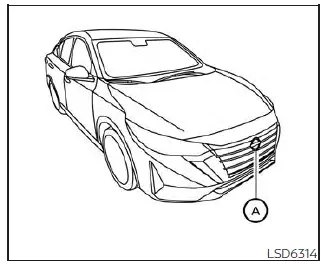
The I-FCW system uses a front-mounted radar sensor (A) located at the front of the Nissan Sentra to continuously measure the distance and relative speed of vehicles ahead in the same driving lane.
I-FCW system operation
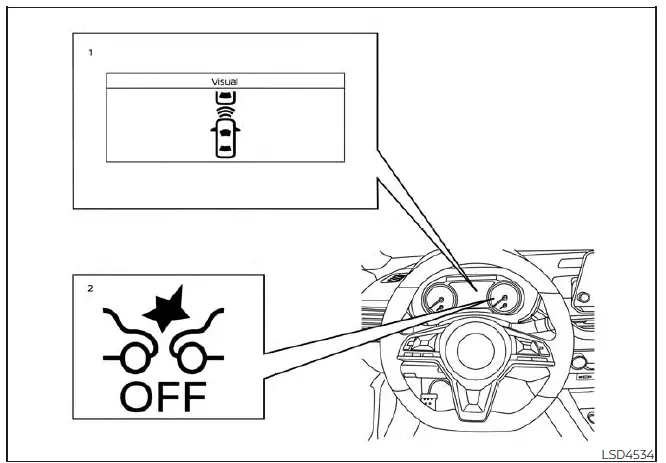
For vehicles with the 7 inch meter display
- Vehicle ahead detection indicator
- AEB with Pedestrian Detection system warning light
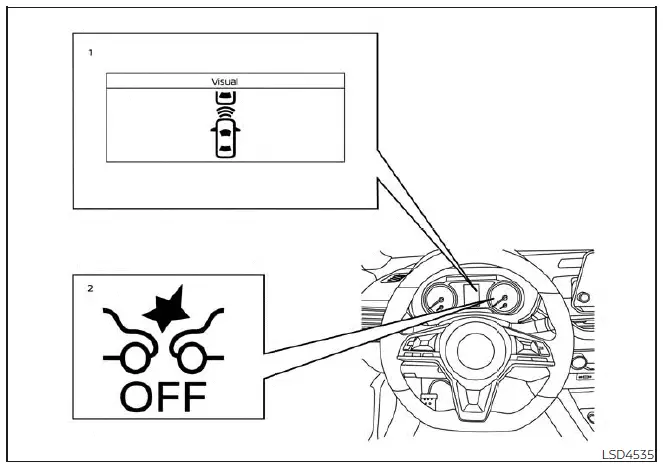
For vehicles with the 4.2 inch meter display
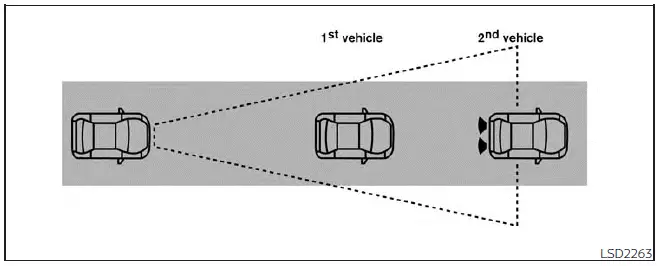
The I-FCW system operates when the Nissan Sentra is traveling at speeds above approximately 3 mph (5 km/h).
When a potential risk of a forward collision is detected, the I-FCW system warns the driver by flashing the vehicle-ahead detection indicator and sounding an audible alert to prompt timely driver response.
Turning the I-FCW system on/off
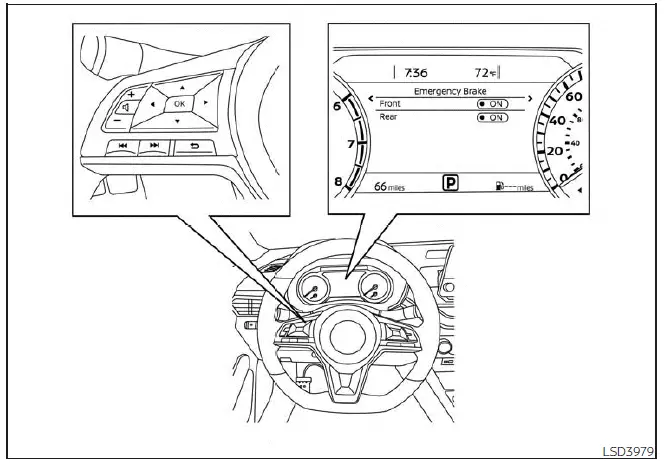
For vehicles with the 7 inch meter display
Follow the steps below to turn the Intelligent Forward Collision Warning system ON or OFF on your Nissan Sentra.
1. Press the
 button
until “Settings� appears in the vehicle information display.
button
until “Settings� appears in the vehicle information display.
Use the
 button
to select “Driver Assistance,� then press the OK button.
button
to select “Driver Assistance,� then press the OK button.
2. Select “Emergency Brake� and press the OK button.
3. Select “Front� and press the OK button to enable or disable the system.
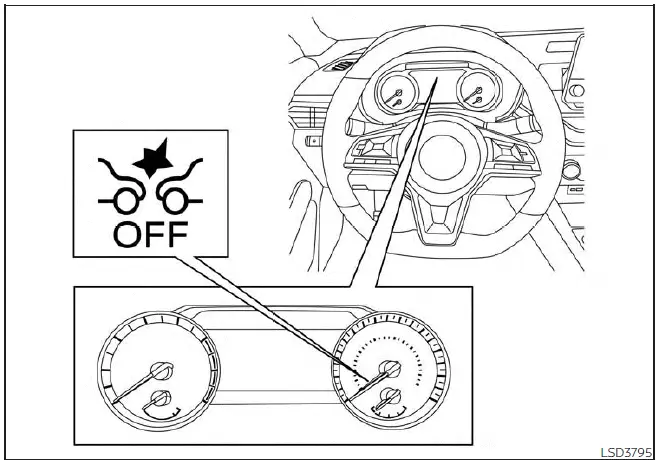
When the I-FCW system is turned off, the AEB with Pedestrian Detection system warning light will illuminate to indicate system status.
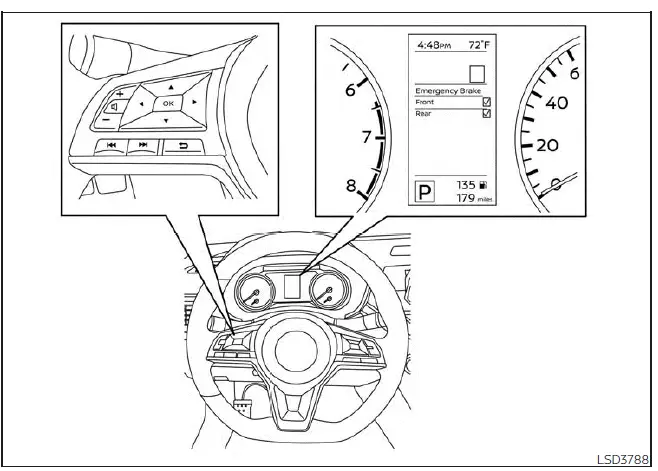
For vehicles with the 4.2 inch meter display
NOTE:
- The I-FCW system will automatically turn back on whenever the engine is restarted.
- The I-FCW system is integrated into the AEB with Pedestrian Detection system. There is no separate menu option for I-FCW. When the AEB with Pedestrian Detection system is turned off, the I-FCW system is also disabled.
I-FCW system limitations
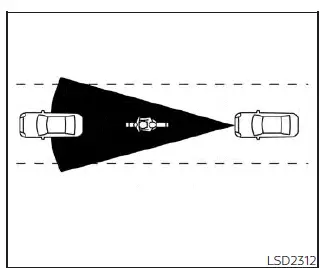
Illustration A
WARNING
Listed below are the system limitations for the Intelligent Forward Collision Warning (I-FCW) system. Failure to operate the Nissan Sentra in accordance with these system limitations could result in serious injury or death.
- The I-FCW system on the Nissan Sentra cannot detect all vehicles under all driving, traffic, or environmental conditions.
- The radar sensor does not detect the following objects:
- Pedestrians, animals, or stationary obstacles located in the roadway
- Oncoming vehicles approaching from the opposite direction
- Vehicles crossing the path of travel
- (Illustration A) The I-FCW system does not function correctly when the vehicle ahead is a narrow vehicle, such as a motorcycle or similar profile.
- The radar sensor may not detect a vehicle ahead under the following conditions:
- Snowfall or heavy rain that interferes with radar signal transmission
- Dirt, ice, snow, or other materials covering the radar sensor area
- Interference from other nearby radar sources
- Snow or road spray generated by surrounding vehicles
- Driving through tunnels or enclosed road structures
- (Illustration B) When the vehicle ahead is being towed
- (Illustration C) When the following distance is extremely short, causing the radar beam to be obstructed
- (Illustration D) When driving on steep downhill slopes or roads with sharp curves
- The system is designed to automatically monitor sensor functionality within defined limits. However, it may not detect certain obstructions such as ice, snow, or stickers placed over the sensor area. In such cases, the Nissan Sentra I-FCW system may not provide proper warnings. Always inspect, clean, and clear the sensor area regularly.
- Excessive external or interior noise may interfere with the warning chime, reducing the likelihood that the alert will be heard by the driver.
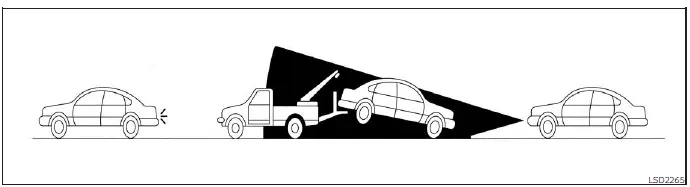
Illustration B
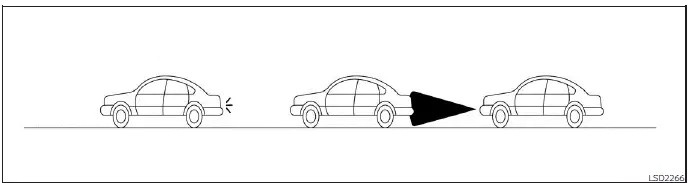
Illustration C
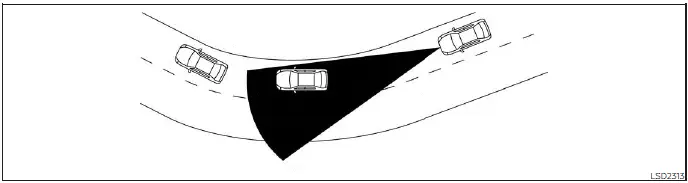
Illustration D
System temporarily unavailable
Condition A
When the radar sensor detects interference from another radar source and is unable to reliably identify a vehicle ahead, the I-FCW system on the Nissan Sentra will be automatically turned off.
The AEB with Pedestrian Detection system warning light (orange) will illuminate to notify the driver.
Action to take:
Once the above conditions no longer exist, the I-FCW system will resume normal operation automatically without driver intervention.
Condition B
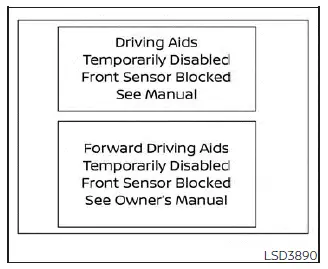
When inclement weather conditions such as rain, fog, or snow obstruct the front radar sensor, the I-FCW system will be automatically canceled. An audible chime will sound, and the warning message “Forward Driving Aids Temporarily Disabled – Front Sensor Blocked: See Owner’s Manual� or “Driving Aids Temporarily Disabled – Front Sensor Blocked: See Manual� will appear in the vehicle information display.
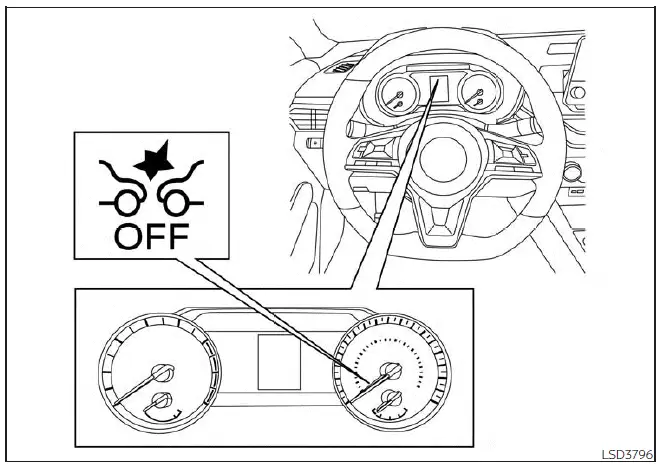
For vehicles with the 4.2 inch meter display
Action to take:
When the listed conditions are no longer present, the warning message will disappear from the vehicle information display. If the warning message continues to appear, have the Nissan Sentra I-FCW system inspected. It is recommended that you visit a NISSAN dealer for service.
Condition C
When the radar sensor on the front bumper is covered by mud, dirt, snow, ice, or otherwise obstructed, the I-FCW system will automatically be canceled. A chime will sound and the corresponding front sensor blocked warning message will be displayed.
Action to take:
If the warning message appears, stop the vehicle in a safe location, shift to the P (Park) position, and turn the engine off. Clean the radar sensor area on the front bumper, then restart the engine. If the warning message remains displayed, have the system checked by a NISSAN dealer.
Condition D
When driving the Nissan Sentra on roads with limited surrounding structures or minimal visual references—such as long bridges, desert areas, snowfields, or when traveling alongside extended walls—the front radar sensor may receive insufficient or distorted reflections. In these situations, the system may illuminate the warning light and display the message “Forward Driving Aids Temporarily Disabled Front Sensor Blocked: See Owner’s Manual� or “Driving Aids Temporarily Disabled Front Sensor Blocked: See Manual� in the vehicle information display.
Action to take:
Once the above driving conditions no longer exist and normal road environments are restored, turn the driver assistance system back on to resume standard operation of the Nissan Sentra safety features.
NOTE:
If the AEB with Pedestrian Detection system stops working, the Intelligent Forward Collision Warning (I-FCW) system on the Nissan Sentra will also stop functioning, as both systems operate in an integrated manner.
System malfunction
If the Intelligent Forward Collision Warning (I-FCW) system on the Nissan Sentra malfunctions, the system will automatically deactivate. A warning chime will sound, the Automatic Emergency Braking (AEB) with Pedestrian Detection warning light (orange) will illuminate, and the warning message [Malfunction] will be displayed in the vehicle information display to alert the driver.
Action to take
If the warning light (orange) illuminates, safely stop the Nissan Sentra in an appropriate location, turn the engine off, and then restart the engine. If the warning light continues to remain illuminated after restarting, have the I-FCW system inspected. It is recommended that you visit an authorized NISSAN dealer for proper diagnosis and service.
System maintenance
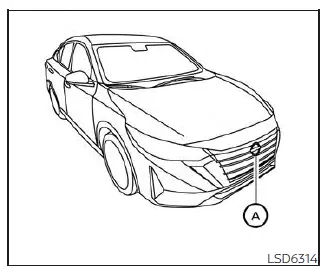
The radar sensor A for the I-FCW system is located on the front of the Nissan Sentra.
To ensure reliable operation of the Intelligent Forward Collision Warning system, observe the following maintenance guidelines:
- Always keep the front bumper and emblem sensor area clean and free of dirt, snow, or debris.
- Do not strike, impact, or otherwise damage the area surrounding the sensor.
- Do not attach stickers, films, or similar materials to the front bumper near the sensor, as this may interfere with system operation or cause malfunction.
- Do not install metallic accessories near the sensor area (such as brush guards), which may block radar signals and lead to system failure.
- Do not modify, remove, or repaint the front bumper. Before performing any customization or repairs to the front bumper, it is recommended that you consult an authorized NISSAN dealer.
Radio frequency statement
For USA
This device complies with Part 15 of the FCC Rules. Operation is subject to the following two conditions:
1. This device may not cause harmful interference, and
2. This device must accept any interference received, including interference that may cause undesired operation.
FCC Warning
Changes or modifications not expressly approved by the party responsible for compliance could void the user's authority to operate the equipment.
For Canada
This device complies with Part 15 of the FCC Rules and with Industry Canada licence-exempt RSS standard(s). Operation is subject to the following two conditions:
1. This device may not cause interference, and
2. This device must accept any interference received, including interference that may cause undesired operation of the device.
Le présent appareil est conforme aux CNR d'Industrie Canada applicables aux appareils radio exempts de licence.
L'exploitation est autorisée aux deux conditions suivantes:
1. L'appareil ne doit pas produire de brouillage, et
2. L'utilisateur de l'appareil doit accepter tout brouillage radioélectrique subi, même si le brouillage est susceptible d'en compromettre le fonctionnement.
Radio frequency radiation exposure information:
This equipment complies with FCC and IC radiation exposure limits set forth for an uncontrolled environment.
This equipment should be installed and operated with a minimum distance of 30 cm between the radiator and your body.
This transmitter must not be co-located or operated in conjunction with any other antenna or transmitter.
Cet équipement est conforme aux limites d'exposition aux rayonnements IC établies pour un environnement non contrôlé.
Cet équipement doit être installé et utilisé avec un minimum de 30 cm de distance entre la source de rayonnement et votre corps.
FCC Notice
Changes or modifications not expressly approved by the party responsible for compliance could void the user's authority to operate the equipment.
Other materials:
P1217 Engine Over Temperature
Dtc Description
DTC Description
ECM controls cooling fan to the maximum speed when receives the
signal abnormality of each sensor, CAN and IPDM E/R, and severed wire short
circuit abnormality.
If the cooling fan or another component in the cooling system
malfunctions, engine coola ...
Distance Sensor
Values on the Diagnosis Tool
Values On The Diagnosis Tool
Note:
The following table includes information (items)
inapplicable to this Nissan Sentra vehicle. For information (items) applicable to this
vehicle, refer to CONSULT display items.
...
U2118-87 Can Comm Err (intelligent Key)
Dtc Description
DTC Description
DESCRIPTION
CAN (Controller Area Network) is a serial communication
line for real time applications. It is an on-Nissan Sentra vehicle multiplex communication
line with high data communication speed and excellent error detection
ability. Modern Nissan ...