Nissan Sentra B18 (2020-2025) Service Manual: High Pressure Fuel Pump and Fuel Hose
Exploded View
Exploded View
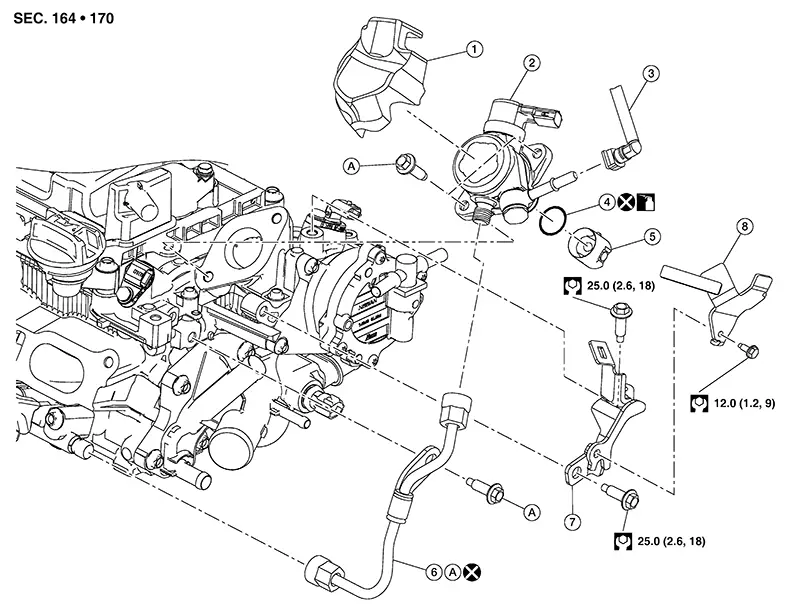
|
1. |
High pressure fuel pump insulator |
2. |
High pressure fuel pump |
3. |
Fuel feed hose |
|
4. |
O-ring |
5. |
High pressure fuel pump lifter |
6. |
High pressure fuel tube |
|
7. |
Bracket |
8. |
Fuel pump connector protector |
A. |
Refer to Removal and Installation. |
CAUTION:
Do not remove or disassemble parts unless instructed as shown.
Removal and Installation
Removal and Installation
REMOVAL
Warning:
-
Be sure to read Precaution for Handling High Pressure Fuel System when working on the high pressure fuel system.
-
Put a “CAUTION: FLAMMABLE� sign in the workshop.
-
Be sure to work in a well ventilated area and furnish workshop with a CO2 fire extinguisher.
-
Do not smoke while servicing fuel system. Keep open flames and sparks away from the work area.
-
To avoid the danger of being scalded, do not drain engine coolant when engine is hot.

When removing components such as hoses, tubes/lines, etc., cap or plug openings to prevent fluid from spilling.
Release fuel pressure. Refer to Work Procedure.
Disconnect the battery. Refer to Battery Disconnect.
Remove intake manifold. Refer to Removal and Installation.
Remove the high pressure fuel rail protector. Refer to Exploded View.
Remove fuel pump connector protector and remove high pressure fuel pump insulator.
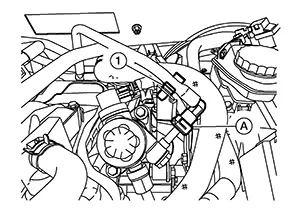
Disconnect
quick connector (A) using the following procedure: Remove fuel feed hose from the clip
(1).
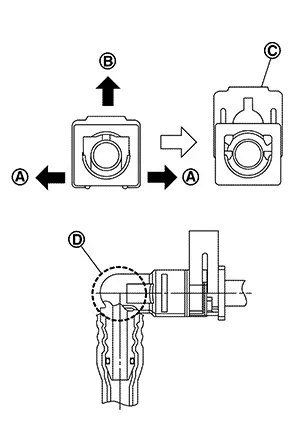
 Disengage (A) and pull up (B) the
pawl of the fuel feed hose connector retainer (C) to disconnect the
fuel feed hose from high pressure fuel pump.
Disengage (A) and pull up (B) the
pawl of the fuel feed hose connector retainer (C) to disconnect the
fuel feed hose from high pressure fuel pump.
 Note:
Note:
If the fuel feed hose is stuck, hold the fuel pipe by hand and disconnect it by pushing and pulling.
CAUTION:
-
Keep parts away from heat source. Especially, be careful when welding is performed around them.
-
Do not expose parts to battery electrolyte or other acids.
-
Do not bent or twist connection between quick connector and fuel feed hose during installation/removal.
-
Pull quick connector while holding at location (D).
-
Do not remove the retainer.
-
Prepare a tray and waste beforehand as fuel leaks out.
-
Do not pull with lateral force applied. O-ring inside quick connector may be damaged.
Retainer color
: Red
-
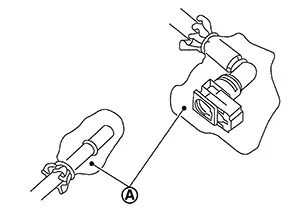
To prevent damage to each joint and protect it from the entry of foreign matter, cover the joint with plastic bag (A) or an equivalent.
Remove high pressure fuel tube.
CAUTION:
Do not reuse high pressure fuel tube.
Disconnect the harness connector from the high pressure fuel pump.
Remove high
pressure fuel pump (1) and lifter. 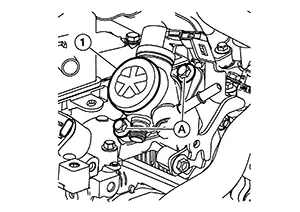
CAUTION:
-
To prevent damage to high pressure fuel pump and camshaft bracket, loosen bolts (A) by alternating sides one turn at a time until the reaction force applied on the high pressure fuel pump disappears.
-
Do not reuse O-ring.
Remove O-ring from high pressure fuel pump.
INSTALLATION
CAUTION:
-
Do not reuse O-rings.
-
To prevent damage to parts due to generated abnormal stress and eccentric load, always observe the installation procedure.
Install
high pressure fuel pump using the following procedure: Check
the orientation of pump cam from the mounting area of high pressure
fuel pump.
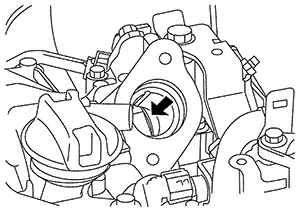 Aim
pump cam at the BDC area as shown.
Aim
pump cam at the BDC area as shown.
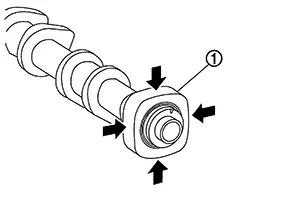 Note:
Note:
For BDC area, anywhere within the area indicated
by  can be accepted.
|
(1) |
: Camshaft (EXH) |
CAUTION:
-
Do not reuse O-ring.
-
Handle O-ring with bare hands. Do not wear gloves.
-
Lubricate O-ring with new engine oil.
-
Do not clean O-ring with solvent.
-
Check that O-ring and its mating part are free of foreign material.
-
Do not damage O-ring with tools and fingernails during the installation. In addition, twisting or stretching O-ring is not allowed. If O-ring is stretched during the installation to high pressure fuel pump, do not install high pressure fuel pump immediately.
 Note:
Note:
-
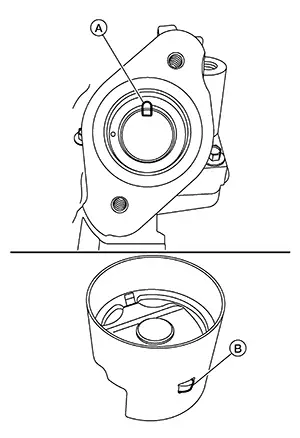
Lubricate the high pressure fuel pump lifter and bore of camshaft bracket.
-
When installing the high pressure fuel pump lifter, note the orientation of the protrusion (B) and cutout (A) in the camshaft bracket, they should be aligned.
|
High pressure fuel pump bolts |
: 26.5 N·m (2.7 kg-m, 20 ft-lb) |
Install the
fuel feed hose using the following procedure: Check
no foreign substances are deposited in and around matching pipe and
quick connector, and no damage on them. Quick
connector shall be inserted gradually, aligning with the axis of
the matching pipe. Insert the retainer until it clicks
and check the retainer is locked. After insertion, pull the
connector and check that the connector is locked.
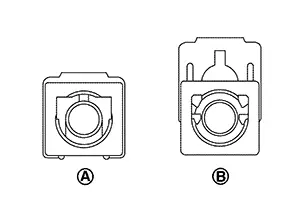
CAUTION:
If retainer cannot be installed smoothly, quick connector may be have not been installed correctly. Check connection again.
|
(A) |
: Lock position |
|
(B) |
: Unlock position |
Install the high pressure fuel tube with the following procedure.
CAUTION:
-
Do not reuse high pressure fuel tube.
-
Do not use high pressure fuel tube if its terminal tip is damaged.
-
Observe the tightening sequence and the tightening torque.
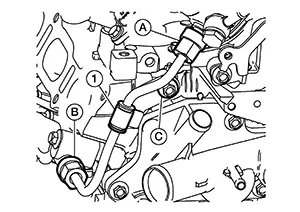 Move
high pressure fuel tube back and forth to make sure tube is seated
in high pressure fuel pump and high pressure fuel
rail. Tighten flare nut (A) and flare nut
(B) until no threads are showing on high pressure fuel pump or high
pressure fuel rail.
Move
high pressure fuel tube back and forth to make sure tube is seated
in high pressure fuel pump and high pressure fuel
rail. Tighten flare nut (A) and flare nut
(B) until no threads are showing on high pressure fuel pump or high
pressure fuel rail.
CAUTION:
After high pressure fuel tube is installed, make sure it does not contact adjacent parts.
Tighten high pressure fuel tube bracket bolt (C) to the specified torque.|
High pressure fuel tube bracket bolt |
: 25 N·m (2.6 kg-m, 18 ft-lb) |
|
Flare nuts |
: 15 N·m (1.5 kg-m, 11 ft-lb) |
CAUTION:
Securely install the tool to flare nut before tightening.
|
Flare nut |
: 30.0 N·m (3.1 kg-m, 22 ft-lb) |
Installation of the remaining components is in the reverse order of removal.
Inspection
Inspection
INSPECTION AFTER INSTALLATION
Check for Fuel Leaks
Place
ignition switch in the “ON� position (with the engine
stopped). With fuel pressure applied to fuel piping, check that
there are no fuel leaks at connection points.
Note:
Use mirrors for checking at points out of clear sight.
Start the engine. With engine speed increased, check again that there are no fuel leaks at connection points.
CAUTION:
-
Do not touch the engine immediately after it is stopped because the engine is extremely hot.
-
After checking for fuel leaks, maintain idling condition for 10 minutes to discharge air included in the fuel piping.
Other materials:
Traffic Sign Recognition (TSR)
The Traffic Sign Recognition (TSR) system in the Nissan Sentra provides the driver
with information about the most recently detected speed limit and certain traffic
signs. The system captures road sign data using the multi-sensing front camera unit
(A), which is mounted on the windshield i ...
B20d2-11 Parking Lamp Pwr Sply Circ
Dtc Description
DTC Description
DTC DETECTION LOGIC
DTC No.
CONSULT screen items
(Trouble diagnosis content)
DTC detection condition
...
Laser/radar (distance Sensor)
C2580-44 Control Unit
Dtc Description
DTC Description
DTC DETECTION LOGIC
DTC
CONSULT screen terms
(Trouble diagnosis
content)
DTC dete ...