Nissan Sentra B18 (2020-2025) Service Manual: Cylinder Block
Exploded View
Exploded View
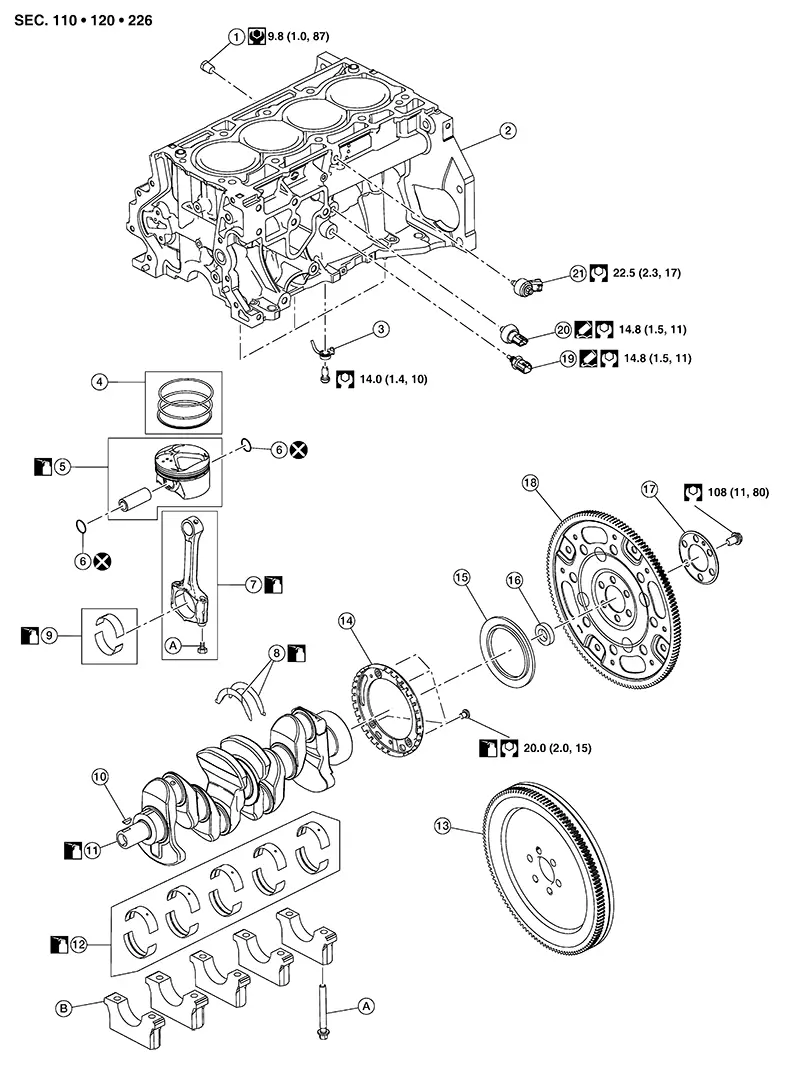
|
1. |
Drain plug |
2. |
Cylinder block |
3. |
Oil jet |
|
4. |
Piston rings |
5. |
Piston |
6. |
Circlip |
|
7. |
Connecting rod |
8. |
Thrust bearing |
9. |
Connecting rod bearing |
|
10. |
Crankshaft key |
11. |
Crankshaft |
12. |
Main bearings |
|
13. |
Flywheel (M/T models) |
14. |
Signal plate |
15. |
Rear oil seal |
|
16. |
Pilot converter (CVT models) |
17. |
Drive plate (CVT models) |
18. |
Drive plate reinforcement (CVT models) |
|
19. |
Engine oil temperature sensor |
20. |
Engine oil pressure sensor |
21. |
Knock sensor |
|
A. |
Refer to Disassembly and Assembly. |
B. |
Main bearing cap |
CAUTION:
-
Main bearing cap cannot be replaced individually, it is machined with the cylinder block and must be serviced as an assembly.
-
Connecting rod cap cannot be replaced individually, it is machined with the connecting rod and must be serviced as an assembly.
-
Main bearing (upper) and main bearing (lower) are serviced together.
-
Connecting rod bearing (upper) and connecting rod bearing (lower) are serviced together.
Disassembly and Assembly
Disassembly and Assembly
DISASSEMBLY
Remove the cylinder head. Refer to Removal and Installation.
Remove the oil pan (upper). Refer to Removal and Installation.
Remove the water pump housing. Refer to Removal and Installation.
Remove the engine oil pressure sensor and engine oil temperature sensor.
Remove the knock sensor.
CAUTION:
Handle it carefully and avoid impacts.
Remove
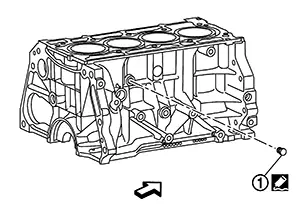
drain plug (1) from cylinder block.
|
|
: Engine front |
Remove piston and connecting rod assembly using the following procedure:
-
Before removing piston and connecting rod assembly, check the connecting rod side clearance. Refer to Inspection.
CAUTION:
Identify the original positions for installation and store the connecting rod caps without mixing them up.
Using a suitable tool, push piston and connecting rod assembly out through the cylinder head side.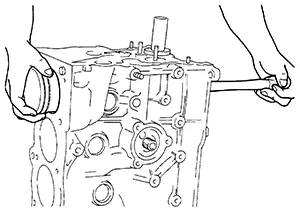
CAUTION:
-
Be careful not to damage matching surface with connecting rod cap.
-
Be careful not to damage the cylinder wall or crankshaft pin, resulting from an interference of the connecting rod big end.
Remove connecting rod bearings.
CAUTION:
Identify the original positions for installation and store the connecting rod bearings without mixing them up.
Remove piston rings from piston.
-
Before removing piston rings, check the piston ring side clearance. Refer to Inspection.
-
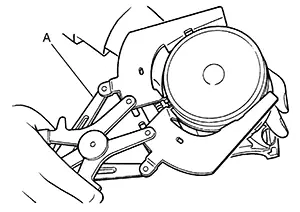
Use suitable tool (A) to remove piston rings as shown.
CAUTION:
-
When removing piston rings, be careful not to damage the piston.
-
Be careful not to damage piston rings by expanding them excessively.
-
Remove
piston from connecting rod using the following procedure:
Using
suitable tool (A), remove snap rings.
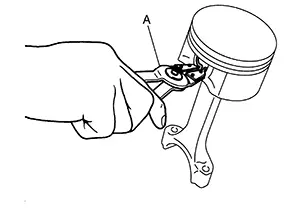
CAUTION:
Do not reuse snap rings.
Heat piston to 60 to 70°C (140 to 158°F) with a suitable tool (A).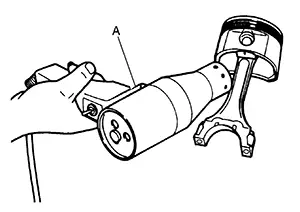 Push
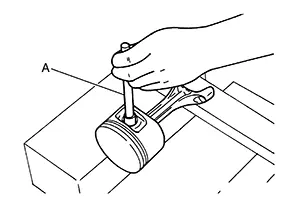
out piston pin with a suitable tool (A) with an outer diameter
approximately 18 mm (0.71 in).
Push
out piston pin with a suitable tool (A) with an outer diameter
approximately 18 mm (0.71 in).
Remove main bearing cap bolts.
-
Measure crankshaft end play before loosening main bearing cap bolts. Refer to Inspection.
-
Loosen and remove main bearing cap bolts in reverse of the sequence shown.
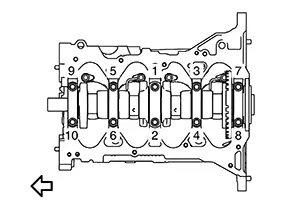

: Engine front
Remove main bearing caps.
-
Tap main bearing caps lightly with a suitable tool for removal.
CAUTION:
Be careful not to damage the mounting surface.
Remove crankshaft.
CAUTION:
-
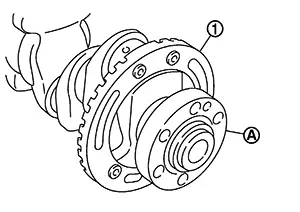
Be careful not to damage or deform signal plate (1) mounted on rear end of crankshaft (A).
-
When setting crankshaft on a flat floor surface, use a block of wood to avoid interference between signal plate and the floor surface.
-
Do not remove signal plate unless it is necessary to do so.
Remove the signal plate from the crankshaft (if necessary).
Pull rear oil seal out from rear end of crankshaft.
CAUTION:
Do not reuse rear oil seal.
Remove main bearings and thrust bearings from cylinder block and main bearing caps.
CAUTION:
Identify original installation positions and store main bearings and thrust bearings without mixing them up.
Remove the oil jets.
Inspect dowel pins, welch plugs and threaded plugs and remove if necessary.
ASSEMBLY
Fully air-blow engine coolant and engine oil passages in cylinder block, cylinder bore and crankcase to remove any foreign material.
CAUTION:
Use a goggles to protect your eye.
Install
drain plug (1) to cylinder block.
|
|
: Engine front |

-
Apply liquid gasket to thread of water drain plug (1).
Use Genuine Silicone RTV Sealant or equivalent. Refer to Recommended Chemical Products and Sealants.
Install
main bearings and thrust bearings using the following
procedure:
Remove dust, dirt, and engine oil on
the bearing mating surfaces of cylinder block and main bearing
cap.
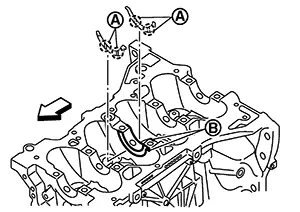
Install thrust bearings to the both
sides of the No. 3 journal housing (B) on cylinder block.
|
|
: Engine front |
-
Install thrust bearings with the oil groove (A) facing crankshaft arm (outside).
-
Before installing main bearings, apply new engine oil to the bearing surface (inside). Do not apply new engine oil to the back surface, but thoroughly clean it.
-
When installing, align main bearing to the center position of cylinder block and main bearing cap.
-
The difference (A) between main bearing [upper (1)] and main bearing [lower (3)] should be 0.85 mm (0.0335 in) or less when installing.
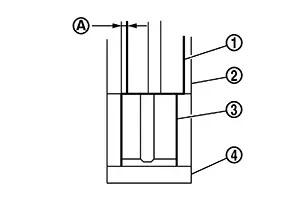
(2)
: Cylinder block
(4)
: Main bearing cap
-
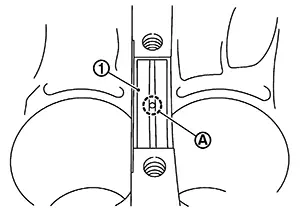
Ensure the oil holes on cylinder block and oil holes (A) on the main bearings (1) are aligned.
Install
signal plate to crankshaft if removed.
Set
the signal plate with the flange facing toward the counter weight
side (engine front side) to the crankshaft rear
surface.
Apply
new engine oil to threads and seat surfaces of bolts.
Install dowel pin (service part)
into hole on crankshaft.
Position crankshaft and signal plate
using a dowel pin (service part) and tighten bolts to the specified
torque.
Note:
Dowel pin of crankshaft and signal plate is provided as a set for each.
|
Signal plate bolts |
: 20.0 N·m (2.0 kg-m, 15 ft-lb) |
CAUTION:
Be sure to remove dowel pin.
Install crankshaft to cylinder block.
-
While turning crankshaft by hand, check that it turns smoothly.
Install
main bearing caps using the following procedure:
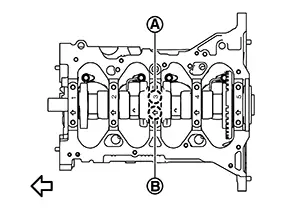
Install main bearing caps referring
to the journal No. stamp (A) and front mark (B) as shown.
 Note:
Note:
Main bearing cap cannot be replaced as a single part because it is machined together with cylinder block.
|
|
: Engine front |
-
Tighten main bearing cap bolts to the specified torque in the sequence shown.
Main bearing cap bolts
: 34.3 N·m (3.5 kg-m, 25 ft-lb)
: Engine front
-
Tighten main bearing cap bolts to the specified angle in the sequence shown.
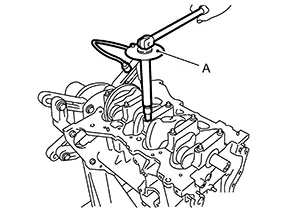
CAUTION:
Confirm the tightening angle by using Tool (A). Do not judge by visual inspection without the Tool.
Tool number (A)
: KV10112100 (BT-8653-A)
Tightening angle
: 60° - 65°
-
After installing bolts, check that crankshaft can be rotated smoothly by hand.
-
Check crankshaft end play. Refer to Inspection.
Install piston to connecting rod with the following procedure: Using suitable tool, install new snap ring to the groove of the piston rear side.
-
Insert it fully into groove to install.
CAUTION:
Do not reuse snap rings.
-
Using a suitable tool, heat the piston until the piston pin can be pushed in by hand without excess force [approximately 60 to 70°C (140 to 158°F)]. From the front to the rear, insert piston pin into piston and connecting rod.
-
Assemble so that the front mark (A) on the piston head and the oil hole (B) and the cylinder number (D) on connecting rod are positioned as shown.
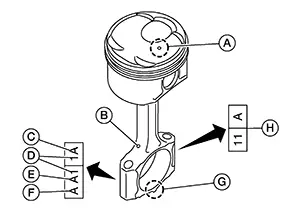
(C)
: Engine type
(E)
: Big end diameter grade
(F)
: Small end diameter grade
(G)
: Front mark (connecting rod cap)
H.
: Management code
-
Insert it fully into groove to install.
CAUTION:
Do not reuse snap rings.
-
After installing, check that connecting rod moves smoothly.
Using a
suitable tool (A), install piston rings.
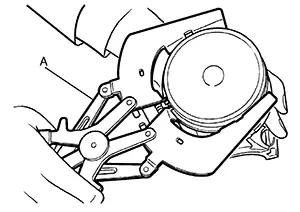
CAUTION:
-
Be careful not to damage piston.
-
Be careful not to damage piston rings by expanding them excessively.
-
Position end gaps of each piston ring as shown when referring to the piston front mark (E).
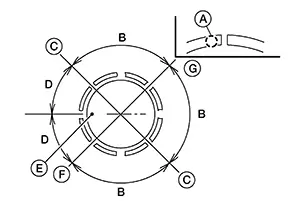
CAUTION:
Do not allow the rail end gap under the oil ring to contact the oil drain cast groove of piston.
(B)
: 90°
(C)
: Oil ring upper or lower rail gap
(D)
: 45°
(F)
: Second ring gap
(G)
: Top ring gap
-
Install second ring and top ring with the stamped mark (A) facing upward.
Stamped mark:
Top ring
: 1N
Second ring
: 2N
Install
connecting rod bearing [upper (2)] and connecting rod bearing
[lower (3)] to connecting rod (1) and connecting rod cap
(4).
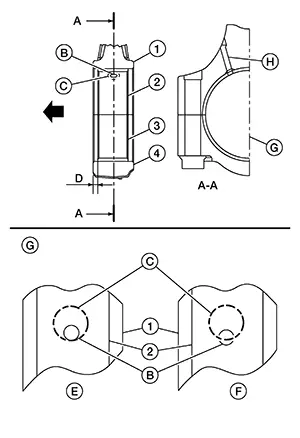
|
(D) |
: 2.05 - 2.45 mm (0.0807 - 0.0965 in) |
|
(E) |
: OK |
|
(F) |
: NG |
|
(G) |
: View G |
|
(H) |
: Oil hole |
|
|
: Engine front |
-
Install the connecting rod in the dimension shown.
-
Check that connecting rod bearing oil hole (B) is completely in the inside of connecting rod oil hole chamfered area (C).
-
When installing connecting rod bearings, apply new engine oil to the bearing surface (inside). Do not apply new engine oil to the back surface, but thoroughly clean it.
Note:
-
There is no positioning tab.
-
Install the connecting rod bearings in the center of connecting rod and connecting rod cap as shown. For service operation, the center position can be checked, visually.
-
Install piston and connecting rod assembly to crankshaft.
-
Position crankshaft pin corresponding to connecting rod to be installed onto the bottom dead center.
-
Apply new engine oil sufficiently to the cylinder bore, piston and crankshaft pin.
-
Match the cylinder position with the cylinder number (D) on connecting rod to install.
(B)
: Oil hole
(C)
: Engine type
(E)
: Big end diameter grade
(F)
: Small end diameter grade
(G)
: Front mark (connecting rod cap)
(H)
: Management code
-
Install so that front mark (A) on the piston head faces the front of engine.
-
Using a suitable tool (A), install piston and connecting rod assembly with the front mark on the piston head facing the front of the engine.
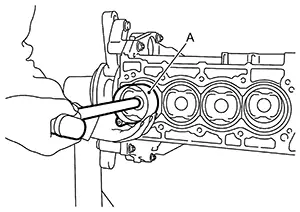
CAUTION:
Be careful not to damage the cylinder wall and crankshaft pin, resulting from an interference of the connecting rod big end.
Install connecting rod cap.
-
Match the stamped cylinder number marks (D) on connecting rod with those on connecting rod cap to install.
(A)
: Front mark (piston)
(B)
: Oil hole
(C)
: Engine type
(E)
: Big end diameter grade
(F)
: Small end diameter grade
(G)
: Front mark (connecting rod cap)
(H)
: Management code
Tighten connecting rod cap bolt using the following procedure:
CAUTION:
-
Check that there is no gap in the thrust surface (A) of the joint between connecting rod (1) and connecting rod cap (2) and that these parts are in the correct position. And then, tighten the connecting rod cap bolts.
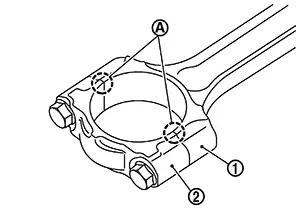
-
If the connecting rod cap bolts are reused, measure the outer diameter. Refer to Inspection.
|
Connecting rod cap bolts |
: 33.0 N·m (3.4 kg-m, 24 ft-lb) |
|
Connecting rod cap bolts |
: 0 N·m (0 kg-m, 0 ft-lb) |
|
Connecting rod cap bolts |
: 19.6 N·m (2.0 kg-m, 14 ft-lb) |
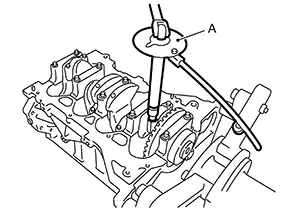
CAUTION:
Check and confirm the tightening angle by using a Tool. Do not judge by visual inspection without the Tool.
|
Tool number |
: KV10112100 (BT-8653-A) |
|
Tightening angle |
: 60° - 65° |
-
After tightening connecting rod cap bolt, check that crankshaft rotates smoothly.
-
Check the connecting rod side clearance. Refer to Inspection.
Install oil
pan (upper). Refer to Removal and Installation.
Note:
Install the rear oil seal after installing the oil pan (upper).
Install rear oil seal. Refer to Removal and Installation.
Install drive plate (CVT models only). Refer to Removal and Installation.
Install flywheel (M/T models only). Refer to Removal and Installation.
Install
knock sensor (1) with harness connector facing toward the rear of
engine.
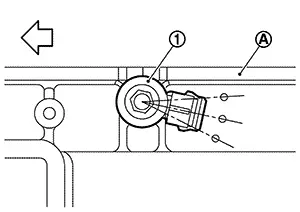
CAUTION:
-
Do not tighten bolt while holding the harness connector.
-
If any impact by dropping is applied to knock sensor, replace it with a new one.
-
Check that there is no foreign material on the cylinder block mating surface and the back surface of knock sensor.
-
Check that knock sensor does not interfere with other parts.
|
(A) |
: Cylinder block left side |
|
|
: Engine front |
Assembly of the remaining components is in the reverse order of disassembly.
Inspection
Inspection
CRANKSHAFT END PLAY
-
Measure the clearance between thrust bearings and crankshaft arm when crankshaft is moved fully forward or backward with a suitable tool (A).
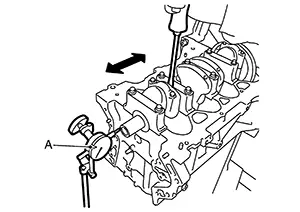
Standard and Limit
: Refer to Cylinder Block.
If the measured value exceeds the limit, replace thrust bearings, and measure again.
If it still exceeds the limit, replace crankshaft also.
CONNECTING ROD SIDE CLEARANCE
-
Measure the side clearance between connecting rod and crankshaft arm with a suitable tool (A).
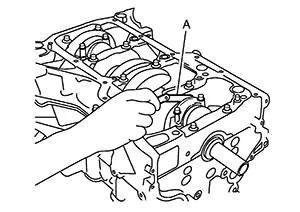
Standard and Limit
: Refer to Cylinder Block.
-
If the measured value exceeds the limit, replace connecting rod, and measure again. If it still exceeds the limit, replace crankshaft also.
PISTON TO PISTON PIN OIL CLEARANCE
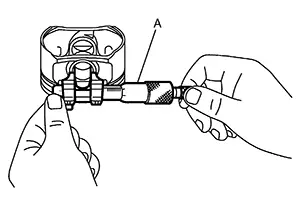
Piston Pin Hole Diameter
Measure the inner diameter of piston pin hole with a suitable tool (A).
|
Standard |
: Refer to Cylinder Block. |
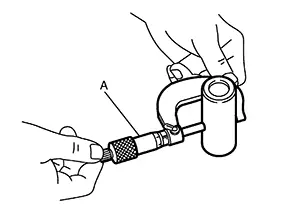
Piston Pin Outer Diameter
Measure the outer diameter of piston pin with a suitable tool (A).
|
Standard |
: Refer to Cylinder Block. |
Piston to Piston Pin Oil Clearance
(Piston to piston pin oil clearance) = (Piston pin hole diameter) – (Piston pin outer diameter)
|
Standard |
: Refer to Cylinder Block. |
-
If oil clearance is out of the standard, replace piston and piston pin assembly.
Note:
-
Piston is available together with piston pin as assembly.
-
Piston pin (piston pin hole) grade is provided only for the parts installed at the plant. For service parts, no grades can be selected. (Only grade “0� is available.)
-
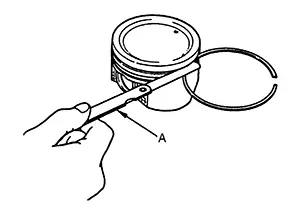
PISTON RING SIDE CLEARANCE
-
Measure the side clearance of piston ring and piston ring groove with a suitable tool (A).
|
Standard and Limit |
: Refer to Cylinder Block. |
-
If the measured value exceeds the limit, replace piston ring, and measure again. If it still exceeds the limit, replace piston also.
PISTON RING END GAP
-
Check that cylinder bore inner diameter is within specification. Refer to “PISTON TO CYLINDER BORE CLEARANCE�.
-
Lubricate with new engine oil to piston (1) and piston ring (2), and then insert (A) piston ring until middle of cylinder (B) with piston, and measure piston ring end gap with a suitable tool (C).
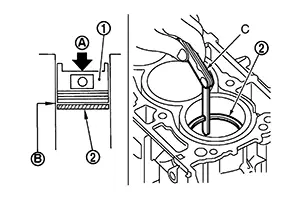
Standard and Limit
: Refer to Cylinder Block.
-
If the measured value exceeds the limit, replace piston ring, and measure again. If it still exceeds the limit, rebore cylinder and use oversized piston and piston rings.
CONNECTING ROD BEND AND TORSION
-
Check with a suitable tool (C).
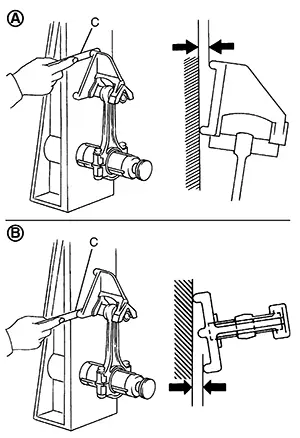
(A)
: Bend
(B)
: Torsion
Limit
: Refer to Cylinder Block.
-
If it exceeds the limit, replace connecting rod assembly.
CONNECTING ROD BIG END DIAMETER
-
Install connecting rod cap (1) without connecting rod bearing installed, and tightening connecting rod cap bolts to the specified torque. Refer to Disassembly and Assembly.
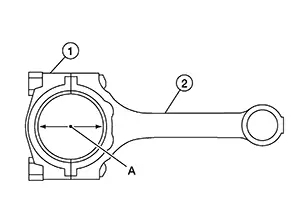
-
Measure the inner diameter of connecting rod big end with an inside micrometer.
Standard
: Refer to Cylinder Block.
(2)
: Connecting rod
-
If out of the standard, replace connecting rod assembly.
CONNECTING ROD BUSHING OIL CLEARANCE
Connecting Rod Bushing Inner Diameter
Measure the inner diameter of connecting rod bushing with a suitable tool (A).
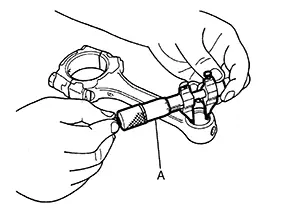
|
Standard |
: Refer to Cylinder Block. |
Piston Pin Outer Diameter
Measure the outer diameter of piston pin with a suitable tool (A).
|
Standard |
: Refer to Cylinder Block. |
Connecting Rod Bushing Oil Clearance
(Connecting rod bushing oil clearance) = (Connecting rod bushing inner diameter) – (Piston pin outer diameter)
|
Standard and Limit |
: Refer to Cylinder Block. |
-
If the measured value is out of the standard, replace connecting rod assembly and/or piston and piston pin assembly.
-
If replacing piston pin assembly, refer to Piston.
-
If replacing connecting rod assembly, refer to Connecting Rod Bearing.
CYLINDER BLOCK TOP SURFACE DISTORTION
-
Using a suitable tool, remove gasket on the cylinder block surface, and also remove engine oil, scale, carbon, or other contamination.
CAUTION:
Be careful not to allow gasket particles to enter engine oil or engine coolant passages.
-
Measure the distortion on the cylinder block upper face at different points in six different directions with a suitable tool (A) and suitable tool (B).
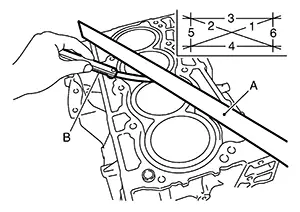
Limit
: Refer to Cylinder Block.
-
If it exceeds the limit, replace cylinder block.
MAIN BEARING HOUSING INNER DIAMETER
-
Install main bearing cap without main bearings installed, and tighten main bearing cap mounting bolts to the specified torque. Refer to Disassembly and Assembly.
-
Measure the inner diameter of main bearing housing with a suitable tool.
-
Measure the position shown backward from main bearing housing front side in the 2 directions as shown. The smaller one is the measured value.
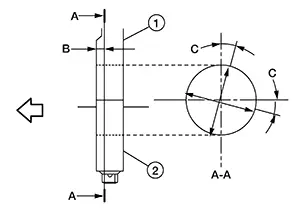
Standard
: Refer to Cylinder Block.
(1)
: Cylinder block
(2)
: Main bearing cap
(B)
: 5 mm (0.20 in)
(C)
: 15°
: Engine front
-
If out of the standard, replace cylinder block and main bearing caps assembly.
Note:
Main bearing caps cannot be replaced as a single, because it is machined together with cylinder block.
PISTON TO CYLINDER BORE CLEARANCE
Cylinder Bore Inner Diameter
-
Using a cylinder gauge, measure the cylinder bore for wear, out-of-round and taper at six different points on each cylinder. [(A) and (B) directions at (C), (D), and (E)] [(A) is in longitudinal direction of engine]
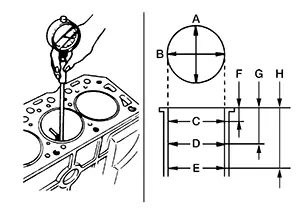 Note:
Note:
When determining cylinder bore grade, measure the cylinder bore (B) direction at (D) position.
(F)
: 10 mm (0.39 in)
(G)
: 60 mm (2.36 in)
(H)
: 130 mm (5.12 in)
Standard:
Cylinder bore inner diameter
: Refer to Cylinder Block.
Limit:
Out-of-round [Difference between (A) and (B)]
Taper [Difference between (C) and (D)]
: Refer to Cylinder Block.
-
If the measured value exceeds the limit, or if there are scratches and/or seizure on the cylinder inner wall, replace cylinder block.
Note:
Oversize piston is not provided.
Piston Skirt Diameter
Measure the outer diameter of piston skirt with a suitable tool (A).
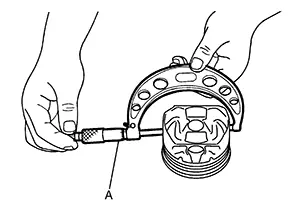
|
Standard |
: Refer to Cylinder Block. |
Piston to Cylinder Bore Clearance
Calculate by piston skirt diameter and cylinder bore inner diameter [direction (B), position (D)].
|
(A) |
: Direction A |
|
(C) |
: Position C |
|
(E) |
: Position E |
|
(F) |
: 10 mm (0.39 in) |
|
(G) |
: 60 mm (2.36 in) |
|
(H) |
: 130 mm (5.12 in) |
(Clearance) = (Cylinder bore inner diameter) – (Piston skirt diameter)
|
Standard and Limit |
: Refer to Cylinder Block. |
-
If it exceeds the limit, replace piston and piston pin assembly and/or cylinder block. Refer to Piston.
CRANKSHAFT MAIN JOURNAL DIAMETER
-
Measure the outer diameter of crankshaft main journals with a suitable tool (A).
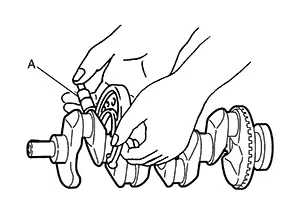
Standard
: Refer to Cylinder Block.
-
If out of the standard, measure the main bearing oil clearance. Then use undersize bearing. Refer to Main Bearing.
CRANKSHAFT PIN JOURNAL DIAMETER
-
Measure the outer diameter of crankshaft pin journal with a suitable tool.
Standard
: Refer to Cylinder Block.
-
If out of the standard, measure the connecting rod bearing oil clearance. Then use undersize bearing. Refer to Connecting Rod Bearing.
OUT-OF-ROUND AND TAPER OF CRANKSHAFT
-
Measure the dimensions at four different points as shown on each main journal and pin journal with a suitable tool.
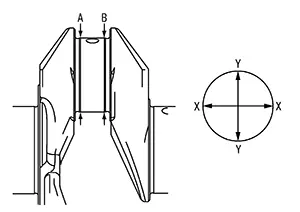
-
Out-of-round is indicated by the difference in dimensions between (X) and (Y) at (A) and (B).
-
Taper is indicated by the difference in dimension between (A) and (B) at (X) and (Y).
Limit:
Out-of-round [Difference between (X) and (Y)]
Taper [Difference between (A) and (B)]
: Refer to Cylinder Block.
-
If the measured value exceeds the limit, correct or replace crankshaft.
-
If corrected, measure main bearing oil clearance of the corrected main journal and/or pin journal. Then select main bearing and/or connecting rod bearing. Refer to Connecting Rod Bearing and/or Main Bearing.
CRANKSHAFT RUNOUT
-
Place a V-block on a precise flat table to support the journals on the both end of the crankshaft.
-
Place a suitable tool (A) straight up on the No. 3 journal.
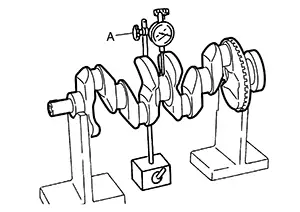
-
While rotating crankshaft, read the movement of the pointer on the suitable tool. (Total indicator reading)
Standard and Limit
: Refer to Cylinder Block.
-
If it exceeds the limit, replace crankshaft.
CONNECTING ROD BEARING OIL CLEARANCE
Method by Calculation
-
Install connecting rod bearings (2) to connecting rod (3) and connecting rod bearing cap (1) and tighten connecting rod cap bolts to the specified torque. Refer to Disassembly and Assembly.
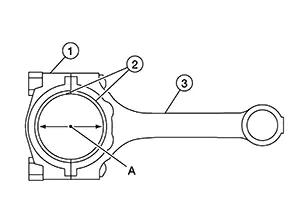
-
Measure the inner diameter (A) of connecting rod bearing with a suitable tool.
(Bearing oil clearance) = (Connecting rod bearing inner diameter) – (Crankshaft pin journal diameter)
Standard and Limit
: Refer to Connecting Rod Bearing.
-
If clearance exceeds the limit, select proper connecting rod bearing according to connecting rod big end diameter and crankshaft pin journal diameter to obtain specified bearing oil clearance. Refer to Connecting Rod Bearing.
Method of Using Plastigage
-
Remove engine oil and dust on crankshaft pin and the surfaces of each bearing completely.
-
Cut a plastigage slightly shorter than the bearing width, and place it in crankshaft axial direction, avoiding oil holes.
-
Install connecting rod bearings to connecting rod and connecting rod cap, and tighten connecting rod cap bolts to the specified torque. Refer to Disassembly and Assembly.
CAUTION:
Do not rotate crankshaft.
-
Remove connecting rod cap and connecting rod bearing, and using the scale (A) on the plastigage bag, measure the plastigage width.
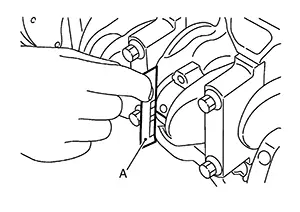 Note:
Note:
The procedure when the measured value exceeds the limit is same as that described in the “Method by Calculation�.
MAIN BEARING OIL CLEARANCE
Method by Calculation
-
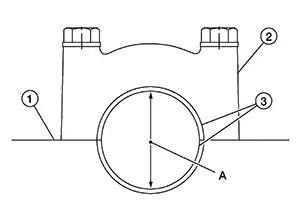
Install main bearings (3) to cylinder block (1) and main bearing cap (2) and tighten main bearing cap bolts to the specified torque. Refer to Disassembly and Assembly.
-
Measure the inner diameter (A) of main bearing with a suitable tool.
(Bearing oil clearance) = (Main bearing inner diameter) – (Crankshaft main journal diameter)
|
Standard and Limit |
: Refer to Main Bearing. |
-
If clearance exceeds the limit, select proper main bearing according to main bearing inner diameter and crankshaft main journal diameter to obtain specified bearing oil clearance. Refer to Main Bearing.
Method of Using Plastigage
-
Remove engine oil and dust on crankshaft main journal and the surfaces of each bearing completely.
-
Cut a plastigage slightly shorter than the bearing width, and place it in crankshaft axial direction, avoiding oil holes.
-
Install main bearings to cylinder block and main bearing cap, and tighten main bearing cap bolts to the specified torque. Refer to Disassembly and Assembly.
CAUTION:
Never rotate crankshaft.
-
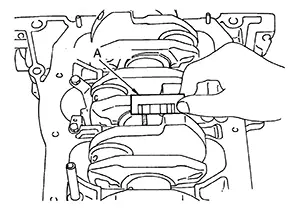
Remove main bearing cap and main bearings, and using the scale (A) on the plastigage bag, measure the plastigage width.
 Note:
Note:
The procedure when the measured value exceeds the limit is same as that described in the “Method by Calculation�.
MAIN BEARING CRUSH HEIGHT
-
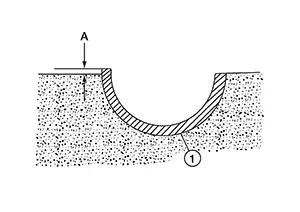
When main bearing cap is removed after being tightened to the specified torque with main bearings (1) installed, the tip end of main bearing must protrude (B). Refer to Disassembly and Assembly.
Standard
: There must be crush height.
-
If the standard is not met, replace main bearings.
CONNECTING ROD BEARING CRUSH HEIGHT
-
When connecting rod cap is removed after being tightened to the specified torque with connecting rod bearings (1) installed, the tip end of connecting rod bearing must protrude (A). Refer to Disassembly and Assembly.
Standard
: There must be crush height.
-
If the standard is not met, replace connecting rod bearings.
MAIN BEARING CAP BOLT OUTER DIAMETER
-
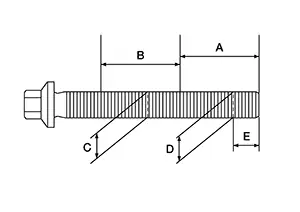
Measure the outer diameters (C) and (D) at two positions as shown.
(A)
: 30 mm (1.18 in)
(B)
: Diameter (C) measurement range 30 mm (1.18 in)
(E)
: 10 mm (0.39 in)
-
If reduction appears in places other than (B) range, regard it as (C).
Limit [(D) – (C)]
: 0.15 mm (0.0059 in)
-
If it exceeds the limit, replace main bearing cap bolt with a new one.
CONNECTING ROD CAP BOLT OUTER DIAMETER
-
Measure the outer diameter (B) at position as shown.
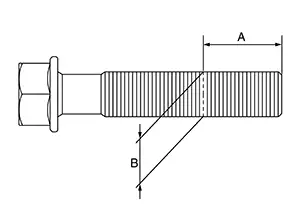
-
If reduction appears in a position other than (B), regard it as (B).
Limit
: 7.75 mm (0.3051 in)
(A)
: 17 mm (0.67 in)
-
When (B) exceeds the limit, replace connecting rod cap bolt with a new one.
Other materials:
Periodic Maintenance
Engine Oil
Inspection
Inspection
ENGINE OIL LEVEL
Note:
Before starting engine, put Nissan Sentra vehicle horizontally
and check the engine oil level. If engine is already started, stop
it and allow 10 minutes before checking.
Pull out
oil level gauge and wipe it clean.
...
B2070-68 Key Registration
Dtc Description
DTC Description
DTC DETECTION LOGIC
DTC No.
CONSULT screen items
(Trouble diagnosis
content)
DTC detecting condition
...
Precautions on child restraints
WARNING
Failure to carefully follow all warnings and instructions regarding the
proper use and installation of child restraints can result in serious injury
or death to a child or other passengers during a sudden stop or collision in
the Nissan Sentra:
The child restraint must ...