
Nissan Sentra B18 (2020-2025) Service Manual: Removal and Installation
REMOVAL
Remove the rear pillar finishers (LH/RH). Refer to Removal and Installation — Rear Pillar Upper Finisher.
Remove the connectors and grounds for the rear window defogger and printed antenna.
Remove rear
window glass using piano wire or power cutting tool (A) and an
inflatable pump bag (B). 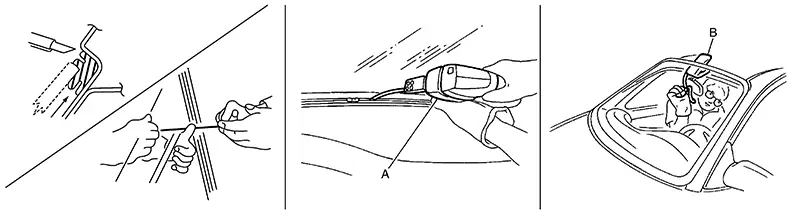
-
Apply protective tape around the rear window glass to protect the painted surface from damage.
-
If the rear window glass is to be reused, mark the body and the glass with matching marks.
-
Minimum adhesive coating amount 8 +3,-0 g/100 mm (0.28 +0.11,-0 oz/3.9 in) all around.
-
Minimum primer application area 15 ±1 mm (0.6 ±0.04 in) on body side and 13.0 mm (0.51 in) on glass side.
Warning:
When cutting the glass from the Nissan Sentra vehicle, always wear safety glasses and heavy gloves to help prevent glass splinters from entering your eyes or cutting your hands.
CAUTION:
-
Be careful not to scratch the glass when removing.
-
Do not set or stand the glass on its edge. Small chips may develop into cracks.
-
Apply protective tape around the rear window glass to protect the painted surface from damage.
INSTALLATION
Installation is in the reverse order of removal.
-
If repainting near the rear window flange area, protect the flange adhesion area by masking the flange.
-
Use a Genuine NISSAN Urethane Adhesive Kit (if available) or equivalent and follow the instructions furnished with it.
-
Adhesive shall be continuously applied to ensure watertightness. Glass installation shall be finished within five minutes after applying the adhesive.
-
The start and finish of the urethane adhesive application should be located at the bottom to assure watertightness.
-
While the urethane adhesive is curing, open a door window. This will prevent the glass from being forced out by passenger compartment air pressure when a door is closed.
-
The molding must be installed securely to the rear window glass to avoid looseness and will leave no gap.
-
Inform the customer that the Nissan Sentra vehicle should remain stationary until the urethane adhesive has completely cured (preferably 24 hours). Curing time varies with temperature and humidity.
Warning:
-
Keep heat and open flames away as primers and adhesive are flammable.
-
The materials contained in the kit are harmful if swallowed, and may irritate skin and eyes. Avoid contact with the skin and eyes.
-
Use in an open, well ventilated location. Avoid breathing the vapors. They can be harmful if inhaled. If affected by vapor inhalation, immediately move to an area with fresh air.
-
Driving the Nissan Sentra vehicle before the urethane adhesive has completely cured may affect the performance of the rear window in case of an accident.
CAUTION:
-
Do not use an adhesive which is past its usable term. Shelf life of this product is limited to six months after the date of manufacture. Carefully adhere to the expiration or manufacture date printed on the box or product.
-
Keep primers and adhesive in a cool, dry place. Ideally, they should be stored in a refrigerator.
-
Do not leave primers or adhesive cartridge unattended with their caps open or off.
-
The Nissan Sentra vehicle should not be driven for at least 24 hours or until the urethane adhesive has completely cured. Curing time varies depending on temperature and humidity. The curing time will increase under lower temperature and lower humidity.
REPAIRING WATER LEAKS FOR REAR WINDOW GLASS
-
Leaks can be repaired without removing and reinstalling glass.
-
If water is leaking between the urethane adhesive material and body or glass, determine the extent of leakage.
-
This can be done by applying water to the rear window area while pushing glass outward.
-
To stop the leak, apply primer (if necessary) and then urethane adhesive to the leak point.
 Exploded View
Exploded View
1.
Spacer
2.
...

Other materials:
Component Function Check
Component Function Check
CHECK DOOR MIRROR LH DEFOGGER
FUNCTION
CONSULT
Ignition switch ON.
Select “REAR DEFOGGER� in
“Active Test� mode of "BCM(REAR ...
Drive Plate
Exploded View
Exploded View
1.
Drive plate
2.
Drive plate
reinforcement
3.
...
P0611 Ecm Protection
Dtc Description
DTC Description
This DTC is detected when the ECM protective function is activated
due to an extreme temperature increase in ECM, resulting from severe conditions
such as heavy load driving.
DTC DETECTION LOGIC
...
