Nissan Sentra B18 (2020-2025) Service Manual: Precautions for Refrigerant System Service
Precautions For Refrigerant System Service
GENERAL REFRIGERANT PRECAUTION
Warning:
-
Do not breathe A/C refrigerant and oil vapor or mist. Exposure may irritate eyes, nose and throat. Remove HFO-1234yf (R-1234yf) from the A/C system, using certified service equipment meeting requirements of SAE J2843 [HFO-1234yf (R-12314yf) Recovery/Recycling/Recharging Equipment for Flammable Refrigerants for Mobile Air Conditioning System]. Ventilate work area before resuming service if accidental system discharge occurs. Additional health and safety information may be obtained from refrigerant and oil manufacturers.
-
Do not release refrigerant into the air. Use approved recovery/recycling recharging equipment to capture the refrigerant each time an air conditioning system is discharged.
-
Always wear eye and hand protection (goggles and gloves) when working with any refrigerant or air conditioning system.
-
Do not store or heat refrigerant containers above 52°C (126°F).
-
Do not heat a refrigerant container with an open flame; Place the bottom of the container in a warm pail of water if container warming is required.
-
Do not intentionally drop, puncture or incinerate refrigerant containers.
-
Keep refrigerant away from open flames; poisonous gas is produced if refrigerant burns.
-
Refrigerant displaces oxygen; therefore be certain to work in well ventilated areas to prevent suffocation.
-
Do not pressure test or leak test HFO-1234yf (R-1234yf) service equipment and/or Nissan Sentra vehicle air conditioning systems with compressed air during repair. Some mixtures of air and HFO-1234yf (R-1234yf) have been shown to be combustible at elevated pressures. These mixtures, if ignited, may cause injury or property damage. Additional health and safety information may be obtained from refrigerant manufacturers.
WORKING WITH HFO-1234yf (R-1234yf)
CAUTION:
-
HFC-134a (R-134a), CFC-12 (R-12) and HFO-1234yf (R-1234yf) refrigerants are not compatible. Compressor malfunction is likely to occur if the refrigerants are mixed, refer to “CONTAMINATED REFRIGERANT� below. To determine the purity of HFO-1234yf (R-1234yf) in the Nissan Sentra vehicle and recovery tank, use Refrigerant recovery/recycling recharging equipment and Refrigerant Identifier.
-
Use only specified oil for the HFO-1234yf (R-1234yf) A/C system and HFO-1234yf (R-1234yf) components. Compressor malfunction is likely to occur if oil other than that specified is used.
-
The specified HFO-1234yf (R-1234yf) oil rapidly absorbs moisture from the atmosphere. The following handling precautions must be observed:
-
Cap (seal) the component immediately to minimize the entry of moisture from the atmosphere when removing refrigerant components from a Nissan Sentra vehicle.
-
Do not remove the caps (unseal) until just before connecting the components when installing refrigerant components to a Nissan Sentra vehicle. Connect all refrigerant loop components as quickly as possible to minimize the entry of moisture into system.
-
Use only the specified oil from a sealed container. Reseal containers of oil immediately. Oil becomes moisture saturated and should not be used without proper sealing.
-
Do not allow oil to come in contact with styrene foam parts. Damage may result.
-
CONTAMINATED REFRIGERANT
Take appropriate steps shown below if a refrigerant other than pure HFO-1234yf (R-1234yf) is identified in a Nissan Sentra vehicle:
-
Explain to the customer that environmental regulations prohibit the release of contaminated refrigerant into the atmosphere.
-
Explain that recovery of the contaminated refrigerant could damage service equipment and refrigerant supply.
-
Suggest the customer return the Nissan Sentra vehicle to the location of previous service where the contamination may have occurred.
-
In case of repairing, recover the refrigerant using only dedicated equipment and containers. Do not recover contaminated refrigerant into the existing service equipment. Contact a local refrigerant product retailer for available service if the facility does not have dedicated recovery equipment. This refrigerant must be disposed of in accordance with all federal and local regulations. In addition, replacement of all refrigerant system components on the Nissan Sentra vehicle is recommended.
-
The air conditioner warranty is void if the vehicle is within the warranty period. Please contact NISSAN Customer Affairs for further assistance.
REFRIGERANT CONNECTION
A new type of refrigerant connection has been introduced to all refrigerant lines except the following locations:
-
Expansion valve to evaporator
-
Refrigerant pressure sensor to liquid tank
Warning:
Check that all refrigerant is discharged into the recycling equipment and the pressure in the system is less than atmospheric pressure. Then gradually loosen the discharge side hose fitting and remove it.
CAUTION:
Observe the following when replacing or cleaning refrigerant components.
-
When the compressor is removed, store it in the same way as it is when mounted on the Nissan Sentra vehicle. Failure to do so will cause oil to enter the low-pressure chamber.
-
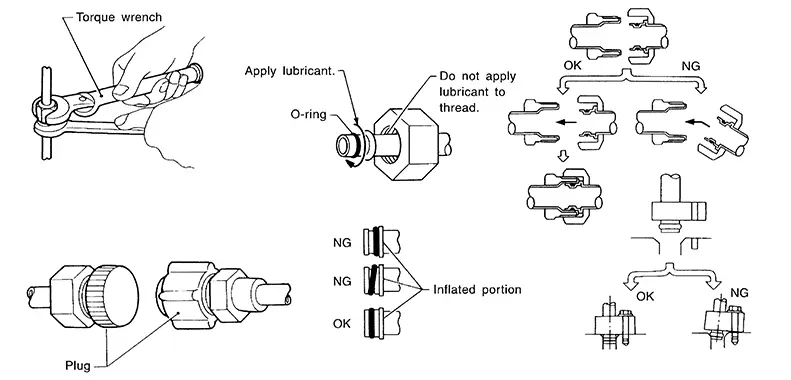
Always use a torque wrench and a back-up wrench when connecting tubes.
-
Plug immediately all openings to prevent entry of dust and moisture after disconnecting tubes.
-
Connect the pipes at the final stage of the operation when installing an air conditioner in the Nissan Sentra vehicle. Do not remove the seal caps of pipes and other components until just before required for connection.
-
Allow components stored in cool areas to warm to working area temperature before removing seal caps. This prevents condensation from forming inside A/C components.
-
Remove moisture thoroughly from the refrigeration system before charging the refrigerant.
-
Always replace used O-rings.
-
Apply oil to the O-rings shown in illustrations when connecting tubes. Be careful not to apply oil to threaded portion.
-
O-ring must be closely attached to the groove portion of tube.
-
Be careful not to damage O-ring and tube when replacing the O-ring.
-
Connect tube until a click can be heard. Then tighten the nut or bolt by hand. Check that the O-ring is installed to tube correctly.
-
Perform leak test and make sure that there are no leaks from connections after connecting line. Disconnect that line and replace the O-ring when the refrigerant leaking point is found. Then tighten connections of seal seat to the specified torque.
COMPRESSOR
CAUTION:
-
Plug all openings to prevent moisture and foreign matter from entering.
-
When the compressor is removed, store it in the same way as it is when mounted on the Nissan Sentra vehicle.
-
Follow “Oil Adjusting Procedure for Compressor Replacement" exactly when replacing or repairing compressor. Refer to Description.
-
Keep friction surfaces between clutch and pulley clean. Wipe them off by using a clean waste cloth moistened with solvent if the surface is contaminated with oil.
-
Turn the compressor shaft by hand more than five turns in both directions after compressor service operation. This distributes oil equally inside the compressor. Let the engine idle and operate the compressor for one hour after the compressor is installed.
-
After replacing the compressor magnet clutch, apply voltage to the new one and check for normal operation.
LEAK DETECTION DYE
CAUTION:
-
The A/C system contains a fluorescent leak detection dye used for locating refrigerant leaks. An ultraviolet (UV) lamp is required to illuminate the dye when inspecting for leaks.
-
Always wear fluorescence enhancing UV safety goggles to protect your eyes and enhance the visibility of the fluorescent dye.
-
A compressor shaft seal should not be repaired because of dye seepage. The compressor shaft seal should only be repaired after confirming the leak with an electronic refrigerant leak detector (NI-41995).
-
Always remove any dye from the leak area after repairs are complete to avoid a misdiagnosis during a future service.
-
Do not allow dye to come into contact with painted body panels or interior components. If dye is spilled, clean immediately with the approved dye cleaner. Fluorescent dye left on a surface for an extended period of time cannot be removed.
-
Do not spray the fluorescent dye cleaning agent on hot surfaces (engine exhaust manifold, etc.).
-
Do not use more than one refrigerant dye bottle (1/4 ounce / 7.4 cc) per A/C system.
-
Do not use HFC-134a (R-134a) leak detection dye in CFC-12 (R-12) or HFO–1234yf (R-1234yf) A/C systems, or, HFO–1234yf (R-1234yf) leak detection dye in HFC-134a (R-134a) or CFC-12 (R-12) A/C systems or A/C system damage may result.
-
The fluorescent properties of the dye will remain for over three (3) years unless a compressor failure occurs.

Identification
-
Nissan Sentra Vehicles with factory installed fluorescent dye have a green label.
-
Vehicles without factory installed fluorescent dye have a blue label.
Other materials:
Sonar System. Ecu Diagnosis Information. Sonar Control Unit
Sonar Control Unit
Values on the Diagnosis Tool
Values on the Diagnosis Tool
Note:
The following table includes information (items)
inapplicable to this Nissan Sentra vehicle. For information (items) applicable to
this vehicle, refer to CONSULT display items.
...
C1f5f-A2 Distance Sensor
Dtc Description
DTC Description
DTC DETECTION LOGIC
DTC
CONSULT screen terms
(Trouble diagnosis
content)
DTC detection
conditi ...
Cvt Belt Inspection
Component Inspection
Component Inspection
Set the vehicle on 2-post car lift.
Set the CVT to N position.
Secure the right front tire with a suitable strap .
This will assist in making the belt turn.
Mark the left fron ...