
Nissan Sentra Service Manual: P0998 Shift solenoid F
DTC Logic
DTC DETECTION LOGIC
| DTC | CONSULT screen terms (Trouble diagnosis content) | DTC detection condition | Possible causes |
| P0998 | SHIFT SOLENOID F (Shift Solenoid F Control Circuit Low) | The TCM low brake solenoid valve current
monitor reading is 200 mA or less continuously
for 480 msec or more under the following diagnosis
conditions: Diagnosis conditions
|
|
DTC CONFIRMATION PROCEDURE
1.PREPARATION BEFORE WORK
If another “DTC CONFIRMATION PROCEDURE” occurs just before, turn ignition switch OFF and wait for at least 10 seconds, then perform the next test.
>> GO TO 2.
2.CHECK DTC DETECTION
- Start the engine
- Shift the selector lever to “D” position and wait for 5 seconds or more.
- Check the first trip DTC.
Is “P0998” detected? YES >> Go to TM-210, "Diagnosis Procedure".
NO >> INSPECTION END
Diagnosis Procedure
1.CHECK CIRCUIT BETWEEN TCM AND CVT UNIT
- Turn ignition switch OFF.
- Disconnect TCM connector and CVT unit connector.
- Check continuity between TCM harness connector terminal and ground.
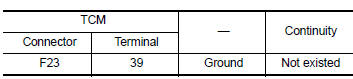 Is the inspection
result normal?
YES >> GO TO 2.
NO >> Repair or replace malfunctioning parts.
2.CHECK LOW BRAKE SOLENOID VALVE
Check low brake solenoid valve. Refer to TM-211, "Component Inspection".
Is the inspection result normal? YES >> Check intermittent incident. Refer to GI-39, "Intermittent Incident".
NO >> Repair or replace malfunctioning parts.
Component Inspection
1.CHECK LOW BRAKE SOLENOID VALVE
Check resistance between CVT unit connector terminal and ground.
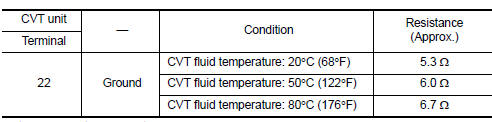 Is the inspection
result normal?
YES >> INSPECTION END
NO >> There is a malfunction of low brake solenoid valve. Replace transaxle assembly. Refer to TM-283, "Removal and Installation".
 P0967 Pressure control solenoid B
DTC Logic
DTC DETECTION LOGIC
DTC
CONSULT screen terms
(Trouble diagnosis content)
DTC detection condition
Possible causes
P0967
PC SOLENOID B
(Pressure Control So ...
 P0999 Shift solenoid F
DTC Logic
DTC DETECTION LOGIC
DTC
CONSULT screen terms
(Trouble diagnosis content)
DTC detection condition
Possible causes
P0999
SHIFT SOLENOID F
(Shift Solenoid F ...
Other materials:
Unit disassembly and assembly
Center console assembly
Exploded View
Center console upper finisher
Center console side finisher (RH)
Center console side finisher (LH)
Center console side finisher screw cover
(LH/RH)
Center console assembly
Center console screw cover (LH/RH)
Center console rear finisher
C ...
P0182, P0183 FTT Sensor
DTC Logic
DTC DETECTION LOGIC
DTC No.
CONSULT screen terms
(Trouble diagnosis content)
DTC detecting condition
Possible cause
P0182
FTT SEN/CIRCUIT
(Fuel temperature sensor
″A″ circuit low)
An excessively low voltage from the sensor is
sent to ...
Wiring diagram
Warning chime system
Wiring diagram
...
