Nissan Sentra B18 (2020-2025) Service Manual: Starting System :: Basic Inspection. Diagnosis and Repair Work Flow
Diagnosis and Repair Work Flow. Work Flow (with 165-Dss-5000p)
Work Flow (With 165-DSS-5000P)
STARTING SYSTEM DIAGNOSIS WITH 165-DSS-5000P
To test the starting system, use the following special service tool:
-
Battery and electrical diagnostic analyzer 165-DSS-5000P.

Refer to the diagnostic analyzer Instruction Manual for proper starting system diagnosis procedures.
OVERALL SEQUENCE
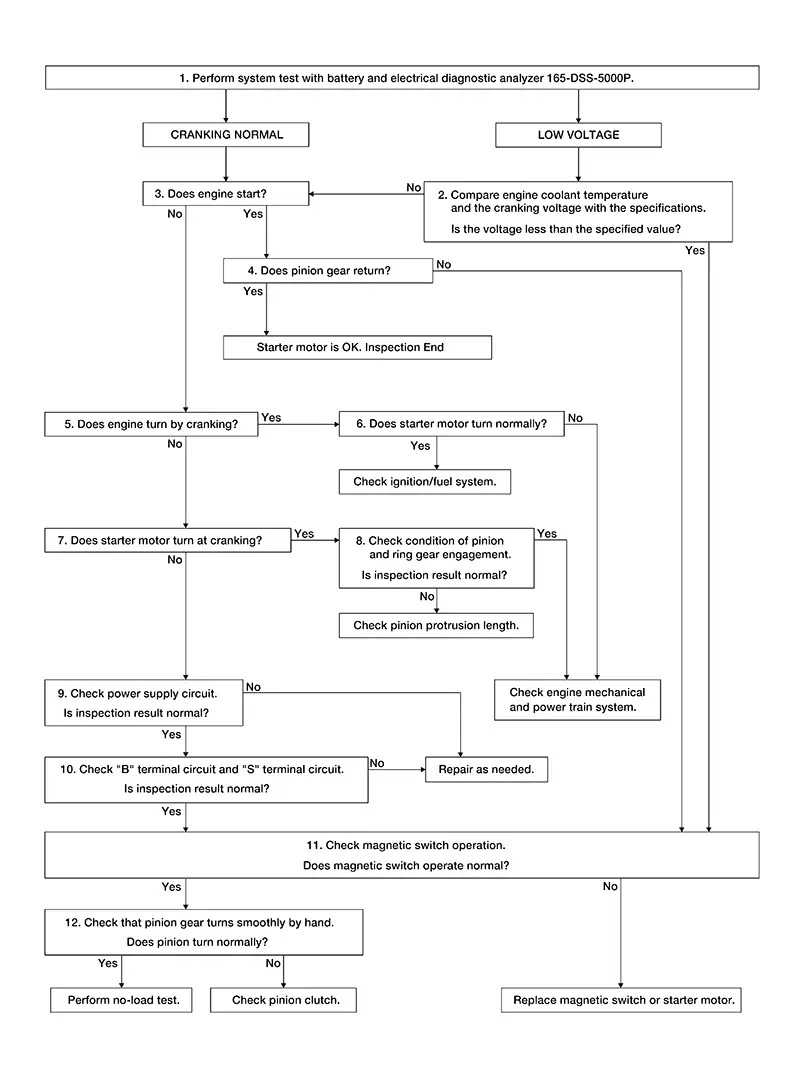
DETAILED FLOW
Note:
-
To ensure a complete and thorough diagnosis, the battery, starter motor and generator test segments must be done as a set from start to finish.
-
If any malfunction is found, immediately disconnect the battery cable from the negative terminal.
-
DIAGNOSIS WITH BATTERY AND ELECTRICAL DIAGNOSTIC ANALYZER 165-DSS-5000P
-
Perform system test with battery and electrical diagnostic analyzer 165-DSS-5000P. For details and operating instructions, refer to diagnostic analyzer Instruction Manual.
How is the test result?
CRANKING NORMAL>>GO TO 3.
LOW VOLTAGE>>GO TO 2.
CHARGE BATTERY>>Perform the slow battery charging procedure. (Initial rate of charge is 10A for 12 hours.) Perform battery test again. Refer to diagnostic analyzer instruction manual.
REPLACE BATTERY>>Before replacing battery, clean the battery cable clamps and battery posts. Perform battery test again. Refer to diagnostic analyzer instruction manual. If second test result is “REPLACE BATTERY�, then do so. Perform battery test again to confirm repair.
-
-
COMPARISON BETWEEN ENGINE COOLANT AND CRANKING VOLTAGE
-
Compare engine coolant temperature and the cranking voltage with the specifications.
Minimum Specification of Cranking Voltage Referencing Coolant Temperature Engine coolant temperature [°F (°C)]
Voltage [V]
−22 to −4 (−30 to −20)
8.6
−2 to 14 (−19 to −10)
9.1
16 to 32 (−9 to 0)
9.5
More than 34 (More than 1)
9.9
Is the voltage less than the specified value?
YES >>GO TO 11.
NO >>GO TO 3.
-
-
CHECK ENGINE START
-
Check engine and check that engine starts.
Does engine start?
YES >>GO TO 4.
NO >>GO TO 5.
-
-
CHECK RETURN OF PINION GEAR
-
Check that pinion gear returns to original position after engine starts.
Does pinion gear return?
YES >>Starter motor is OK. Inspection End.
NO >>GO TO 11.
-
-
CHECK ENGINE SPEED WITH CRANKING
-
Check that engine turns while cranking.
Does engine turn by cranking?
YES >>GO TO 6.
NO >>GO TO 7.
-
-
CHECK STARTER MOTOR TURNING WITH CRANKING
-
Check that starter motor runs smoothly without abnormal noise at cranking.
Does starter motor turn normally?
YES >>Check ignition/fuel system.
NO >>Check engine mechanical and power train system.
-
-
CHECK STARTER MOTOR SPEED WITH CRANKING
-
Check that starter motor turns while cranking.
Does starter motor turn at cranking?
YES >>GO TO 8.
NO >>GO TO 9.
-
-
CHECK PINION GEAR AND RING GEAR ENGAGEMENT
-
Check condition of pinion and ring gear engagement.
Is inspection result normal?
YES >>Check engine mechanical and power train system.
NO >>Check pinion protrusion length. Refer to Inspection.
-
-
CHECK POWER SUPPLY CIRCUIT
-
Check the following conditions:
-
• Fuse and fusible link
-
• Charge condition, corrosion and connection condition of battery. Refer to How to Handle Battery.
Are these inspection results normal?
YES >>GO TO 10.
NO >>Repair as needed.
-
-
CHECK STARTING SYSTEM WIRING
-
Check the following.
-
• “B� terminal circuit. Refer to Diagnosis Procedure.
-
• “S� terminal circuit. Refer to Diagnosis Procedure.
Are these inspection results normal?
YES >>GO TO 11.
NO >>Repair as needed.
-
-
CHECK MAGNETIC SWITCH OPERATION
-
Check magnetic switch operation. Refer to Inspection.
Does magnetic switch operate normal?
YES >>GO TO 12.
NO >>Replace magnetic switch or starter motor.
-
-
CHECK PINION TURNING
-
1. Remove starter motor.
2. Check that pinion turns smoothly by hand.
Does pinion turn normally?
YES >>Perform no-load test of starter motor. Refer to Inspection.
NO >>Check pinion clutch. Refer to Inspection.
-
Work Flow (without 165-Dss-5000p)
Work Flow (Without 165-DSS-5000P)
OVERALL SEQUENCE
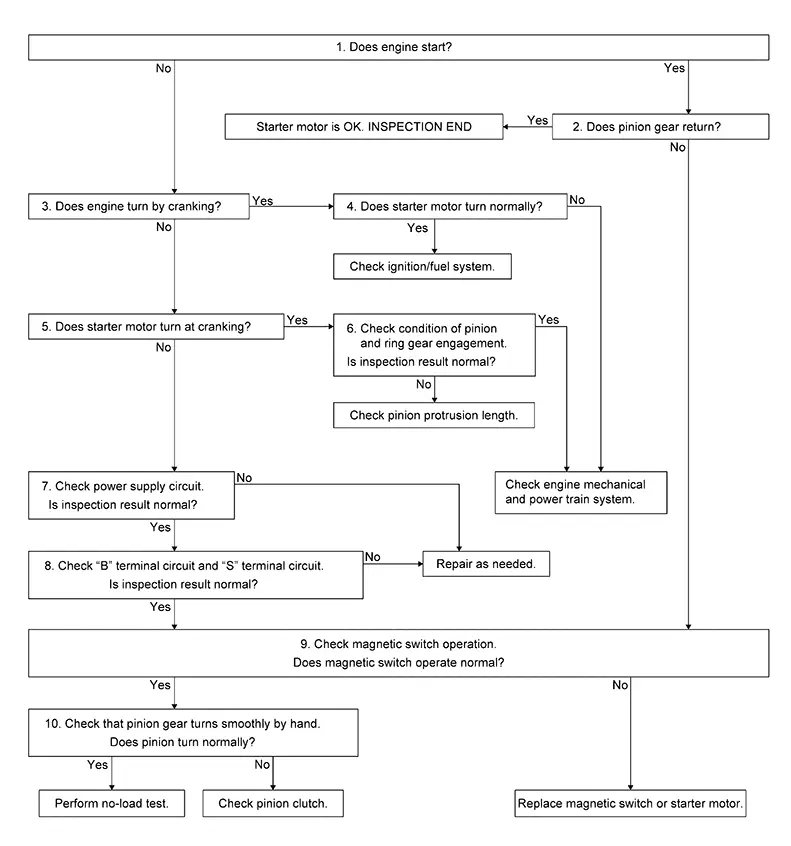
DETAILED FLOW
Note:
If any malfunction is found, immediately disconnect the battery cable from the negative terminal.
-
CHECK ENGINE START
-
Crank engine and check that engine starts.
Does engine start?
YES>>GO TO 2.
NO>>GO TO 3.
-
-
CHECK RETURN OF PINION GEAR
-
Check that pinion gear returns to original position after engine starts.
Does pinion gear return?
YES>>Starter motor is OK. Inspection End.
NO>>GO TO 9.
-
-
CHECK ENGINE SPEED WITH CRANKING
-
Check that engine turns while cranking.
Does engine turn by cranking?
YES>>GO TO 4.
NO>>GO TO 5.
-
-
CHECK STARTER MOTOR TURNING WITH CRANKING
-
Check that starter motor runs smoothly without abnormal noise at cranking.
Does starter motor turn normally?
YES>>Check ignition/fuel system.
NO>>Check engine mechanical and power train system.
-
-
CHECK STARTER MOTOR SPEED WITH CRANKING
-
Check that starter motor turns while cranking.
Does starter motor turn at cranking?
YES>>GO TO 6.
NO>>GO TO 7.
-
-
CHECK PINION GEAR AND RING GEAR ENGAGEMENT
-
Check condition of pinion and ring gear engagement.
Is inspection result normal?
YES>>Check engine mechanical and power train system.
NO>>Check pinion protrusion length. Refer to Inspection.
-
-
CHECK POWER SUPPLY CIRCUIT
-
Check the following conditions:
-
Fuse and fusible link
-
Charge condition, corrosion and connection condition of the battery. Refer to How to Handle Battery.
-
Are these inspection results normal?
YES>>GO TO 8.
NO>>Repair as needed.
-
-
CHECK STARTING SYSTEM WIRING
-
Check the following:
-
“B� terminal circuit. Refer to Diagnosis Procedure.
-
“S� terminal circuit. Refer to Diagnosis Procedure.
-
Are these inspection results normal?
YES>>GO TO 9.
NO>>Repair as needed.
-
-
CHECK MAGNETIC SWITCH OPERATION
-
Check magnetic switch operation. Refer to Inspection.
Does magnetic switch operate normal?
YES>>GO TO 10.
NO>>Replace magnetic switch or starter motor.
-
-
CHECK PINION TURNING
-
1. Remove starter motor.
2. Check that pinion turns smoothly by hand.
Does pinion turn normally?
YES>>Perform no-load test of starter motor. Refer to Inspection.
NO>>Check pinion clutch. Refer to Inspection.
-
Other materials:
U215b-87 Can Comm Err (ipdm E/r)
Dtc Description
DTC Description
DESCRIPTION
CAN (Controller Area Network) is a serial communication
line for real time applications. It is an on-Nissan Sentra vehicle multiplex communication
line with high data communication speed and excellent error detection
ability. Modern Nissan ...
P188e-00 Electric Oil Pump
Dtc Description
DTC Description
DTC DETECTION LOGIC
DTC
CONSULT screen terms
(Trouble diagnosis
content)
DTC detection
conditi ...
Egr Valve
Exploded View
Exploded View
1.
Vacuum delay valve
bracket
2.
EGR cooler
bracket
...