Nissan Sentra B18 (2020-2025) Service Manual: Repairing High Strength Steel
High Strength Steel (hss)
High Strength Steel (HSS)
High strength steel is used for body panels in order to reduce vehicle weight.
Accordingly, precautions in repairing automotive bodies made of high strength steel are described below:
|
Tensile strength |
Major applicable parts |
|---|---|
|
590 MPa |
|
|
780 - 1300 MPa |
|
Read the following precautions when repairing HSS:
-
Additional points to consider:
-
The repair of reinforcements (such as side members) by heating is not recommended since it may weaken the component. When heating is unavoidable, do not heat HSS parts above 550°C (1,022°F).
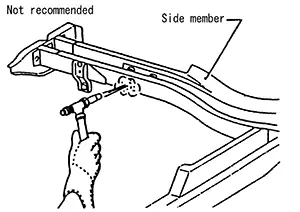
Verify heating temperature with a thermometer.
(Crayon-type and other similar type thermometers are appropriate.)
-
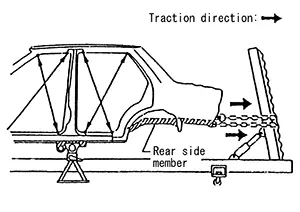
When straightening body panels, use caution in pulling any HSS panel. Because HSS is very strong, pulling may cause deformation in adjacent portions of the body. In this case, increase the number of measuring points and carefully pull the HSS panel.
-
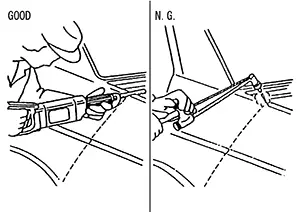
When cutting HSS panels, avoid gas (torch) cutting if possible. Instead, use a saw to avoid weakening surrounding areas due to heat. If gas (torch) cutting is unavoidable, allow a minimum margin of 50 mm (1.97 in).
-
When welding HSS panels, use spot welding whenever possible in order to minimize weakening surrounding areas due to heat.
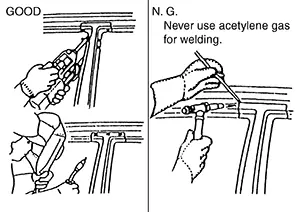
If spot welding is impossible, use MAG welding. Do not use gas (torch) for welding because it is inferior in welding strength.
-
The spot weld on HSS panels is harder than that of an ordinary steel panel.
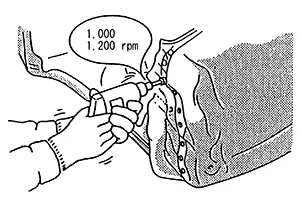
Therefore, when cutting spot welds on a HSS panel, use a low speed high torque drill (1,000 to 1,200 rpm) to increase drill bit durability and facilitate the operation.
-
-
Precautions in spot welding HSS
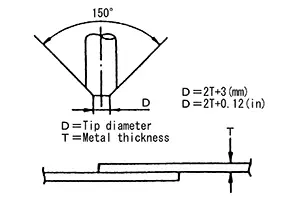
This work should be performed under standard working conditions. Always note the following when spot welding HSS:
-
The electrode tip diameter must be sized properly according to the metal thickness.
-
The panel surfaces must fit flush to each other, leaving no gaps.
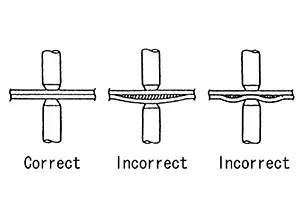
-
Follow the specifications for the proper welding pitch.
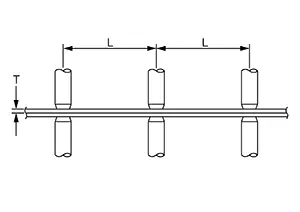 Unit: mm (in)
Thickness (T)
Minimum pitch (L)
0.6 (0.024)
0.8 (0.031)
1.0 (0.039)
1.2 (0.047)
1.6 (0.063)
1.8 (0.071)
10 (0.39) or over
12 (0.47) or over
18 (0.71) or over
20 (0.79) or over
27 (1.06) or over
31 (1.22) or over
-
Handling of Ultra High Strength Steel Plate Parts
Handling of Ultra High Strength Steel Plate Parts
PROHIBITION OF CUT AND CONNECTION
Do not cut and join the lower lock pillar reinforcement (center pillar reinforcement inside frame parts) because its material is high strength steel plate (ultra high strength steel plate).
The center pillar reinforcement must be replaced if this part is damaged.
Welding of Ultra High Strength Steel
Welding of Ultra High Strength Steel
SPOT WELDING
Spot welding is limited to ultra high strength steel of (tensile strength: 980 MPa) according to the welding conditions listed below.
CAUTION:
-
If the below welding conditions cannot be met, then perform plug welding.
-
Never spot weld ultra high strength steel of tensile strength more than 980 MPa. For this type of ultra high strength steel, perform plug welding.
-
The below welding condition is applicable only to this Nissan Sentra vehicle. Never apply these same conditions to other vehicles.
|
Welder tip diameter |
6 MM |
|
|
Welding pressure (Gun force) |
3100 N |
|
|
Welding current |
8000 A |
|
|
Weld time* |
.10 sec (8 cyc: 50 Hz) .12 sec (9 cyc: 60 Hz) |
|
|
Panel configuration |
Combination of a plate of tensile strength of 980 MPa and that of tensile strength less than 980 MPa. (Up to 3 plates) |
|
|
* Select weld time based on the frequency (Hz) of the electrical power supplied in your area. |
||
PLUG WELDING
To weld ultra high strength steel of tensile strength 980 MPa or more, perform plug welding observing the welding hole diameter described in the manual.
CAUTION:
-
To perform plug welding, use fuel mixture (Ar 80% + CO2 20%) for shielding gas of welder.
-
Never use carbon dioxide gas (CO2 100%) as shielding gas of welder. Using CO2 100% gas results in inadequate weld strength.
-
When welding hole diameter cannot be met, make multiple holes (smaller diameter) so that the sum of the holes areas equals the area of the original weld hole.
Other materials:
Removal and Installation
Av Control Unit
Exploded View
Exploded View
1.
Audio unit bracket (LH)
2.
Audio unit
3.
...
P0139 Ho2s2
Dtc Description
DTC Description
The heated oxygen sensor 2 has a much longer switching time
between rich and lean than the air fuel ratio (A/F) sensor 1. The oxygen storage
capacity of the three way catalyst 1 causes the longer switching time. To judge
the malfunctions of heated oxy ...
B20ce-15 Hl (hi) Lh Pwr Sply Circ
Dtc Description
DTC Description
DTC DETECTION LOGIC
DTC No.
CONSULT screen items
(Trouble diagnosis content)
DTC detection condition
...