
Nissan Sentra B18 (2020-2025) Service Manual: Removal and Installation
CAUTION:
-
All hoses and piping (tubes) must be free from excessive bending, twisting, and pulling.
-
Make sure there is no interference with other parts when turning steering both clockwise and counterclockwise.
-
Do not spill or splash brake fluid on painted surfaces. Brake fluid may seriously damage paint. Wipe it off immediately and wash with water if it gets on a painted surface.
-
Do not allow foreign matter (e.g. dust) and oils other than brake fluid to enter the master cylinder reservoir tank.

When removing components such as hoses, tubes/lines, etc., cap or plug openings to prevent fluid from spilling.
REMOVAL
Remove the reservoir cap from the master cylinder reservoir tank.
Remove the front wheel and tire using power tool. Refer to Removal and Installation.
Loosen the flare nut using a flare nut wrench. Separate the brake tube from the brake hose. Refer to Exploded View.
CAUTION:
-
Do not scratch the flare nut and the brake tube.
-
All brake hoses and tubes must be free from excessive bending, twisting and pulling.
Remove the union bolt and the brake hose from the brake caliper assembly. Remove and discard the copper sealing washers.
CAUTION:
Do not reuse copper sealing washers.
Remove the lock plates and remove the brake hose.
INSTALLATION
Assemble
the union bolt (1) and the copper sealing washers (2) to the brake
hose and install it as an assembly to the brake caliper. Align the
brake hose part (A) with the brake caliper assembly projection (B),
and tighten the union bolt to the specified torque. Refer to Exploded View. 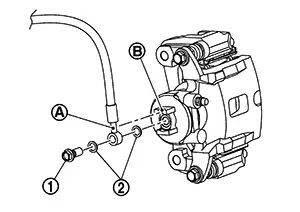
CAUTION:
Do not reuse copper sealing washers.
Install the brake tube to the brake hose, temporarily tighten the flare nut by hand until it does not rotate further, and attach the brake hose to the brackets with the lock plates.
CAUTION:
Check that the brake hoses and tubes are not bent or twisted.
Tighten the flare nut to the specified torque using a flare nut crowfoot and a torque wrench.
CAUTION:
Do not scratch the flare nut and the brake tube.
Refill with new brake fluid and bleed air from the brake system. Refer to Bleeding Brake System.
CAUTION:
Do not reuse drained brake fluid.
Install the front wheel and tire. Refer to Removal and Installation.
Perform the inspection after installation. Refer to Inspection.
 Exploded View
Exploded View
1.
Brake tube to front (RH)
2.
...

Other materials:
B0002-09 Driver Air Bag Module
Dtc Description
DTC Description
DTC DETECTION LOGIC
DTC No.
CONSULT screen terms
(Trouble diagnosis
content)
DTC detecting condition
...
Inspection
Inspection
BRAKE FLUID LEVEL
Make sure that the brake fluid level in the
master cylinder reservoir tank is between the MAX and MIN
lines.
Visually check around the master cylinder
reservoir tank for brake fluid leaks.
If ...
If your vehicle overheats
If your Nissan Sentra begins to overheat, which may be indicated by an extremely
high temperature gauge reading, a noticeable loss of engine power, unusual smells,
steam, or abnormal engine noise, take the following steps immediately to protect
the engine and ensure personal safety.
WARNING
...
