
Nissan Sentra B18 (2020-2025) Service Manual: Removal and Installation
REMOVAL
Remove the wheel and tire using power tool. Refer to Removal and Installation.
Remove the
valve cap and the valve core to deflate the tire. Refer to Exploded View. Note: 
If the tire is to be reused, apply a matching mark on the tire in line with the position of the valve hole in the wheel for the purpose of wheel and tire balance adjustment after installation.
Lubricate the tire outside bead well with a suitable non-silicone lubricant and separate the tire outside bead from the wheel.
CAUTION:
-
Do not use silicone lubricant. Use of silicone lubricant will deteriorate the tire and wheel.
-
Do not damage the wheel.
Lubricate the tire inside bead well with a suitable non-silicone lubricant and separate the tire inside bead from the wheel.
CAUTION:
-
Do not use silicone lubricant. Use of silicone lubricant will deteriorate the tire and wheel.
-
Do not damage the wheel.
Carefully
lift and set the wheel and tire onto the tire changer turntable so
that the tire pressure sensor (1) is at the bottom. Position the
wheel and tire so that the tire pressure sensor is 270 degrees from
the mounting/dismounting head (2). 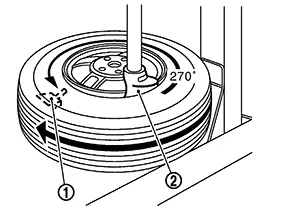
CAUTION:
Do not damage the wheel.
Note:
To avoid damage to Nissan Sentra vehicle, the tire must not slip or spin on the wheel when dismounting, or mounting a tire’s outer bead. Damage to the wheel or the tire pressure sensor could result.
Remove the tire from the wheel.
Remove the screw and the tire pressure sensor from the valve.
CAUTION:
Do not drop or strike the tire pressure sensor. Replace the tire pressure sensor if it has been dropped from higher than one meter.
Cut the
inner end (A) of the valve using a suitable tool (B).
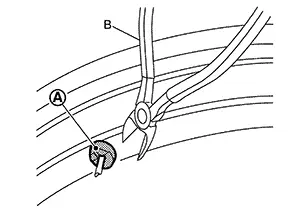
CAUTION:
Do not damage the wheel.
Remove the
valve (2) from the wheel (1) using Tool (A).
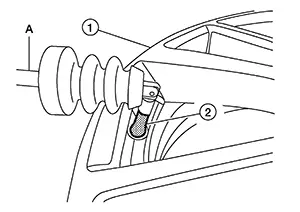
|
Tool (A) number |
: NI-51980 |
CAUTION:
Do not damage the wheel.
INSTALLATION
Clean the valve hole in the wheel.
CAUTION:
Make sure there are no burrs, foreign substances, or indications of damage to the wheel.
Apply a
suitable non-silicone lubricant to the surface of the valve (A)
that touches the wheel and to the valve hole in the wheel. 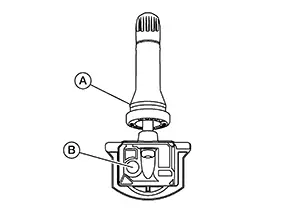
CAUTION:
-
Do not use silicone lubricant. Use of silicone lubricant will deteriorate the tire and wheel.
-
Do not allow lubricant to contact the air pressure detection hole (B).
Remove the valve cap from the new tire pressure sensor unit.
Position
the valve (C) in the valve hole in the wheel (A). 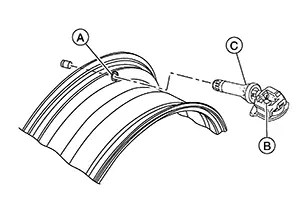
CAUTION:
-
Do not damage the tire pressure sensor.
-
Do not allow lubricant to contact the air pressure detection hole (B).
-
The tire pressure sensor must be oriented tangentially to the rim of the wheel.
Install the
valve (2) to the wheel (1) using Tool (A).
|
Tool (A) number |
: NI-51980 |
CAUTION:
-
Do not drop or strike the tire pressure sensor. Replace the tire pressure sensor if it has been dropped from higher than one meter.
-
Do not damage the wheel.
-
Install the valve all the way to the wheel.
-
Make sure the valve seats properly in the valve hole in the wheel.
-
If the tire pressure sensor unit position is not correct, rotate the tire pressure sensor unit to the correct position using Tool.
Apply a suitable non-silicone lubricant to the tire inside bead.
CAUTION:
-
Do not use silicone lubricant. Use of silicone lubricant will deteriorate the tire and wheel.
-
Do not allow lubricant to contact the air pressure detection hole.
Install the
tire inside bead (1) onto the wheel (2) in the position
shown.
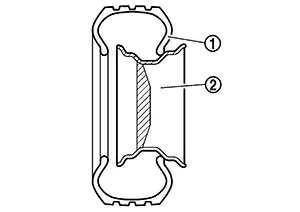
CAUTION:
-
Do not damage the wheel or the tire pressure sensor.
-
Do not allow the tire beads to make contact with the tire pressure sensor.
Place the
wheel on the turntable of the tire machine. Make sure that the tire
pressure sensor (1) is 270 degrees from the mounting/dismounting
head (2).
CAUTION:
Do not touch the tire pressure sensor with the mounting head.
Apply a suitable non-silicone lubricant to the tire outside bead.
CAUTION:
-
Do not use silicone lubricant. Use of silicone lubricant will deteriorate the tire and wheel.
-
Do not allow lubricant to make contact with the tire pressure sensor.
Install the tire outside bead onto the wheel as normal.
CAUTION:
When installing, make sure that the tire does not rotate relative to the wheel.
Note:
-
If the tire is being reused, align the matching mark applied on the tire with the position of the valve hole in the wheel for the purpose of wheel and tire balance adjustment after installation.
-
To avoid damage to Nissan Sentra vehicle, the tire must not slip or spin on the wheel when dismounting, or mounting a tire’s outer bead. Damage to the wheel or the tire pressure sensor could result.
Inflate the tire. Refer to Tire Air Pressure.
Install the valve cap.
Balance the wheel and tire. Refer to Adjustment.
Install the wheel and tire in the appropriate position on the Nissan Sentra vehicle. Refer to Removal and Installation.
Perform the "ID REGISTRATION PROCEDURE". Refer to Description.
CAUTION:
For replacing the tire pressure sensor, the ID registration procedure must be performed.
 Exploded View
Exploded View
1.
Tire pressure sensor
2.
...
 Disposal
Disposal
CAUTION:
When discarding tire pressure sensor, remove
battery from tire pressure sensor.
Dispose of battery according to the law and l ...
Other materials:
Dlc branch line circuit
Diagnosis procedure
1.Check connector
Turn the ignition switch OFF.
Disconnect the battery cable from the negative terminal.
Check the terminals and connectors of the data link connector for
damage, bend and loose connection
(connector side and harness side).
Is the inspection resul ...
Vehicle Dynamic Control (VDC) system
The Vehicle Dynamic Control (VDC) system uses
various sensors to monitor driver inputs and vehicle
motion. Under certain driving conditions,
the VDC System helps to perform the following
functions:
Controls brake pressure to reduce wheel
slip on one slipping drive wheel so power is
trans ...
P1574 ASCD Vehicle speed sensor
Description
The ECM receives two vehicle speed sensor signals via CAN communication line.
One is sent from combination
meter, and the other is from TCM (Transmission control module). The ECM uses
these signals for ASCD
control. Refer to EC-51, "AUTOMATIC SPEED CONTROL DEVICE (ASCD) : Sys ...
