Nissan Sentra B18 (2020-2025) Owner's Manual: NISSAN Advanced Air Bag System (front seats)
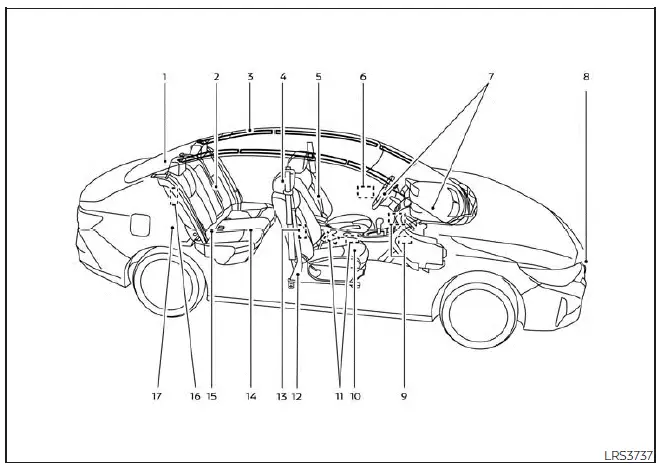
- Top tether anchor
- Rear seat belts
- Roof-mounted curtain side-impact and rollover supplemental air bag
- Head restraints/headrests
- Front seat belts
- Pressure sensors in door (driver's side shown; front passenger side similar)
- Supplemental front-impact air bags
- Front crash zone sensor
- Driver and front passenger supplemental knee air bags
- Front seats
- Occupant classification sensor (weight sensor)
- Seat belt with pretensioner(s) (front seats shown; rear outboard seats similar)
- Front seat-mounted side-impact supplemental air bag
- Rear seats
- LATCH (Lower Anchors and Tethers for CHildren) system
- Rear outboard seat-mounted side impact supplemental air bag
- Satellite sensor (passenger side shown; driver's side similar)
WARNING
To ensure correct and reliable operation of the passenger-side NISSAN Advanced Air Bag System in the Nissan Sentra, carefully observe the following guidelines.
- Do not allow a rear-seat passenger to push, pull, or apply pressure to the seatback pocket (if equipped).
- Do not place heavy objects exceeding 9.1 lbs. (4 kg) on the seatback, head restraint/headrest, or inside the seatback pocket (if equipped).
- Ensure that no objects are pressing against the rear of the front passenger seatback, such as a child restraint installed in the rear seat or items stored on the floor.
- Make sure no objects are placed underneath the front passenger seat, as this may interfere with sensor operation.
- Ensure there are no objects positioned between the seat cushion and the center console or between the seat cushion and the door.
- If a forward-facing child restraint is installed in the front passenger seat, do not position the seat so the child restraint contacts the instrument panel. If contact occurs, the system may incorrectly determine the seat is occupied, which could result in deployment of the front passenger air bag and front passenger supplemental knee air bag during a collision. In this situation, the front passenger air bag status light may also fail to illuminate.
- Always confirm system status using the front passenger air bag status light.
- If the front passenger air bag status light does not operate as described, have the occupant classification system inspected. It is recommended that you visit a NISSAN dealer for service.
- Until a dealer confirms proper operation of the occupant classification system, seat occupants in the rear seating positions of the Nissan Sentra.
- Do not position the front passenger seat so it contacts the rear seat. If contact occurs, the system may detect a sensor malfunction, causing the front passenger air bag status light to illuminate and the supplemental air bag warning light to flash.
This vehicle is equipped with the NISSAN Advanced Air Bag System for both the driver and front passenger seating positions. In the Nissan Sentra, this system is designed to comply with applicable U.S. certification requirements and is also approved for use in Canada. All instructions, cautions, and warnings contained in this Owner’s Manual must be followed to ensure proper system operation.
The driver supplemental front-impact air bag is located in the center of the steering wheel, while the front passenger supplemental front-impact air bag is mounted in the instrument panel above the glove box. These air bags are engineered to deploy in higher-severity frontal collisions, although deployment may also occur in other types of impacts if the forces are comparable. In certain frontal collisions, the air bags may not inflate. The extent of vehicle damage alone does not necessarily indicate correct or incorrect air bag system operation.
The NISSAN Advanced Air Bag System continuously monitors input from the front crash zone sensor and the Air Bag Control Unit (ACU). Deployment decisions are based on collision severity and driver seat belt usage.
For the front passenger seat, the system also monitors input from the occupant classification sensor. Based on this information, one or both front air bags may deploy, depending on crash severity and seat belt usage. Under certain conditions, the front passenger air bag and front passenger supplemental knee air bag may be automatically deactivated depending on detected occupant weight and belt usage. When these air bags are OFF, the passenger air bag status light will illuminate to inform the driver.
For additional details, refer to "Front passenger air bag and status light". The deployment of only one front air bag in the Nissan Sentra does not indicate improper system operation and may be a normal response depending on collision severity and occupant conditions.
If you have any questions regarding the air bag system in your Nissan Sentra, it is recommended that you visit an authorized NISSAN dealer for accurate information and professional assistance. If you are considering vehicle modifications due to a disability, you may also contact NISSAN directly. Official contact information is provided at the front of this Owner's Manual.
When a front air bag deploys, a noticeable noise may be heard, followed by the release of a smoke-like substance. This substance is not harmful and does not indicate a fire. However, care should be taken to avoid inhaling it, as it may cause temporary irritation or coughing. Occupants with respiratory conditions should seek fresh air as soon as possible.
Front air bags, when used together with properly worn seat belts, help cushion the impact forces applied to the face and chest of front-seat occupants in the Nissan Sentra during certain collisions.
These systems are designed to help save lives and reduce the risk of serious injury. However, deployment of a front air bag may cause minor injuries such as facial abrasions or other impact-related effects. Front air bags, except for the driver and front passenger supplemental knee air bags, do not provide restraint for the lower body.
Even with the NISSAN Advanced Air Bag System, seat belts must always be worn correctly, and both the driver and front passenger should sit upright and as far away as practical from the steering wheel or instrument panel. Front air bags deploy rapidly to provide protection, and the force of deployment may increase injury risk if an occupant is seated too close to the air bag module.
Following a collision, the front air bags deflate quickly to allow occupant movement and facilitate exit from the vehicle if necessary.
The front air bags operate only when the ignition switch is placed in the ON position.
After the ignition switch is turned to the ON position, the supplemental air bag warning light will illuminate as part of a self-check. If the system is operating correctly, the supplemental air bag warning light will turn off after approximately 7 seconds.
Other materials:
Engine Mounting Insulator (rh)
Exploded View
Exploded View
CVT Models
1.
Engine mounting
insulator (LH)
2.
Engine mounting
insula ...
Front Brake Caliper Assembly
Exploded View
Exploded View
1.
Brake caliper body
2.
Bleeder valve
3.
...
P0300 Misfire
Dtc Description
DTC Description
When a misfire occurs, engine speed will fluctuate. If the engine
speed fluctuates enough to cause the crankshaft position (CKP) sensor signal to
vary, ECM can determine that a misfire is occurring.
...