Nissan Sentra B18 (2020-2025) Owner's Manual: Forward-facing child restraint installation using LATCH
Do not use the LATCH lower anchors if the combined weight of the child and the child restraint exceeds 65 lbs (29.5 kg). If the combined weight is greater than 65 lbs (29.5 kg), install the child restraint in the Nissan Sentra using the vehicle’s seat belt instead of the lower anchors. Always follow the child restraint manufacturer’s installation instructions.
Follow these steps to install a forward-facing child restraint using the LATCH system:
1. Position the child restraint on the vehicle seat.
Always follow the child restraint manufacturer’s instructions to ensure correct placement and orientation.
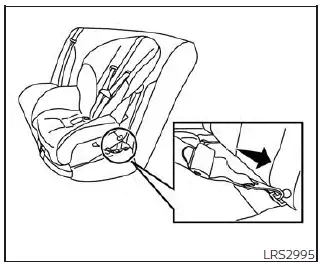
Forward-facing webbing-mounted - step 2
2. Secure the child restraint anchor attachments to the LATCH lower anchors.
Verify that each LATCH attachment is fully engaged and properly connected to the lower anchors.
If the child restraint is equipped with a top tether strap, route the top tether strap as instructed and secure it to the designated tether anchor point.
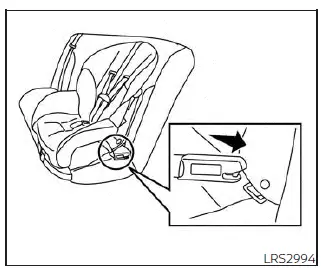
Forward-facing rigid-mounted - step 2
Do not install child restraints that require a top tether strap in seating positions that are not equipped with a top tether anchor.
3. Ensure the back of the child restraint is firmly positioned against the vehicle seatback.
If needed, adjust or remove the head restraint/headrest to achieve proper child restraint fit. If the head restraint/headrest is removed, store it securely and reinstall it once the child restraint is removed.
If the seating position does not have an adjustable head restraint/headrest and it interferes with proper child restraint installation, choose a different seating position or use a different child restraint that is compatible with the Nissan Sentra.
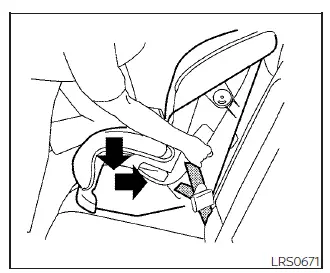
Forward-facing - step 4
4. For child restraints equipped with webbing-mounted attachments, remove any remaining slack from the anchor straps. Press firmly downward and rearward in the center of the child restraint, using your knee to compress the vehicle seat cushion and seatback, while tightening the webbing attachments.
5. Tighten the top tether strap according to the child restraint manufacturer’s instructions until all slack is removed.
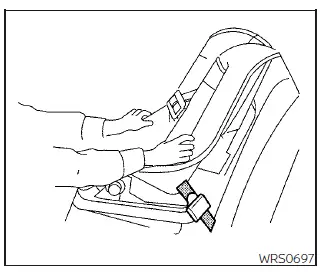
Forward-facing - step 6
6. After securing the child restraint, test the installation before placing the child in the seat. Hold the child restraint near the LATCH attachment path and push it from side to side. The restraint should not move more than 1 inch (25 mm) side to side. Pull forward on the restraint to confirm that the LATCH attachments hold it firmly in place.
If the child restraint is not secure, tighten the LATCH attachments as necessary or reposition the restraint to another seating position and test it again. You may need to try a different child restraint, as not all child restraints fit all vehicles.
7. Before each use, confirm that the child restraint is properly secured. If the restraint is loose, repeat steps 1 through 6.
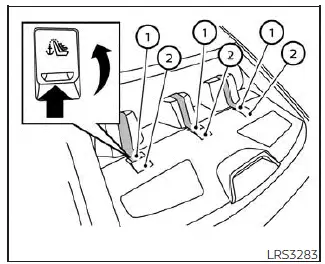
Rear seats
- Top tether strap
- Anchor point
Installing top tether strap
The child restraint top tether strap must always be used when installing a forward-facing child restraint with the LATCH lower anchor attachments in the Nissan Sentra.
First, secure the child restraint using the LATCH lower anchors.
Rear bench seat
OUTBOARD AND CENTER SEATING POSITIONS
1. Route the top tether strap 1 over the seatback.
2. Secure the tether strap to the tether anchor point 2 as illustrated.
3. Tighten the tether strap according to the child restraint manufacturer’s instructions to remove all slack.
If you have any questions regarding top tether strap installation, it is recommended that you visit a NISSAN dealer for professional assistance.
WARNING
Child restraint anchorages are designed to withstand only the loads applied by correctly installed child restraints.
Under no circumstances should these anchor points be used to secure adult seat belts, cargo, or other equipment. Misuse can damage the anchorages, prevent proper child restraint installation, and significantly increase the risk of serious injury or death in a collision.
Other materials:
B203f-14 Outside Antenna
Dtc Description
DTC Description
DTC DETECTION LOGIC
DTC No.
CONSULT screen items
(Trouble diagnosis
content)
DTC detecting condition
...
Precaution. Precautions
Precautions
Precaution for Supplemental Restraint System (srs) "air Bag" and "seat Belt Pre-Tensioner"
Precaution for Supplemental Restraint System (SRS) "AIR BAG" and "SEAT BELT PRE-TENSIONER"
The Supplemental Restraint System such as
“AIR BAG� and “SEAT BELT PRE-TENSIONER�,
u ...
Power Supply, Ground & Circuit Elements. Basic Inspection
Battery
How to Handle Battery
How to Handle Battery
CAUTION:
If it becomes necessary to start the engine with
a booster battery and jumper cables, use a 12-volt booster
battery.
After connecting battery cables, ensure that they
...