Nissan Sentra B18 (2020-2025) Service Manual: Diagnosis System (ecm)
On Board Diagnosis Function
Diagnosis Description
Diagnosis Description
ON BOARD DIAGNOSIS ITEM
The on board diagnostic system has the following functions.
|
Diagnostic test mode |
Function |
|---|---|
|
Bulb check |
MIL can be checked. |
|
SRT status |
ECM can read if SRT codes are set. |
|
Malfunction warning |
If ECM detects a malfunction, it illuminates or blinks MIL to inform the driver that a malfunction has been detected. |
|
Accelerator pedal released position learning |
ECM can learn the accelerator pedal released position. Refer to Work Procedure. |
|
Throttle valve closed position learning |
ECM can learn the throttle valve closed position. Refer to Work Procedure. |
BULB CHECK MODE
Description
This function allows damage inspection in the MIL bulb (blown, open circuit, etc.).
Operation Procedure
-
Turn ignition switch ON.
-
The MIL on the instrument panel should stay ON.
If it remains OFF, check MIL circuit. Refer to Diagnosis Procedure.
SRT STATUS MODE
Description
This function allows to read if ECM has completed the self-diagnoses of major emission control systems and components. For SRT, Refer to Diagnosis Description.
Operation Procedure
-
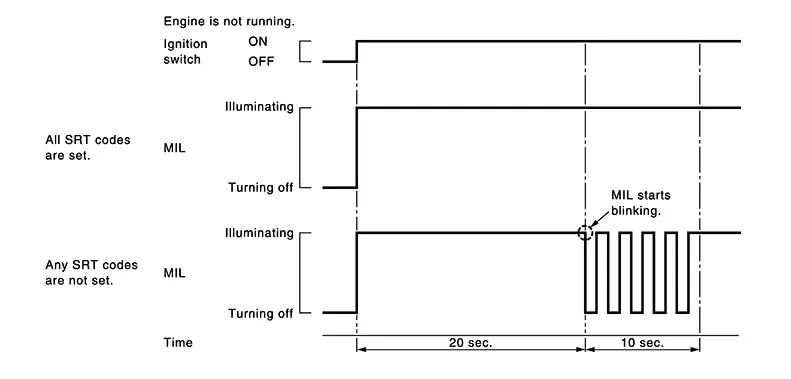
Turn ignition switch ON and wait 20 seconds.
-
SRT status is indicated as shown blow.
-
ECM continues to illuminate MIL if all SRT codes are set.
-
ECM blinks MIL for about 10 seconds if all SRT codes are not set.
-
MALFUNCTION WARNING MODE
Description
In this function ECM turns on or blinks MIL when it detects a malfunction in the emission control system components and/or the powertrain control components (which affect Nissan Sentra vehicle emissions) to inform the driver that a malfunction has been detected.
Operation Procedure
-
Turn ignition switch ON.
-
Check that MIL illuminates.
If it remains OFF, check MIL circuit. Refer to Diagnosis Procedure.
-
Start engine and let it idle.
-
For two trip detection logic diagnoses, ECM turns on MIL when it detects the same malfunction twice inthe two consecutive driving cycles. (2 trip detection logic diagnoses)
-
For 1st trip detection logic diagnoses, ECM turns on MIL when it detects a malfunction in one driving cycle.
-
ECM blinks MIL when it detects a malfunction that may damage the three way catalyst (misfire).
-
Consult Function
Diagnosis Description
Diagnosis Description
FUNCTION
|
Diagnostic test mode |
CGW Status |
Description |
||
|---|---|---|---|---|
|
Restricted Mode |
Diag Test Mode |
Open Mode |
||
|
Self Diagnostic Result |
Display |
Display |
Display |
Self-diagnostic results such as 1st trip DTC, DTCs and 1st trip freeze frame data or freeze frame data can be read and erased quickly.*1 |
|
CGW Information*2 |
Display*2 |
Display*2 |
Display*2 |
|
|
Data Monitor |
Display |
Display |
Display |
Input/Output data in the ECM can be read. |
|
Work Support*2 |
Non-display*2 |
Non-display*2 |
Display*2 |
This mode enables a technician to adjust some devices faster and more accurately by following the indications on the CONSULT unit. |
|
Active Test*2 |
Non-display*2 |
Display*2 |
Display*2 |
Diagnostic Test Mode in which CONSULT drives some actuators apart from the ECMs and also shifts some parameters in a specified range. |
|
DTC Work Support |
Non-display |
Display |
Display |
The status of system monitoring tests and the self-diagnosis status/result can be confirmed. |
|
ECU Identification |
Display |
Display |
Display |
ECM part number can be read. |
|
Network-DTC |
Display |
Display |
Display |
Display network DTC which ECM memorizes when performing "Diagnosis (All System)" |
*1: The following emission-related diagnostic information is cleared when the ECM memory is erased.
-
DTC (Diagnostic trouble codes)
-
1st trip diagnostic trouble codes
-
Freeze frame data
-
1st trip freeze frame data
-
System readiness test (SRT) codes
-
Test values
*2: In some Nissan Sentra vehicles, it is not malfunctioning in case of no display of "CGW Information". In this case, it is not necessary to switch the CGW status. In Nissan Sentra vehicles where "CGW information" is not displayed, "Work Support" and "Active Test" are always displayed.
SELF DIAGNOSTIC RESULT MODE
Self Diagnostic Item
Regarding items of DTC and 1st trip DTC, Refer to DTC Index.
How to Read DTC and 1st Trip DTC
DTCs and 1st trip DTCs related to the malfunction are displayed in “Self-diag results” mode with CONSULT. “TIME” indicates the number of driving the Nissan Sentra vehicle after the last detection of DTC.
-
When ECM has detected a current DTC, “0” is displayed for “TIME”.
-
When ECM memorizes a 1st trip DTC, “1t” is displayed for “TIME”.
-
If “TIME” is neither “0” nor “1t”, the DTC occurred in the past.
How to Erase DTC
Note:
If the ignition switch stays ON after repair work, be sure to turn ignition switch OFF once. Wait at least 10 seconds and then turn it ON (engine stopped) again.
-
Select “ENGINE” with CONSULT.
-
Select “SELF-DIAG RESULTS” mode.
-
Touch “ERASE”. (DTC in ECM will be erased.)
Freeze Frame Data and 1st Trip Freeze Frame Data
|
Freeze frame data item*1 |
Description |
|---|---|
|
DIAG TROUBLE CODE [PXXXX] |
The engine control component part/control system has a trouble code displayed as PXXXX. (Refer to DTC Index.) |
|
CAL/LD VALUE [%] |
The calculated load value at the moment a malfunction is detected is displayed. |
|
COOLANT TEMP [°C] |
The engine coolant temperature at the moment a malfunction is detected is displayed. |
|
L-FUEL TRM-B1 [%] |
|
|
L-FUEL TRM-B2 [%] |
|
|
S-FUEL TRM-B1 [%] |
|
|
S-FUEL TRM-B2 [%] |
|
|
ENGINE SPEED [rpm] |
The engine speed at the moment a malfunction is detected is displayed. |
|
VEHICL SPEED [km/h] or [mph] |
The Nissan Sentra vehicle speed at the moment a malfunction is detected is displayed. |
|
ABSOL TH·P/S [%] |
The throttle valve opening angle at the moment a malfunction is detected is displayed. |
|
INT/A TEMP SE [°C] or [°F] |
The intake air temperature at the moment a malfunction is detected is displayed. |
|
FUEL SYS-B1 |
|
|
FUEL SYS-B2 |
|
|
INT MANI PRES [kPa] |
|
|
COMBUST CONDITION |
|
|
FUEL RAIL PRESSURE [MPa] |
The fuel rail pressure at the moment a malfunction is detected is displayed. |
|
TARGET FUEL RAIL PRESSURE [MPa] |
The target fuel rail pressure at the moment a malfunction is detected is displayed. |
|
BATTERY VOLTAGE [V] |
The battery voltage at the moment a malfunction is detected is displayed. |
|
FUEL LEVEL [%] |
The fuel level at the moment a malfunction is detected is displayed. |
|
ODO/TRIP METER [km] |
ODO/TRIP meter at the moment a malfunction is detected is displayed. |
|
DTC count |
— |
|
B/FUEL SCHDL [msec] |
The basic injection quantity at the moment a malfunction is detected is displayed. |
*1: The items are the same as those of 1st trip freeze frame data.
DATA MONITOR MODE
Note:
-
The following table includes information (items) inapplicable to this Nissan Sentra vehicle. For information (items) applicable to this vehicle, refer to CONSULT display items.
-
For reference values of the following items, Refer to Physical Values.
Monitored Item
|
Monitored item |
Unit |
Monitor Item Selection |
Description |
Remarks |
||
|---|---|---|---|---|---|---|
|
ECU INPUT SIGNALS |
MAIN SIGNALS |
Start/Stop error |
||||
|
COOLANT TEMP/S |
°C |
× |
× |
The engine coolant temperature (determined by the signal voltage of the engine outlet coolant temperature sensor) is displayed. |
When the engine coolant temperature sensor is open or short-circuited, ECM enters fail-safe mode.The engine coolant temperature determined by the ECM is displayed. |
|
|
VHCL SPEED SE |
km/h or mph |
× |
× |
The Nissan Sentra vehicle speed computed from the vehicle speed signal sent from combination meter is displayed. |
||
|
BATTERY VOLT |
V |
The power supply voltage of ECM is displayed. |
||||
|
EGR TEMP SEN |
||||||
|
INT/A TEMP SE |
°C or °F |
× |
× |
The intake air temperature (determined by the signal voltage of the intake air temperature sensor) is indicated. |
||
|
IGN TIMING |
BTDC |
Indicates the ignition timing computed by ECM according to the input signals. |
When the engine is stopped, a certain value is indicated. |
|||
|
PURG VOL C/V |
% |
|
||||
|
FUEL T/TMP SE |
°C or °F |
× |
The fuel temperature (determined by the signal voltage of the fuel tank temperature sensor) is displayed. |
|||
|
CAL/LD VALUE |
% |
“Calculated load value” indicates the value of the current air flow divided by peak air flow. |
||||
|
HO2S2 (B1) |
V |
× |
× |
The signal voltage of the heated oxygen sensor 2 is displayed. |
||
|
ENG OIL TEMP |
°C or °F |
The engine oil temperature (determined by the signal voltage of the engine oil temperature sensor) is displayed. |
— |
|||
|
A/F ALPHA-B1 |
% |
The mean value of the air-fuel ratio feedback correction factor per cycle is indicated. |
|
|||
|
MAP SENSOR |
V |
The atmospheric pressure sensor signal voltage is displayed. |
— |
|||
|
FUEL INJ TIM |
BTDC |
Indicates the fuel injection timing computed by ECM according to the input signals. |
— |
|||
|
EXH/V TIM B1 |
°CA |
Indicates [°CA] of exhaust camshaft advance angle. |
— |
|||
|
EGR VALVE POSITION |
deg |
Indicates the EGR volume control valve angle |
— |
|||
|
FAN DUTY |
% |
Indicates a command value for cooling fan. The value is calculated by ECM based on input signals. |
— |
|||
|
THRTL STK CNT B1 |
— |
Note:
These items are displayed but are not applicable to this model. |
— |
|||
|
A/GRLL SHTTR POSITION |
F/CLOSE MOVING F/OPEN UNIDTF |
Indicates the status of active grille shutter.
|
— |
|||
|
ENG SPEED |
rpm |
× |
× |
Indicates the engine speed computed from the signal of the crankshaft position sensor and camshaft position sensor. |
Accuracy becomes poor if engine speed drops below the idle rpm. |
|
|
TRVL AFTER MIL |
km or mile |
Distance traveled while MIL is activated. |
— |
|||
|
B/FUEL SCHDL |
ms |
× |
× |
“Base fuel schedule”indicates the fuel injection pulse width programmed into ECM, prior to any learned on board correction. |
Specification value is indicated on monitor screen under the following conditions.
|
|
|
MASS AIRFLOW |
g/s |
Indicates the mass air flow computed by ECM according to the mass air flow sensor signal. |
— |
|||
|
FUEL PRES SEN |
MPa |
Indicates the fuel rail pressure computed by ECM according to the input signals. |
— |
|||
|
ACCEL SEN 1 |
V |
The signal voltage of the accelerator pedal position sensor 1 is displayed. |
— |
|||
|
ACCEL SEN 2 |
V |
The converted value of the accelerator pedal position sensor signal voltage is displayed. |
ACCEL SEN 2 signal is converted by ECM internally. Thus, they differs from ECM terminal voltage signal. |
|||
|
TP SEN 1-B1 |
V |
× |
× |
The signal voltage of the throttle position sensor 1 B1 is displayed. |
— |
|
|
TP SEN 2-B1 |
V |
× |
× |
The value converted from the signal voltage of the throttle position sensor 2 B1 is displayed. |
TP SEN 2-B1 signal is converted by ECM internally. Thus, they differs from ECM terminal voltage signal. |
|
|
I/P PULLY SPD |
rpm |
Indicates the engine speed computed from the input shaft revolution signal. |
||||
|
Nissan Sentra Vehicle SPEED |
km/h or mph |
The Nissan Sentra vehicle speed computed from the vehicle speed signal sent from TCM is displayed. |
||||
|
TUMBLE POS SEN |
V |
The intake manifold runner control valve position sensor signal voltage is displayed. |
||||
|
AC PRESS SEN |
V |
The signal voltage from the refrigerant pressure sensor is displayed. |
||||
|
A/F SEN1 (B1) |
V |
× |
× |
The A/F signal voltage computed from the input signal of the air fuel ratio (A/F) sensor 1 is displayed. |
||
|
VHCL SPEED SE |
km/h or mph |
The Nissan Sentra vehicle speed computed from the vehicle speed signal sent from combination meter is displayed. |
||||
|
SET VHCL SPD |
km/h or mph |
The preset Nissan Sentra vehicle speed is displayed. |
||||
|
VTC DTY EX B1 |
% |
|
||||
|
BAT CUR SEN |
V |
The signal voltage from the battery temperature sensor is displayed. |
||||
|
A/F ADJ-B1 |
— |
Indicates the correction of a factor stored in ECM. The factor is calculated from the difference between the target air-fuel ratio stored in ECM and the air-fuel ratio calculated from A/F sensor 1 signal. |
||||
|
INT/V TIM(B1) |
°CA |
Indicates [°CA] of intake camshaft advance angle. |
||||
|
H/P FUEL PUMP DEG |
deg |
Displays ECM-calculated fuel discharge position of the high pressure fuel pump. |
||||
|
FUEL PRES SEN V |
mV |
The signal voltage of FRP sensor is displayed. |
||||
|
EOP SENSOR |
mV |
The signal voltage of EOP sensor is displayed. |
||||
|
ECM TEMP 1 |
°C |
Displays a temperature calculated from a signal of ECM temperature sensor 1. |
||||
|
ECM TEMP 2 |
°C |
Displays a temperature calculated from a signal of ECM temperature sensor 2. |
||||
|
STRT OPRTN CNTR |
count |
Starter motor operation counter is displayed. |
Indicated multiplication value of the starter motor operation of key switch operation and the restart. |
|||
|
Mass air flow sensor (HZ) B1 |
Hz |
The signal frequency of the mass air flow sensor is displayed. |
||||
|
EGR VALVE POSITION SEN |
V |
The signal voltage of EGR volume control valve position sensor is displayed. |
||||
|
LOAD SIGNAL |
On/Off |
× |
× |
Indicates [On/Off] condition of the electrical load signal.
|
— |
|
|
AIR COND SIG |
On/Off |
× |
× |
Indicates [On/Off] condition of the air conditioner switch as determined by the air conditioner signal. |
— |
|
|
PW/ST SIGNAL |
On/Off |
× |
× |
Indicates [On/Off] condition of the power steering system (determined by the signal voltage of the power steering pressure sensor signal). |
— |
|
|
P/N POSI SW |
On/Off |
× |
× |
Indicates [On/Off] condition from the reverse/neutral position signal. |
— |
|
|
START SIGNAL |
On/Off |
Indicates start signal status [On/Off] computed by the ECM according to the signals of engine speed and battery voltage. |
After starting the engine, [Off] is displayed regardless of the starter signal. |
|||
|
CLSD THL POS |
On/Off |
× |
× |
Indicates idle position [On/Off] computed by ECM according to the accelerator pedal position sensor signal. |
— |
|
|
HO2S2 MNTR(B1) |
RICH/LEAN |
× |
Display of heated oxygen sensor 2 signal: RICH: means the amount of oxygen after three way catalyst is relatively small. LEAN: means the amount of oxygen after three way catalyst is relatively large. |
When the engine is stopped, a certain value is indicated. |
||
|
IGNITION SW |
On/Off |
× |
× |
Indicates [On/Off] condition from ignition switch signal. |
— |
|
|
HEATER FAN SW |
On/Off |
× |
Indicates [On/Off] condition from the heater blower ON signal. |
— |
||
|
IDL A/V LEARN |
YET/CMPLT |
Displays the condition of Idle Air Volume Learning.
|
— |
|||
|
BRAKE SW |
On/Off |
Indicates [On/Off] condition from the stop lamp switch signal. |
— |
|||
|
COMBUSTION |
Note:
These items are displayed but are not applicable to this model. |
— |
||||
|
SWRL CONT S/V* |
On/Off |
The control condition of the intake manifold runner control valve (determined by ECM according to the input signals) is indicated.
|
— |
|||
|
AIR COND RLY |
On/Off |
The air conditioner relay control condition (determined by ECM according to the input signals) is indicated. |
— |
|||
|
FUEL PUMP RLY |
On/Off |
Indicates the fuel pump relay control condition determined by ECM according to the input signals. |
— |
|||
|
VENT CONT/V |
On/Off |
× |
The control condition of the EVAP canister vent control valve (determined by ECM according to the input signals) is indicated.
|
— |
||
|
THRTL RELAY |
On/Off |
Indicates the throttle control motor relay control condition determined by the ECM according to the input signals. |
— |
|||
|
HO2S2 HTR (B1) |
On/Off |
Indicates [On/Off] condition of heated oxygen sensor 2 heater determined by ECM according to the input signals. |
— |
|||
|
BRAKE SW2 (Stop lamp switch) |
On/Off |
Indicates [On/Off] condition of stop lamp switch signal. |
— |
|||
|
BRAKE SW1 (Brake pedal position switch) |
On/Off |
Indicates [On/Off] condition from brake pedal position switch signal. |
— |
|||
|
SET SW |
On/Off |
Indicates [On/Off] condition from SET − switch signal. |
— |
|||
|
RESUME/ACC SW |
On/Off |
Indicates [On/Off] condition from RES + switch signal. |
— |
|||
|
CANCEL SW |
On/Off |
Indicates [On/Off] condition from CANCEL switch signal. |
— |
|||
|
MAIN SW |
On/Off |
Indicates [On/Off] condition from MAIN switch signal. |
— |
|||
|
SET LAMP |
On/Off |
Indicates [On/Off] condition of SET indicator determined by the ECM according to the input signals. |
— |
|||
|
CRUISE LAMP |
On/Off |
Indicates [On/Off] condition of CRUISE indicator determined by the ECM according to the input signals. |
||||
|
A/GRLL SHTTR CALIBRATION |
INCMP/ CMPLT |
Indicates initial position learning status of active grille shutter.
|
||||
|
A/GRLL SHTTR CIRCUIT DIAG |
OK/NG |
Indicates the diagnosis result of active grille shutter circuit.
|
||||
|
A/GRLL SHTTR TEMP DIAG |
OK/NG |
Indicates the diagnosis result of active grille shutter actuator temperature status.
|
||||
|
A/GRLL SHTTR OVER RUN |
OK/NG |
Indicates active grille shutter moves beyond normal moving limit.
|
||||
|
A/GRLL SHTTR STUCK |
OK/NG |
Indicates the diagnosis result of active grille shutter stuck or the operation range less than normal.
|
||||
|
A/GRLL SHTTR CALIB DIAG |
OK/NG |
Indicates the diagnosis result of initial position learning of active grille shutter.
|
||||
|
HO2 S2 DIAG2 (B1) |
INCMP/CMPLT |
Indicates DTC P0139 self-diagnosis (slow response) condition.
|
||||
|
A/F SEN1 DIAG2(B1) |
INCMP/CMPLT |
Indicates DTC P014C or P014D self-diagnosis condition.
|
||||
|
FUEL LEVEL SE |
V |
The signal voltage of the fuel level sensor is displayed. |
— |
|||
|
EVAP SYS PRES |
V |
The signal voltage of EVAP control system pressure sensor is displayed. |
— |
|||
|
CAL/LD VALUE |
% |
“Calculated load value” indicates the value of the current air flow divided by peak air flow. |
— |
|||
|
HO2S2 (B1) |
V |
The signal voltage of the heated oxygen sensor 2 is displayed. |
— |
|||
|
ENG OIL TEMP |
°C°F |
The engine oil temperature (determined by the signal voltage of the engine oil temperature sensor) is displayed. |
— |
|||
|
A/F ALPHA-B1 |
% |
The mean value of the air-fuel ratio feedback correction factor per cycle is indicated. |
|
|||
|
MAP SENSOR |
V |
The atmospheric pressure sensor signal voltage is displayed. |
||||
|
A/F S1 HTR (B1) |
% |
|
||||
|
EXH/V TIM B1 |
°CA |
Indicates [°CA] of exhaust camshaft advance angle. |
||||
|
EGR VALVE POSITION |
deg |
Indicates the EGR volume control valve angle |
||||
|
FAN DUTY |
% |
Indicates a command value for cooling fan. The value is calculated by ECM based on input signals. |
||||
|
THRTL STK CNT B1 |
— |
Note:
These items are displayed but are not applicable to this model. |
||||
|
A/GRLL SHTTR POSITION |
F/CLOSE MOVING F/OPEN UNIDTF |
Indicates the status of active grille shutter.
|
||||
|
ENG SPEED |
rpm |
Indicates the engine speed computed from the signal of the crankshaft position sensor and camshaft position sensor. |
Accuracy becomes poor if engine speed drops below the idle rpm. |
|||
|
TRVL AFTER MIL |
km or mile |
Distance traveled while MIL is activated. |
||||
|
B/FUEL SCHDL |
ms |
“Base fuel schedule” indicates the fuel injection pulse width programmed into ECM, prior to any learned on board correction. |
Specification value is indicated on monitor screen under the following conditions.
|
|||
|
MASS AIRFLOW |
g/s |
Indicates the mass air flow computed by ECM according to the mass air flow sensor signal. |
— |
|||
|
FUEL PRES SEN |
Mpa |
Indicates the fuel rail pressure computed by ECM according to the input signals. |
— |
|||
|
ACCEL SEN 1 |
V |
The signal voltage of the accelerator pedal position sensor 1 is displayed. |
— |
|||
|
ACCEL SEN 2 |
V |
The converted value of the accelerator pedal position sensor signal voltage is displayed. |
ACCEL SEN 2 signal is converted by ECM internally. Thus, they differs from ECM terminal voltage signal. |
|||
|
TP SEN 1-B1 |
V |
The signal voltage of the throttle position sensor 1 B1 is displayed. |
— |
|||
|
TP SEN 2-B1 |
V |
The value converted from the signal voltage of the throttle position sensor 2 B1 is displayed. |
TP SEN 2-B1 signal is converted by ECM internally. Thus, they differs from ECM terminal voltage signal. |
|||
|
I/P PULLY SPD |
rpm |
Indicates the engine speed computed from the input shaft revolution signal. |
— |
|||
|
Nissan Sentra Vehicle SPEED |
km/h or mph |
The Nissan Sentra vehicle speed computed from the vehicle speed signal sent from TCM is displayed. |
— |
|||
|
TUMBLE POS SEN |
V |
The intake manifold runner control valve position sensor signal voltage is displayed. |
— |
|||
|
AC PRESS SEN |
V |
The signal voltage from the refrigerant pressure sensor is displayed. |
— |
|||
|
A/F SEN1 (B1) |
V |
The A/F signal voltage computed from the input signal of the air fuel ratio (A/F) sensor 1 is displayed. |
— |
|||
|
VHCL SPEED SE |
km/h or mph |
The Nissan Sentra vehicle speed computed from the vehicle speed signal sent from combination meter is displayed. |
— |
|||
|
VTC DTY EX B1 |
% |
|
— |
|||
|
A/F ADJ-B1 |
— |
Indicates the correction of a factor stored in ECM. The factor is calculated from the difference between the target air-fuel ratio stored in ECM and the air-fuel ratio calculated from A/F sensor 1 signal. |
— |
|||
|
H/P FUEL PUMP DEG |
deg |
Displays ECM-calculated fuel discharge position of the high pressure fuel pump. |
— |
|||
|
FUEL PRES SEN V |
mV |
The signal voltage of FRP sensor is displayed. |
— |
|||
|
EOP SENSOR |
mV |
The signal voltage of EOP sensor is displayed. |
— |
|||
|
ECM TEMP 1 |
°C |
Displays a temperature calculated from a signal of ECM temperature sensor 1. |
— |
|||
|
ECM TEMP 2 |
°C |
Displays a temperature calculated from a signal of ECM temperature sensor 2. |
— |
|||
|
Mass air flow sensor (HZ) B1 |
Hz |
The signal frequency of the mass air flow sensor is displayed. |
— |
|||
|
EGR VALVE POSITION SEN |
V |
The signal voltage of EGR volume control valve position sensor is displayed. |
— |
|||
|
TOTAL DISTNC-OCS RST 1 |
Km |
Total travel distance of odd meter when Oil Control System is reset. |
— |
|||
|
TOTAL DISTNC-OCS RST 2 |
Km |
Total travel distance of odd meter when Oil Control System is reset. (two times ago) |
— |
|||
|
TOTAL DISTNC-OCS RST 3 |
Km |
Total travel distance of odd meter when Oil Control System is reset. (three times ago) |
— |
|||
|
DETERIORTN VL -OCS RST 1 |
— |
Indicates deterioration condition of the engine oil when Oil Control System is reset. |
— |
|||
|
DETERIORTN VL -OCS RST 2 |
— |
Indicates deterioration condition of the engine oil when Oil Control System is reset. (two times ago) |
— |
|||
|
DETERIORTN VL -OCS RST 3 |
— |
Indicates deterioration condition of the engine oil when Oil Control System is reset. (two times ago) |
— |
|||
|
TOTAL DISTNC-OCS WRN 1 |
Km |
Total travel distance of odd meter when Oil Control System remaining distance is zero. |
— |
|||
|
TOTAL DISTNC-OCS WRN 2 |
Km |
Total travel distance of odd meter when Oil Control System remaining distance is zero. (two times ago) |
— |
|||
|
TOTAL DISTNC-OCS WRN 3 |
Km |
Total travel distance of odd meter when Oil Control System remaining distance is zero. (two times ago) |
— |
|||
|
DETERIORTN VL-OCS WRN 1 |
— |
Indicates deterioration condition of the engine oil when Oil Control System remaining distance is zero. |
— |
|||
|
DETERIORTN VL-OCS WRN 2 |
— |
Indicates deterioration condition of the engine oil when Oil Control System remaining distance is zero. (two times ago) |
— |
|||
|
DETERIORTN VL-OCS WRN 3 |
— |
Indicates deterioration condition of the engine oil when Oil Control System remaining distance is zero. (three times ago) |
— |
|||
|
CURRENT DETERIORATN VAN |
— |
Indicates deterioration condition of the engine oil. |
— |
|||
|
EVAP LEAK DIAG |
YET/CMPLT |
Indicates the condition of EVAP leak diagnosis.
|
— |
|||
|
EVAP DIAG READY |
ON/OFF |
Indicates the ready condition of EVAP leak diagnosis.
|
— |
|||
|
SYSTEM 1 DIAGNOSIS A B1 |
INCMP/CMPLT |
Indicates DTC P219A self-diagnosis condition.
|
— |
|||
|
A/F SEN DIAG 1(B1) |
INCMP/CMPLT |
Indicates DTC P015A or P015B self-diagnosis condition.
|
— |
|||
|
A/F SEN1 DIAG2(B1) |
INCMP/CMPLT |
Indicates DTC P014C or P014D self-diagnosis condition.
|
— |
|||
|
SYSTEM 1 DIAGNOSIS B B1 |
ABSNT/PRSNT |
Indicates DTC P219A self-diagnosis condition.
|
— |
|||
|
A/F SEN1 DIAG3(B1) |
ABSNT/PRSNT |
Indicates DTC P014C, P014D, P015A or P015B self-diagnosis condition.
|
— |
|||
|
Ignition timing 2 |
deg |
Indicates the ignition timing computed by ECM according to the input signals. Note:
Indicates degree from BTDC (Before Top Dead Center) of compression stroke. |
— |
|||
|
Di timing SOI multi inj step1 |
BTDC |
These items are displayed but not used. |
— |
|||
|
Di inj pules B1 |
msec |
Indicates VCR control shaft 2 angle. |
— |
|||
|
Driver's seat belt switch |
OK/NG |
× |
When the malfunction of the Driver's seat belt switch is judged, OK or NG is displayed. |
— |
||
|
Engine parts |
OK/NG |
× |
When the malfunction of engine parts related to the idle start/stop system is judged, OK or NG is displayed. |
— |
||
|
ABS error |
OK/NG |
× |
When an ABS abnormality is received from the ABS actuator and electric unit, NG is displayed. |
— |
||
|
TCM error A |
OK/NG |
× |
When an CVT abnormality is received from the TCM, NG is displayed. |
— |
||
|
TCM error B |
OK/NG |
× |
When an DTC abnormality is received from the TCM, NG is displayed. |
— |
||
|
VDC error |
OK/NG |
× |
When an VDC abnormality is received from the ABS actuator and electric unit, NG is displayed. |
— |
||
|
IPDM error |
OK/NG |
× |
When an abnormal voltage status is received from the IPDM E/R, NG is displayed. |
— |
||
|
CAN comm (VDC) A |
OK/NG |
× |
When the communication status with the ABS actuator and electric unit is judged, OK or NG is displayed. |
— |
||
|
CAN comm (VDC) B |
OK/NG |
× |
When the communication status with the ABS actuator and electric unit is judged, OK or NG is displayed. |
— |
||
|
CAN comm (VDC) C |
OK/NG |
× |
When VDC is judged based on the communication status with the ABS actuator and electric unit, OK or NG is displayed. |
— |
||
|
CAN comm (VDC) D |
OK/NG |
× |
When VDC is judged based on the communication status with the ABS actuator and electric unit, OK or NG is displayed. |
— |
||
|
CAN comm (VDC) E |
OK/NG |
× |
When VDC is judged based on the communication status with the ABS actuator and electric unit, OK or NG is displayed. |
— |
||
|
CAN comm (VDC) F |
OK/NG |
× |
When VDC is judged based on the communication status with the ABS actuator and electric unit, OK or NG is displayed. |
— |
||
|
CAN comm (VDC) G |
OK/NG |
× |
When VDC is judged based on the communication status with the ABS actuator and electric unit, OK or NG is displayed. |
— |
||
|
CAN comm (VDC) H |
OK/NG |
× |
When VDC is judged based on the communication status with the ABS actuator and electric unit, OK or NG is displayed. |
— |
||
|
CAN comm (TCM) A |
OK/NG |
× |
When A/T is judged based on the communication status with the TCM, OK or NG is displayed. |
— |
||
|
CAN comm (TCM) B |
OK/NG |
× |
When CVT is judged based on the communication status with the TCM, OK or NG is displayed. |
— |
||
|
CAN comm (TCM) C |
OK/NG |
× |
When A/T is judged based on the communication status with the TCM, OK or NG is displayed. |
— |
||
|
CAN comm (TCM) D |
OK/NG |
× |
When CVT is judged based on the communication status with the TCM, OK or NG is displayed. |
— |
||
|
CAN comm (TCM) E |
OK/NG |
× |
When A/T is judged based on the communication status with the TCM, OK or NG is displayed. |
— |
||
|
CAN comm (BCM) A |
OK/NG |
× |
When the communication status with the BCM is judged, OK or NG is displayed. |
— |
||
|
CAN comm (BCM) B |
OK/NG |
× |
When the communication status with the BCM is judged, OK or NG is displayed. |
— |
||
|
CAN comm (BCM) C |
OK/NG |
× |
When the communication status with the BCM is judged, OK or NG is displayed. |
— |
||
|
CAN comm (BCM) D |
OK/NG |
× |
When the communication status with the BCM is judged, OK or NG is displayed. |
— |
||
|
CAN comm (BCM) E |
OK/NG |
× |
When the communication status with the BCM is judged, OK or NG is displayed. |
— |
||
|
CAN comm (IPDM) A |
OK/NG |
× |
When the communication status with the IPDM E/R is judged, OK or NG is displayed. |
— |
||
|
CAN comm (IPDM) B |
OK/NG |
× |
When the communication status with the IPDM E/R is judged, OK or NG is displayed. |
— |
||
|
CAN comm (IPDM) C |
OK/NG |
× |
When the communication status with the IPDM E/R is judged, OK or NG is displayed. |
— |
||
|
CAN comm (IPDM) D |
OK/NG |
× |
When the communication status with the IPDM E/R is judged, OK or NG is displayed. |
— |
||
|
CAN comm (IPDM) E |
OK/NG |
× |
When the communication status with the IPDM E/R is judged, OK or NG is displayed. |
— |
||
|
Starter motor relay |
OK/NG |
× |
When the malfunction of the ST/IS relay is judged, OK or NG is displayed. |
— |
||
|
Neutral switch |
OK/NG |
× |
When the malfunction of the neutral switch is judged, OK or NG is displayed. |
— |
||
|
CAN comm (EPS) |
OK/NG |
× |
When the communication status with the steering control module is judged, OK or NG is displayed. |
— |
||
|
Negative pressure |
OK/NG |
× |
When the brake booster pressure sensor status is judged, OK or NG is displayed. |
— |
||
WORK SUPPORT MODE
Work Item
|
Work item |
Condition |
Usage |
|---|---|---|
|
STRT OPRTN CNTR CLEAR |
In this mode, Starter motor operation counter is cleared. |
After replacing starter motor |
|
CML B/DCHRG CRNT CLEAR |
In this mode, cumulative main battery discharge current is cleared. |
When main battery is replaced. |
|
FUEL PRESSURE RELEASE |
|
When releasing fuel pressure from fuel line |
|
TARGET IGN TIM ADJ |
Idle condition |
When adjusting target ignition timing |
|
TARGET IDLE RPM ADJ |
Idle condition |
When setting target idle speed |
|
SAVING DATA FOR REPLC CPU |
In this mode, save data that is in ECM. |
When ECM is replaced. |
|
WRITING DATA FOR REPLC CPU |
In this mode, write data stored by “SAVE DATA FOR CPU REPLC” in work support mode to ECM. |
When ECM is replaced. |
|
IDLE AIR VOL LEARN |
The idle air volume that keeps the engine speed within the specified range is memorized in ECM. |
When learning the idle air volume |
|
CLSD THL POS LEARN |
Ignition switch ON and engine stopped. |
When learning the throttle valve closed position |
|
SELF-LEARNING CONT |
The coefficient of self-learning control mixture ratio returns to the original coefficient. |
When clearing mixture ratio self-learning value. |
|
VIN REGISTRATION |
In this mode, VIN is registered in ECM. |
When registering VIN in ECM |
|
EGR control valve closed position learning |
Ignition switch ON and engine stopped. |
When learning the EGR volume control valve closed position |
|
Electric intake valve timing control learning |
Ignition switch ON and engine stopped. |
After the following parts are replaced.
|
|
EVAP SYSTEM CLOSE |
Close the EVAP canister vent control valve in order to make EVAP system close under the following conditions.
When starting engine, CONSULT may display “Battery voltage is low. Charge battery”, even in using charged battery. |
When detecting EVAP vapor leak point of EVAP system |
|
Misfire ciunt (real-time) |
These items are displayed but not used. |
— |
|
Misfire ciunt (past) |
These items are displayed but not used. |
— |
|
Stop/Start prohibit cause data recorder |
Ignition switch: ON (Engine stopped) |
Indicates the reason that idle start/stop system does not operate when Nissan Sentra vehicle is stopped on CONSULT. |
|
Stop/Start engine restart cause data recorder |
Ignition switch: ON (Engine stopped) |
Indicates the reason that engine is stalled on CONSULT. |
|
Stop/Start engine stall cause data recorder |
Ignition switch: ON (Engine stopped) |
Indicates the reason that engine is restarted when idle start/stop system operates on CONSULT. |
ACTIVE TEST MODE
Test Item
|
TEST ITEM |
CONDITION |
JUDGMENT |
CHECK ITEM (REMEDY) |
|---|---|---|---|
|
AUTO STOP START |
Engine: After warming up, run engine at idle
|
Check the idle start/stop system operate and restart. |
|
|
CAUTION:
|
|||
|
ENG COOLANT TEMP |
Change the engine coolant temperature using CONSULT. |
If malfunctioning symptom disappears, see CHECK ITEM. |
|
|
FUEL INJECTION |
Change the amount of fuel injection using CONSULT. |
If malfunctioning symptom disappears, see CHECK ITEM. |
|
|
IGNITION TIMING |
|
If malfunctioning symptom disappears, see CHECK ITEM. |
Perform Idle Air Volume Learning. |
|
PURG VOL CONT/V |
|
Engine speed changes according to the opening percent. |
|
|
POWER BALANCE |
|
Engine runs rough or stops. (Works for accidental fire.) |
|
|
INT V/T ASSIGN ANGLE |
Changes intake valve timing using CONSULT. |
If malfunctioning symptom disappears, see CHECK ITEM. |
|
|
EXT V/T ASSIGN ANGLE |
Changes exhaust valve timing using CONSULT. |
If malfunctioning symptom disappears, see CHECK ITEM. |
|
|
EGR CONTROL VALVE |
|
EGR volume control valve changes according to the target valve opening (0° – 70°) |
|
|
FAN DUTY CONTROL* |
|
Cooling fan speed changes. |
|
|
ACTIVE GRILLE SHUTTER |
Note:
Initial position learning is required every time when the ignition switch is turned OFF.
|
Active grille shutter fully opens or fully closes. |
|
|
FUEL PUMP RELAY |
|
Fuel pump relay makes the operating sound. |
|
|
TUMBLE CONTROL VALVE |
|
Touch the intake manifold runner control valve motor and check the operating vibration and sound. |
|
|
FUEL /T TEMP SEN |
Change the fuel tank temperature using CONSULT. |
||
|
VENT CONTROL VALVE |
|
EVAP canister vent control valve makes an operating sound. |
|
*: Leaving cooling fan OFF with CONSULT while engine is running may cause the engine to overheat.
DTC WORK SUPPORT MODE
Teat Item
|
Test mode |
Test item |
Corresponding DTC No. |
Reference page |
|---|---|---|---|
|
HO2S2 |
HO2S2 (B1) P1146 |
P0138 |
DTC Description |
|
HO2S2 (B1) P1147 |
P0137 |
DTC Description |
|
|
HO2S2 (B1) P0139 |
P0139 |
DTC Description |
|
|
A/F SEN1 |
A/F SEN1 (B1) P1276 |
P0130 |
DTC Description |
|
EVAPORATIVE SYSTEM |
PURG FLOW P0441 |
P0441 |
DTC Description |
|
PURG VOL CN/V P1444 |
P0443 |
DTC Description |
SRT STATUS Mode
-
For items whose SRT codes are set, “CMPLT” is displayed on the CONSULT screen; for items whose SRT codes are not set, “INCMP” is displayed.
-
“SRT STATUS” provides the presence or absence of permanent DTCs stored in control module memory.
PERMANENT DTC STATUS Mode
How to Display Permanent DTC Status
-
Turn ignition switch OFF and wait at 10 seconds.
-
Turn ignition switch ON.
-
Turn ignition switch OFF and wait at 10 seconds.
-
Turn ignition switch ON.
-
Select “PERMANENT DTC STATUS” in “DTC & SRT CONFIRMATION” mode with CONSULT.
Note:
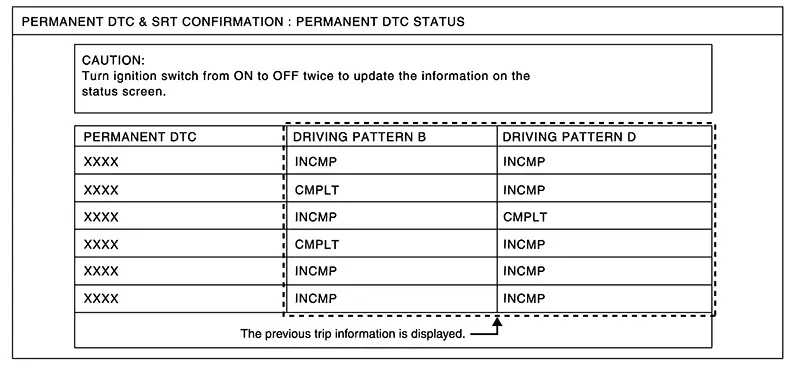
Permanent DTCs stored in control module memory are displayed on the CONSULT screen to show if a driving pattern required for erasing permanent DTCs is complete (CMPLT) or incomplete (INCMP).
CAUTION:
Since the “PERMANENT DTC STATUS” screen displays the previous trip information, repeat the following twice to update the information: “Ignition switch OFF”, “Wait for more than 10 seconds” and “Ignition switch ON”.
This mode is not used in regions that permanent DTCs are not regulated by law.
SRT WORK SUPPORT Mode
This mode enables a technician to drive a Nissan Sentra vehicle to set the SRT while monitoring the SRT status.
PERMANENT DTC WORK SUPPORT Mode
This mode enables a technician to drive a Nissan Sentra vehicle to complete the driving pattern that is required for erasing permanent DTC.
Note:
This mode is not used in regions that permanent DTCs are not regulated by law.
SRT STATUS Mode
For items whose SRT codes are set, “CMPLT” is displayed on the CONSULT screen; for items whose SRTcodes are not set, “INCMP” is displayed.
SRT WORK SUPPORT Mode
This mode enables a technician to drive a Nissan Sentra vehicle to set the SRT while monitoring the SRT status.
System Readiness Test (srt) Code
Diagnosis Description
Diagnosis Description
System Readiness Test (SRT) code is specified in Service $01 of SAE J1979/ISO 15031-5.
As part of an enhanced emissions test for Inspection & Maintenance (I/M), certain states require the status of SRT be used to indicate whether the ECM has completed self-diagnosis of major emission systems and components. Completion must be verified in order for the emissions inspection to proceed.
If a Nissan Sentra vehicle is rejected for a State emissions inspection due to one or more SRT items indicating “INCMP”, use the information in this Service Manual to set the SRT to “CMPLT”.
In most cases the ECM will automatically complete its self-diagnosis cycle during normal usage, and the SRT status will indicate “CMPLT” for each application system. Once set as “CMPLT”, the SRT status remains “CMPLT” until the self-diagnosis memory is erased.
Occasionally, certain portions of the self-diagnostic test may not be completed as a result of the customer's normal driving pattern; the SRT will indicate “INCMP” for these items.
Note:
The SRT will also indicate “INCMP” if the self-diagnosis memory is erased for any reason or if the ECM memory power supply is interrupted for several hours.
If, during the state emissions inspection, the SRT indicates “CMPLT” for all test items, the inspector will continue with the emissions test. However, if the SRT indicates “INCMP” for one or more of the SRT items the Nissan Sentra vehicle is returned to the customer untested.
Note:
If MIL is ON during the state emissions inspection, the Nissan Sentra vehicle is also returned to the customer untested even though the SRT indicates “CMPLT” for all test items. Therefore, it is important to check SRT (“CMPLT”) and DTC (No DTCs) before the inspection.
SRT SET TIMING
SRT is set as “CMPLT” after self-diagnosis has been performed one or more times. Completion of SRT is done regardless of whether the result is OK or NG. The set timing is different between OK and NG results and is shown in the table below.
|
Self-diagnosis result |
Example |
|||||
|---|---|---|---|---|---|---|
|
Diagnosis |
Ignition cycle ← ON → OFF ← ON → OFF ← ON → OFF ← ON → |
|||||
|
All OK |
Case 1 |
P0400 |
OK (1) |
— (1) |
OK (2) |
— (2) |
|
P0402 |
OK (1) |
— (1) |
— (1) |
OK (2) |
||
|
P1402 |
OK (1) |
OK (2) |
— (2) |
— (2) |
||
|
SRT of EGR |
“CMPLT” |
“CMPLT” |
“CMPLT” |
“CMPLT” |
||
|
Case 2 |
P0400 |
OK (1) |
— (1) |
— (1) |
— (1) |
|
|
P0402 |
— (0) |
— (0) |
OK (1) |
— (1) |
||
|
P1402 |
OK (1) |
OK (2) |
— (2) |
— (2) |
||
|
SRT of EGR |
“INCMP” |
“INCMP” |
“CMPLT” |
“CMPLT” |
||
|
NG exists |
Case 3 |
P0400 |
OK |
OK |
— |
— |
|
P0402 |
— |
— |
— |
— |
||
|
P1402 |
NG |
— |
NG |
NG (Consecutive NG) |
||
|
(1st trip) DTC |
1st trip DTC |
— |
1st trip DTC |
DTC (= MIL ON) |
||
|
SRT of EGR |
“INCMP” |
“INCMP” |
“INCMP” |
“CMPLT” |
||
OK: Self-diagnosis is carried out and the result is OK.
NG: Self-diagnosis is carried out and the result is NG.
—: Self-diagnosis is not carried out.
When all SRT related self-diagnoses show OK results in a single cycle (Ignition OFF-ON-OFF), the SRT will indicate “CMPLT”. → Case 1 above
When all SRT related self-diagnoses show OK results through several different cycles, the SRT will indicate “CMPLT” at the time the respective self-diagnoses have at least one OK result. → Case 2 above
If one or more SRT related self-diagnoses show NG results in 2 consecutive cycles, the SRT will also indicate “CMPLT”. → Case 3 above
The table above shows that the minimum number of cycles for setting SRT as “INCMP” is the number one (1) for each self-diagnosis (Case 1 & 2) or the number two (2) for one of self-diagnoses (Case 3). However, in preparation for the state emissions inspection, it is unnecessary for each self-diagnosis to be executed twice (Case 3) for the following reasons:
-
The SRT will indicate “CMPLT” at the time the respective self-diagnoses have one (1) OK result.
-
The emissions inspection requires “CMPLT” of the SRT only with OK self-diagnosis results.
-
During SRT driving pattern, the 1st trip DTC (NG) is detected prior to “CMPLT” of SRT and the self-diagnosis memory must be erased from the ECM after repair.
-
If the 1st trip DTC is erased, all the SRT will indicate “INCMP”.
Note:
SRT can be set as “CMPLT” together with the DTC(s). Therefore, DTC check must always be carried out prior to the state emission inspection even though the SRT indicates “CMPLT”.
Dtc and Freeze Frame Data
Diagnosis Description
Diagnosis Description
DTC AND 1ST TRIP DTC
The 1st trip DTC (whose number is the same as the DTC number) is displayed for the latest self-diagnostic result obtained. If the ECM memory was cleared previously, and the 1st trip DTC did not recur, the 1st trip DTC will not be displayed.
If a malfunction is detected during the 1st trip, the 1st trip DTC is saved in the ECM memory. The MIL will not light up (two trip detection logic). If the same malfunction is not detected in the 2nd trip (meeting the required driving pattern), the 1st trip DTC is cleared from the ECM memory. If the same malfunction is detected in the 2nd trip, both the 1st trip DTC and DTC are saved in the ECM memory and the MIL lights up. In other words, the DTC is stored in the ECM memory and the MIL lights up when the same malfunction occurs in two consecutive trips. If a 1st trip DTC is stored and a non-diagnostic operation is performed between the 1st and 2nd trips, only the 1st trip DTC will continue to be stored. For malfunctions that blink or light up the MIL during the 1st trip, the DTC and 1st trip DTC are stored in the ECM memory.
For malfunctions in which 1st trip DTCs are displayed, Refer to DTC Index. These items are required by legal regulations to continuously monitor the system/component. In addition, the items monitored non-continuously are also displayed on CONSULT.
1st trip DTC is specified in Service $07 of SAE J1979/ISO 15031-5. 1st trip DTC detection occurs without illuminating the MIL and therefore does not warn the driver of a malfunction.
When a 1st trip DTC is detected, check, print out or write down and erase (1st trip) DTC and Freeze Frame data as specified in Work Flow procedure Step 2, Refer to Work Flow. Then perform DTC Confirmation Procedure or Component Function Check to try to duplicate the malfunction. If the malfunction is duplicated, the item requires repair.
FREEZE FRAME DATA AND 1ST TRIP FREEZE FRAME DATA
The ECM records the driving conditions such as fuel system status, calculated load value, engine coolant temperature, short term fuel trim, long term fuel trim, engine speed, Nissan Sentra vehicle speed, absolute throttle position, base fuel schedule and intake air temperature at the moment a malfunction is detected.
Data which are stored in the ECM memory, along with the 1st trip DTC, are called 1st trip freeze frame data. The data, stored together with the DTC data, are called freeze frame data and displayed on CONSULT or GST. The 1st trip freeze frame data can only be displayed on the CONSULT screen.
Only one set of freeze frame data (either 1st trip freeze frame data or freeze frame data) can be stored in the ECM. 1st trip freeze frame data is stored in the ECM memory along with the 1st trip DTC. There is no priority for 1st trip freeze frame data and it is updated each time a different 1st trip DTC is detected. However, once freeze frame data (2nd trip detection/MIL on) is stored in the ECM memory, 1st trip freeze frame data is no longer stored. Remember, only one set of freeze frame data can be stored in the ECM. The ECM has the following priorities to update the data.
|
Priority |
Items |
|
|---|---|---|
|
1 |
Freeze frame data |
Misfire — DTC: P0300 – P0304 Fuel Injection System Function — DTC: P0171, P0172 |
|
2 |
Except the above items |
|
|
3 |
1st trip freeze frame data |
|
For example, the EGR malfunction (Priority: 2) was detected and the freeze frame data was saved in the 2nd trip. After that when the misfire (Priority: 1) is detected in another trip, the freeze frame data will be updated from the EGR malfunction to the misfire. The 1st trip freeze frame data is updated each time a different malfunction is detected. There is no priority for 1st trip freeze frame data. However, once freeze frame data is stored in the ECM memory, 1st trip freeze data is no longer stored (because only one freeze frame data or 1st trip freeze frame data can be stored in the ECM). If freeze frame data is stored in the ECM memory and freeze frame data with the same priority occurs later, the first (original) freeze frame data remains unchanged in the ECM memory.
Both 1st trip freeze frame data and freeze frame data (along with the DTCs) are cleared when the ECM memory is erased.
Driving Pattern
Diagnosis Description
Diagnosis Description
CAUTION:
Always drive at a safe speed.
DRIVING PATTERN A
Driving pattern A means a trip satisfying the following conditions.
-
Engine speed reaches 400 rpm or more.
-
Engine coolant temperature rises by 20°C (36°F) or more after starting the engine.
-
Engine coolant temperature reaches 70°C (158°F) or more.
-
The ignition switch is turned from ON to OFF.
-
When the same malfunction is detected regardless of driving conditions, reset the counter of driving pattern A.
-
When the above conditions are satisfied without detecting the same malfunction, reset the counter of driving pattern A.
DRIVING PATTERN B
Driving pattern B means a trip satisfying the following conditions.
-
Engine speed reaches 400 rpm or more.
-
Engine coolant temperature reaches 70°C (158°F) or more.
-
Nissan Sentra Vehicle speed of 70 – 120 km/h (44 – 75 MPH) is maintained for 60 seconds or more under the control of closed loop.
-
Nissan Sentra Vehicle speed of 30 – 60 km/h (19 – 37 MPH) is maintained for 10 seconds or more under the control of closed loop.
-
Under the closed loop control condition, the following state reaches 12 seconds or more in total: Nissan Sentra Vehicle speed of 4 km/h (2 MPH) or less with idling condition.
-
The state of driving at 10 km/h (7 MPH) or more reaches 10 minutes or more in total.
-
A lapse of 22 minutes or more after engine start.
-
Drive the Nissan Sentra vehicle at a constant velocity.
-
When the same malfunction is detected regardless of driving conditions, reset the counter of driving pattern B.
-
When the above conditions are satisfied without detecting the same malfunction, reset the counter of driving pattern B.
DRIVING PATTERN C
Driving pattern C means operating Nissan Sentra vehicle as per the following:
The following conditions should be satisfied at the same time:
Engine speed: (Engine speed in the freeze frame data) ±375 rpm
Calculated load value: (Calculated load value in the freeze frame data) x (1±0.1) [%]
Engine coolant temperature condition:
-
When the freeze frame data shows lower than 70°C (158°F), engine coolant temperature should be lower than 70°C (158°F).
-
When the freeze frame data shows higher than or equal to 70°C (158°F), engine coolant temperature should be higher than or equal to 70°C (158°F).
-
When the same malfunction is detected regardless of the above Nissan Sentra vehicle conditions, reset the counter of driving pattern C.
-
When the above conditions are satisfied without detecting the same malfunction, reset the counter of driving pattern C.
-
The 1st trip DTC will be cleared when C counter is counted once without the same malfunction after DTC is stored in ECM.
DRIVING PATTERN D
Driving pattern D means a trip satisfying the following conditions.
-
The state of driving at 40 km/h (25 MPH) reaches 300 seconds or more in total.
-
Idle speed lasts 30 seconds or more.
-
A lapse of 600 seconds or more after engine start.
-
When the same malfunction is detected regardless of driving conditions, reset the counter of driving pattern D.
-
When the above conditions are satisfied without detecting the same malfunction, reset the counter of driving pattern D.
Counter System
Diagnosis Description
Diagnosis Description
RELATIONSHIP BETWEEN MIL, 1ST TRIP DTC, DTC, AND DETECTABLE ITEMS
-
When a malfunction is detected for the first time, the 1st trip DTC and the 1st trip freeze frame data are stored in the ECM memory.
-
When the same malfunction is detected in two consecutive trips, the DTC and the freeze frame data are stored in the ECM memory, and the MIL will come on.
-
The MIL will turn OFF after the Nissan Sentra vehicle is driven 3 times (driving pattern B) with no malfunction. The drive is counted only when the recorded driving pattern is met (as stored in the ECM). If another malfunction occurs while counting, the counter will reset.
-
The DTC and the freeze frame data will be stored until the Nissan Sentra vehicle is driven 40 times (driving pattern A) without the same malfunction recurring (except for Misfire and Fuel Injection System). For Misfire and Fuel Injection System, the DTC and freeze frame data will be stored until the Nissan Sentra vehicle is driven 80 times (driving pattern C) without the same malfunction recurring. The “TIME” in “SELF-DIAGNOSTIC RESULTS” mode of CONSULT will count the number of times the Nissan Sentra vehicle is driven.
-
The 1st trip DTC is not displayed when the self-diagnosis results in OK for the 2nd trip.
COUNTER SYSTEM CHART
|
Items |
Fuel Injection System |
Misfire |
Other |
|---|---|---|---|
|
MIL (turns OFF) |
3 (pattern B) |
3 (pattern B) |
3 (pattern B) |
|
DTC, Freeze Frame Data (no display) |
80 (pattern C) |
80 (pattern C) |
40 (pattern A) |
|
1st Trip DTC (clear) |
1 (pattern C), *1 |
1 (pattern C), *1 |
1 (pattern B) |
|
1st Trip Freeze Frame Data (clear) |
*1, *2 |
*1, *2 |
1 (pattern B) |
For details about patterns B and C under “Fuel Injection System” and “Misfire”, see “EXPLANATION FOR DRIVING PATTERNS FOR “MISFIRE <EXHAUST QUALITY DETERIORATION>”, “FUEL INJECTION SYSTEM”.
For details about patterns A and B under Other, see “EXPLANATION FOR DRIVING PATTERNS FOR “MISFIRE <EXHAUST QUALITY DETERIORATION>”, “FUEL INJECTION SYSTEM”.
-
*1: Clear timing is at the moment OK is detected.
-
*2: Clear timing is when the same malfunction is detected in the 2nd trip.
Relationship Between MIL, DTC, 1st Trip DTC and Driving Patterns for “Misfire <Exhaust Quality Deterioration>”, “Fuel Injection System”
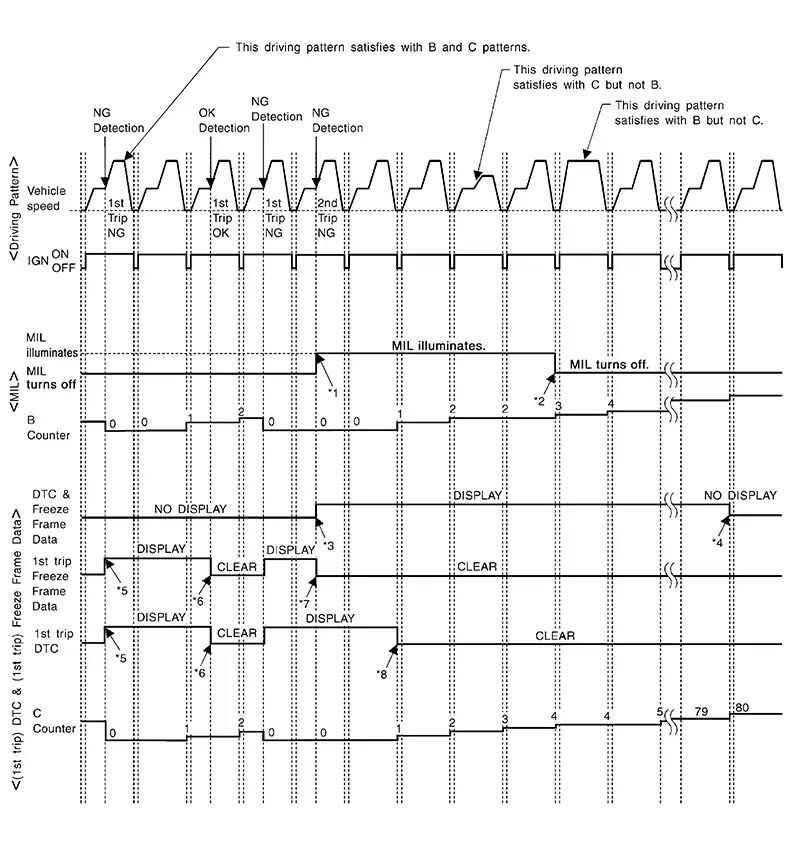
|
*1: |
When the same malfunction is detected in two consecutive trips, MIL will light up. |
*2: |
MIL will turn OFF after Nissan Sentra vehicle is driven 3 times (pattern B) without any malfunctions. |
*3: |
When the same malfunction is detected in two consecutive trips, the DTC and the freeze frame data will be stored in ECM. |
|
*4: |
The DTC and the freeze frame data will not be displayed any longer after Nissan Sentra vehicle is driven 80 times (pattern C) without the same malfunction. (The DTC and the freeze frame data still remain in ECM.) |
*5: |
When a malfunction is detected for the first time, the 1st trip DTC and the 1st trip freeze frame data will be stored in ECM. |
*6: |
The 1st trip DTC and the 1st trip freeze frame data will be cleared at the moment OK is detected. |
|
*7: |
When the same malfunction is detected in the 2nd trip, the 1st trip freeze frame data will be cleared. |
*8: |
1st trip DTC will be cleared when Nissan Sentra vehicle is driven once (pattern C) without the same malfunction after DTC is stored in ECM. |
Explanation for Driving Patterns for “Misfire <Exhaust Quality Deterioration>”, “Fuel Injection System”
Driving Pattern B
Refer to Diagnosis Description.
Driving Pattern C
Refer to Diagnosis Description.
Example:
If the stored freeze frame data is as per the following:
Engine speed: 850 rpm, Calculated load value: 30%, Engine coolant temperature: 80°C (176°F)
To be satisfied with driving pattern C, the Nissan Sentra vehicle should run under the following conditions:
Engine speed: 475 – 1,225 rpm, Calculated load value: 27 – 33%, Engine coolant temperature: more than 70°C (158°F)
Relationship Between MIL, DTC, 1st Trip DTC and Driving Patterns Except For “Misfire <Exhaust Quality Deterioration>”, “Fuel Injection System”
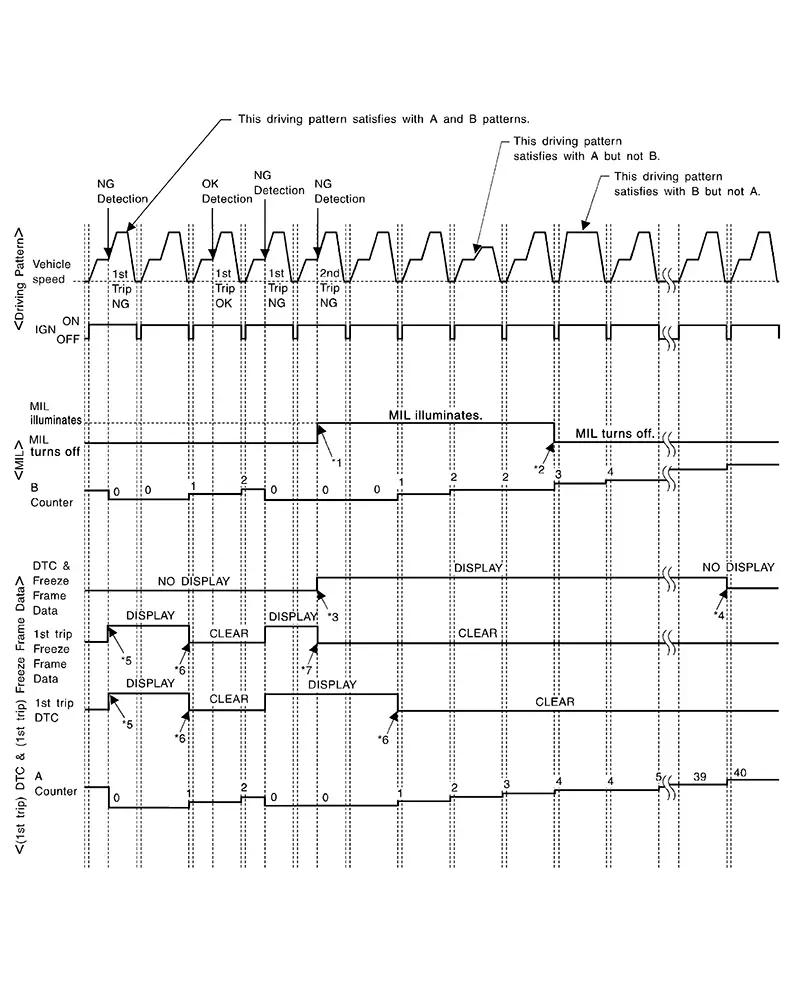
|
*1: |
When the same malfunction is detected in two consecutive trips, MIL will light up. |
*2: |
MIL will turn OFF after Nissan Sentra vehicle is driven 3 times (pattern B) without any malfunctions. |
*3: |
When the same malfunction is detected in two consecutive trips, the DTC and the freeze frame data will be stored in ECM. |
|
*4: |
The DTC and the freeze frame data will not be displayed any longer after Nissan Sentra vehicle is driven 40 times (pattern A) without the same malfunction. (The DTC and the freeze frame data still remain in ECM.) |
*5: |
When a malfunction is detected for the first time, the 1st trip DTC and the 1st trip freeze frame data will be stored in ECM. |
*6: |
1st trip DTC will be cleared after Nissan Sentra vehicle is driven once (pattern B) without the same malfunction. |
|
*7: |
When the same malfunction is detected in the 2nd trip, the 1st trip freeze frame data will be cleared. |
Explanation for Driving Patterns Except for “Misfire <Exhaust Quality Deterioration>”, “Fuel Injection System”
Driving Pattern A
Refer to Diagnosis Description.
Driving Pattern B
Refer to Diagnosis Description.
1 Trip Detection Logic and 2 Trip Detection Logic
Diagnosis Description
Diagnosis Description
When a malfunction is detected for the first time, 1st trip DTC and 1st trip Freeze Frame data are stored in the ECM memory. The MIL will not illuminate at this stage. <1st trip>
If the same malfunction is detected again during the next drive, the DTC and Freeze Frame data are stored in the ECM memory, and the MIL illuminates. The MIL illuminates at the same time when the DTC is stored. <2nd trip> The “trip” in the “Two Trip Detection Logic” means a driving mode in which self-diagnosis is performed during Nissan Sentra vehicle operation. Specific on board diagnostic items will cause the ECM to illuminate or blink the MIL, and store DTC and Freeze Frame data, even in the 1st trip, as shown below.
×: Applicable —: Not applicable|
Items |
MIL |
DTC |
1st trip DTC |
|||||
|---|---|---|---|---|---|---|---|---|
|
1st trip |
2nd trip |
1st trip displaying |
2nd trip displaying |
1st trip displaying |
2nd trip displaying |
|||
|
Blinking |
Illuminated |
Blinking |
Illuminated |
|||||
|
Misfire (Possible three way catalyst damage) — DTC: P0300 – P0304 is being detected |
× |
— |
— |
— |
— |
— |
× |
— |
|
Misfire (Possible three way catalyst damage) — DTC: P0300 – P0304 is being detected |
— |
— |
× |
— |
— |
× |
— |
— |
|
One trip detection diagnoses (Refer to DTC Index.) |
— |
× |
— |
— |
× |
— |
— |
— |
|
Except above |
— |
— |
— |
× |
— |
× |
× |
— |
Malfunction Indicator Lamp (mil)
Diagnosis Description
Diagnosis Description
When emission-related ECU detects a malfunction in the emission control systems components and/or the powertrain control components (which affect Nissan Sentra vehicle emissions), it turns on/blinks MIL to inform the driver that a malfunction has been detected.

-
The MIL illuminates when ignition switch is turned ON (engine is not running).
Note:
Check the MIL circuit if MIL does not illuminate. Refer to Diagnosis Procedure.
-
When the engine is started, the MIL should go off.
Note:
If MIL continues to illuminate/blink, perform self-diagnoses and inspect/repair accordingly because an emission-related ECU has detected a malfunction in the emission control systems components and/or the powertrain control components (which affect Nissan Sentra vehicle emissions).
Other materials:
P0300 Misfire
Dtc Description
DTC Description
When a misfire occurs, engine speed will fluctuate. If the engine
speed fluctuates enough to cause the crankshaft position (CKP) sensor signal to
vary, ECM can determine that a misfire is occurring.
...
P059f Active Grille Shutter
Dtc Description
DTC Description
DTC DETECTION LOGIC
Active grille shutter normally stops within zone which
is defined by zone (90°±20°).
If the active grille shutter stops within zone stuck
error is detected, and if the active grille shutter stops at position beyond
zon ...
Unit Disassembly and Assembly
Rear Combination Lamp (body Side)
Exploded View
Exploded View
1.
Rear combination lamp
2.
Stop/tail lamp bulb
...