Nissan Sentra B18 (2020-2025) Owner's Manual: Child safety
WARNING
Do not allow children to play with seat belts in the Nissan Sentra. Most seating positions are equipped with Automatic Locking Retractor (ALR) mode seat belts. If a seat belt becomes wrapped around a child’s neck while ALR mode is activated, the belt may retract and tighten, which can result in serious injury or death. This danger exists even when the vehicle is parked. Immediately unbuckle the seat belt to release the child. If the belt cannot be unbuckled or has already been released, free the child by cutting the seat belt with an appropriate tool such as a knife or scissors.
Children need adults to help protect them. They must always be properly restrained.
In addition to the general information provided in this Nissan Sentra Owner’s Manual, child safety guidance is available from many reliable sources, including doctors, educators, government traffic safety offices, and community safety organizations.
Every child is unique, so it is important to learn and apply the safest method of transporting your child in the Nissan Sentra.
There are three basic types of child restraint systems:
- Rear-facing child restraints
- Forward-facing child restraints
- Booster seats
The correct child restraint depends on the child’s size. In general, infants up to approximately 1 year old and weighing less than 20 lbs (9 kg) should be placed in rear-facing child restraints. Forward-facing child restraints are designed for children who have outgrown rear-facing restraints and are at least 1 year old. Booster seats are used to correctly position the vehicle’s lap/shoulder belt on a child who can no longer use a forward-facing child restraint.
WARNING
Infants and children require special protection.
The vehicle’s seat belts may not fit children properly. The shoulder belt may be too close to the face or neck, and the lap belt may not sit correctly over the small hip bones.
In a collision, an improperly fitting seat belt can cause serious or fatal injury. Always use an appropriate child restraint system.
All U.S. states and Canadian provinces or territories require the use of approved child restraint systems for infants and young children. For additional details, see “Child restraints�.
A child restraint can be secured in the Nissan Sentra using either the LATCH (Lower Anchors and Tethers for CHildren) system or the vehicle’s seat belt.
NISSAN recommends that all pre-teens and children ride in the rear seat. Research shows that children are safer when properly restrained in the rear seating positions compared to the front seat.
This recommendation is especially important because the Nissan Sentra is equipped with a supplemental restraint system (air bag system) for the front passenger.
Infants
Infants up to at least 1 year of age should always be placed in a rear-facing child restraint.
NISSAN recommends using child restraints that comply with Federal Motor Vehicle Safety Standards (FMVSS) or Canadian Motor Vehicle Safety Standards (CMVSS).
Select a child restraint that fits your Nissan Sentra correctly and always follow the manufacturer’s installation and usage instructions.
Small children
Children who are over 1 year old and weigh at least 20 lbs (9 kg) should remain in a rear-facing child restraint for as long as possible, up to the height or weight limit specified by the restraint manufacturer. Children who outgrow the rear-facing limits and are at least 1 year old should be secured in a forward-facing child restraint with a harness.
Always refer to the child restraint manufacturer’s instructions for minimum and maximum height and weight limits.
NISSAN recommends using child restraints that comply with applicable U.S. or Canadian safety standards and that are appropriate for use in the Nissan Sentra.
Larger children
Children should continue using a forward-facing child restraint with a harness until they reach the maximum height or weight limit specified by the manufacturer.
After outgrowing a harness-equipped forward-facing child restraint, NISSAN recommends placing the child in a commercially available booster seat to achieve proper seat belt fit. A correctly used booster seat raises the child so the shoulder belt rests across the chest and the center of the shoulder. The shoulder belt must not cross the neck or face and must not slip off the shoulder.
The lap belt should fit snugly across the lower hips or upper thighs, not the abdomen.
A booster seat may only be used in seating positions equipped with a three-point seat belt. The booster seat must fit the vehicle seat and display a certification label indicating compliance with Federal Motor Vehicle Safety Standards or Canadian Motor Vehicle Safety Standards.
Once the child has grown so that the shoulder belt no longer contacts the face or neck and the lap belt fits correctly across the lower hips or upper thighs, the seat belt may be used without a booster seat.
A booster seat should continue to be used in the Nissan Sentra until the child is able to successfully pass the seat belt fit test outlined below:
- Are the child’s back and hips positioned firmly against the vehicle seatback?
- Is the child able to sit upright without slouching during the ride?
- Do the child’s knees bend comfortably over the front edge of the seat with both feet resting flat on the floor?
- Can the child wear the seat belt correctly, with the lap belt low and snug across the hips and the shoulder belt positioned across the mid-chest and shoulder?
- Is the child able to use a properly adjusted head restraint/headrest?
- Can the child maintain this seating position for the entire duration of the trip?
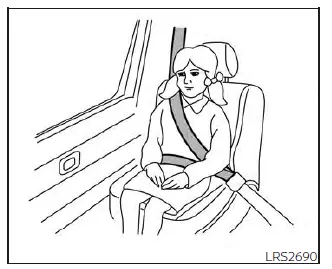
If the answer to any of these questions is no, the child should continue riding in a booster seat secured with a three-point type seat belt in the Nissan Sentra.
NOTE:
Laws and regulations in some regions may differ. Always check local and state requirements to ensure your child is using the appropriate restraint system before traveling.
WARNING
Never allow a child to stand or kneel on any seat, and do not permit a child to ride in the cargo area of the Nissan Sentra. In the event of a sudden stop or collision, a child in these positions could suffer serious injury or death.
Other materials:
Preparation. Preparation
Preparation
Special Service Tools
Special Service Tools
The actual shape of the tools may differ from
those illustrated here.
Tool number
(TechMate No.)
Tool name
...
U2141 Can Comm Err (tcm)
Dtc Description
DTC Description
DTC DETECTION LOGIC
DTC No.
CONSULT screen
terms
(Trouble
diagnosis content)
DTC detection condition
...
Low Tire Pressure Warning Lamp Does Not Turn Off
Symptom Description
Symptom Description
The low tire pressure warning lamp does not turn
OFF after several seconds is passed after the engine starts.
Diagnosis Procedure
Diagnosis Procedure
CHECK TIRE PRESSURE
Ignition switch ...