Nissan Sentra B18 (2020-2025) Owner's Manual: Changing wheels and tires
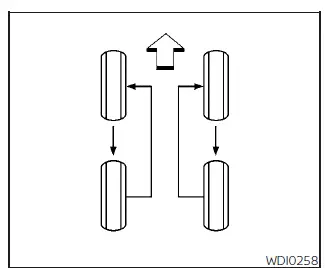
Tire rotation
NISSAN recommends rotating the tires on your Nissan Sentra every 5,000 miles (8,000 km) to promote even tread wear, maintain balanced handling characteristics, and help extend overall tire life.
As soon as possible, tighten the wheel nuts to the specified torque with a torque wrench.
Wheel nut tightening torque: 83 ft-lb (113 N·m)
The wheel nuts must be kept tightened to specifications at all times to ensure safe wheel retention and proper brake and suspension operation.
It is recommended that wheel nuts be tightened to specification at each tire rotation interval on the Nissan Sentra.
WARNING
- After rotating the tires, always check and adjust the tire pressure to the recommended cold tire pressure shown on the Tire and Loading Information label.
- Retighten the wheel nuts after the vehicle has been driven for 600 miles (1,000 km), including after a flat tire repair or wheel replacement.
- Do not include the spare tire in the regular tire rotation sequence.
- For additional tire-related safety information, refer to “Important Tire Safety Information� (U.S.) or “Tire Safety Information� (Canada) in the Warranty Information Booklet provided with your Nissan Sentra.
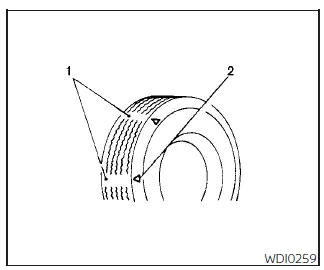
Tire wear and damage
- Wear indicator
- Location mark
WARNING
- Tires should be inspected periodically for signs of wear, cracking, bulging, or foreign objects embedded in the tread. If excessive wear, visible cracks, bulges, or deep cuts are detected, the affected tire(s) must be replaced immediately.
- The original tires installed on the Nissan Sentra are equipped with built-in tread wear indicators. When these indicators become visible across the tread surface, the tire(s) should be replaced without delay.
- Tires naturally degrade with age and use. Have tires, including the spare tire, that are more than 6 years old inspected by a qualified technician, as some forms of internal damage may not be visible externally. Replace tires as necessary to reduce the risk of sudden tire failure and possible personal injury.
- Improper servicing or repair of the spare tire may result in serious personal injury. If spare tire repair is required, it is recommended that you visit a NISSAN dealer for professional service.
- For additional guidance, refer to “Important Tire Safety Information� (U.S.) or “Tire Safety Information� (Canada) in the Warranty Information Booklet.
Replacing wheels and tires
When replacing wheels or tires on your Nissan Sentra, always use tires of the same size, tread design, speed rating, and load carrying capacity as the original factory equipment. Approved tire types and sizes are listed in the “Wheels and tires� section of this manual.
WARNING
- The use of tires other than those recommended by NISSAN, or mixing tires of different brands, constructions (bias, bias-belted, or radial), or tread patterns, can adversely affect ride comfort, braking performance, handling, Vehicle Dynamic Control (VDC) system operation, ground clearance, body-to-tire clearance, tire chain clearance, speedometer accuracy, headlight aim, and bumper height. These effects may lead to unsafe driving conditions and could result in serious personal injury.
- If your Nissan Sentra was originally equipped with four tires of the same size and only two tires are being replaced, install the new tires on the rear axle. Installing new tires on the front axle may increase the risk of loss of vehicle control in certain driving conditions.
- If wheels are replaced for any reason, always select wheels with the
same offset dimension as the original wheels.
Using wheels with an incorrect offset may cause premature tire wear, negatively affect vehicle handling, interfere with the VDC system, or create contact with brake components. Such interference may reduce braking efficiency and accelerate brake pad or shoe wear. For offset specifications, refer to the “Wheels and tires� section.
- When operating the vehicle with a wheel that does not contain a TPMS sensor, such as the spare tire, the TPMS will not function and the low tire pressure warning light will flash for approximately 1 minute and then remain illuminated. Have the tires replaced and/or the TPMS reset as soon as possible. It is recommended that you visit a NISSAN dealer for this service.
- Replacing tires with those not originally specified by NISSAN may impair proper TPMS operation.
- The TPMS sensor can be damaged if handled incorrectly. Exercise caution when removing or installing TPMS components.
- TPMS sensor ID registration may be required after replacement. Contact a NISSAN dealer to perform TPMS registration procedures.
- Do not use valve stem caps that are not specified by NISSAN, as improper caps may seize or become stuck.
- Ensure valve stem caps are correctly installed to prevent dirt intrusion, air leakage, or pressure loss.
- Do not install a damaged or deformed wheel or tire, even if it has been previously repaired. Structural damage may cause sudden failure without warning.
- The use of retread tires on the Nissan Sentra is not recommended.
- For further information, refer to “Important Tire Safety Information� (U.S.) or “Tire Safety Information� (Canada) in the Warranty Information Booklet.
Wheel balance
Proper wheel balance is essential for maintaining stable handling, ride comfort, and optimal tire life on your Nissan Sentra. Even during normal daily driving, wheels can gradually lose balance due to road impacts, tire wear, or environmental factors. For this reason, wheel balancing should be performed whenever vibration is noticed or as part of routine tire service.
Wheel balance service should be performed with the wheels off the vehicle.
Spin balancing the wheels while they are mounted on the vehicle may result in mechanical damage and is not recommended for the Nissan Sentra.
- For additional tire-related safety and maintenance information, refer to “Important Tire Safety Information� (US) or “Tire Safety Information� (Canada) in the Warranty Information Booklet provided with your Nissan Sentra.
Care of wheels
- Wash the wheels regularly whenever washing the vehicle to preserve their appearance and prevent brake dust buildup.
- Clean the inner surfaces of the wheels when a wheel is removed or when the underside of the Nissan Sentra is washed.
- Do not use abrasive or harsh chemical cleaners, as they may damage the wheel finish.
- Inspect wheel rims periodically for dents, cracks, or corrosion. Such damage may cause air leakage or poor sealing at the tire bead.
- NISSAN recommends applying a protective wax to the road wheels, especially in winter climates where road salt is commonly used, to reduce corrosion.
Spare tire (TEMPORARY USE ONLY spare tire)
When a wheel without a Tire Pressure Monitoring System (TPMS) sensor is installed, such as the TEMPORARY USE ONLY spare tire, the TPMS will not operate on your Nissan Sentra.
Observe the following precautions whenever the TEMPORARY USE ONLY spare tire is installed. Failure to follow these guidelines could result in vehicle damage, reduced handling performance, or an accident:
WARNING
- The TEMPORARY USE ONLY spare tire is intended strictly for emergency situations. Replace it with a standard tire as soon as possible to avoid potential tire, drivetrain, or differential damage.
- Drive cautiously while the TEMPORARY USE ONLY spare tire is installed. Avoid sharp steering inputs, sudden acceleration, and abrupt braking.
- Check the spare tire inflation pressure periodically. Always maintain the TEMPORARY USE ONLY spare tire at 60 psi (420 kPa, 4.2 bar).
- With the TEMPORARY USE ONLY spare tire installed, do not drive faster than 50 mph (80 km/h).
- When driving on snow- or ice-covered roads, install the TEMPORARY USE ONLY spare tire on the rear wheels and move the original tire to the front (drive wheels).
- The tread on the TEMPORARY USE ONLY spare tire wears more rapidly than a standard tire. Replace the spare tire once the tread wear indicators become visible.
- Do not install the TEMPORARY USE ONLY spare tire on other vehicles.
- Never use more than one spare tire at the same time.
- Do not tow a trailer when the TEMPORARY USE ONLY spare tire is installed on your Nissan Sentra.
CAUTION
- Do not use tire chains on a TEMPORARY USE ONLY spare tire. Chains will not fit correctly and may damage the vehicle.
- Because the TEMPORARY USE ONLY spare tire is smaller than the original tire, ground clearance is reduced. Avoid driving over obstacles, curbs, or speed bumps. Do not drive through automatic car washes, as the vehicle may become stuck.
Other materials:
C1608-54 Control Unit
Dtc Description
DTC Description
DTC DETECTION LOGIC
DTC No.
CONSULT screen terms
(Trouble diagnosis content)
DTC detection condition
...
C1f4f-82 Bcm Can Circuit 1
Dtc Description
DTC Description
DTC DETECTION LOGIC
DTC
CONSULT screen terms
(Trouble diagnosis
content)
DTC detection
conditi ...
Door Lock and Unlock Switch
Driver Side
Component Function Check
Component Function
Check
CHECK FUNCTION
CONSULT
Ignition switch ON.
Select ″CDL LOCK SW″, ″CDL UNLOCK SW″ in ″Data
...