
Nissan Sentra Service Manual: Precautions in repairing high strength steel
High strength steel (HSS)
High strength steel is used for body panels in order to reduce vehicle weight.
Accordingly, precautions in repairing automotive bodies made of high strength steel are described below:
| Tensile strength | Nissan/Infiniti designation | Major applicable parts |
| 373 N/mm2 (38kg/mm2,54klb/sq in) | SP130 |
|
SP130 is the most commonly used HSS.
Read the following precautions when repairing HSS:
- Additional points to consider
- The repair of reinforcements (such as side members) by heating
is not recommended since it may weaken the component.
When heating is unavoidable, do not heat HSS parts above 550В°C (1,022В°F).
Verify heating temperature with a thermometer.
(Crayon-type and other similar type thermometer are appropriate.)
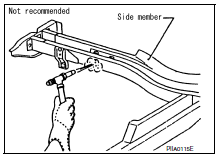
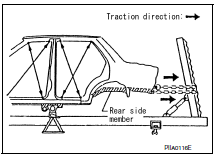
- When straightening body panels, use caution in pulling any HSS panel. Because HSS is very strong, pulling may cause deformation in adjacent portions of the body. In this case, increase the number of measuring points, and carefully pull the HSS panel.
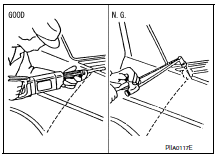
- When cutting HSS panels, avoid gas (torch) cutting if possible.
Instead, use a saw to avoid weakening surrounding areas due to heat. If gas (torch) cutting is unavoidable, allow a minimum margin of 50 mm (1.97in).
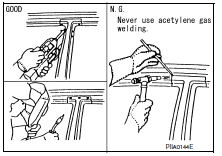
- When welding HSS panels, use spot welding whenever possible
in order to minimize weakening surrounding areas due to
heat.
If spot welding is impossible, use M.I.G. welding. Do not use gas (torch) welding because it is inferior in welding strength.
- The spot weld on HSS panels is harder than that of an ordinary
steel panel.
Therefore, when cutting spot welds on a HSS panel, use a low speed high torque drill (1,000 to 1,200 rpm) to increase drill bit durability and facilitate the operation.
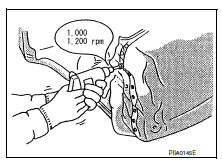
- Precautions in spot welding HSS
This work should be performed under standard working conditions.
Always note the following when spot welding HSS:
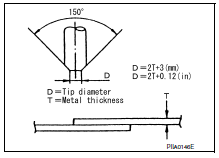
- The electrode tip diameter must be sized properly according to the metal thickness.
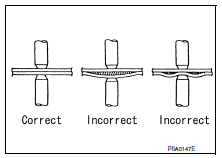
- The panel surfaces must fit flush to each other, leaving no gaps.
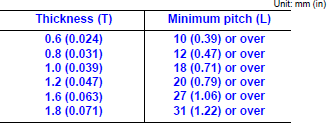
- Follow the specifications for the proper welding pitch.
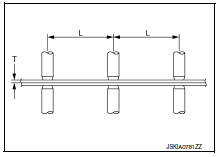
Handling of ultra high strength steel plate parts
PROHIBITION OF CUT AND CONNECTION
Do not cut and join the lower lock pillar reinforcement (center pillar reinforcement inside frame parts) because its material is high strength steel plate (ultra high strength steel plate).
The center pillar reinforcement must be replaced if this part is damaged.
 Precaution for supplemental restraint system (SRS) "air bag" and "seat
belt pre-tensioner"
Precaution for supplemental restraint system (SRS) "air bag" and "seat
belt pre-tensioner"
The Supplemental Restraint System such as “AIR BAG” and “SEAT BELT PRE-TENSIONER”,
used along
with a front seat belt, helps to reduce the risk or severity of injury to the
dri ...
 Preparation
...
Other materials:
Engine cooling system
The engine cooling system is filled at the factory
with a pre-diluted mixture of 50% Genuine
NISSAN Long Life Antifreeze/Coolant (blue) and
50% water to provide year-round anti-freeze and
coolant protection. The antifreeze solution contains
rust and corrosion inhibitors. Additional engine
cool ...
P0706 Transmission range sensor A
DTC Logic
DTC DETECTION LOGIC
DTC
CONSULT screen terms
(Trouble diagnosis content)
DTC detection condition
Possible causes
P0706
T/M RANGE SENSOR A
(Transmission Range Sensor
A Circuit Range/Performance)
All range signals stay OFF continuously for 30
sec ...
High-mounted stop lamp
Removal and Installation
HIGH-MOUNTED STOP LAMP - WITH REAR SPOILER
Removal
Remove the rear air spoiler. Refer to EXT-46, "Removal and
Installation".
Remove the screws and the high-mount stop lamp from the rear air
spoiler.
Installation
Installation is in the reverse or ...
