Nissan Sentra B18 (2020-2025) Owner's Manual: Towing your vehicle
When towing your Nissan Sentra, all applicable state, provincial (in Canada), and local towing regulations must be strictly followed. Using incorrect towing equipment or improper procedures may result in serious damage to your Nissan Sentra.
Detailed towing instructions are available from an authorized NISSAN dealer. Local towing and roadside assistance operators are generally familiar with legal requirements and proper towing techniques. To ensure correct towing procedures and to prevent accidental damage to your Nissan Sentra, NISSAN strongly recommends having your vehicle towed by a professional service operator. It is advisable that the operator carefully review and follow the precautions listed below.
WARNING
- Never ride inside a vehicle that is being towed under any circumstances.
- Never get underneath your Nissan Sentra after it has been lifted by a tow truck.
CAUTION
- Before towing, ensure that the transmission, axles, steering system,
and powertrain of your Nissan Sentra are in proper working condition.
If any of these components are damaged or inoperative, towing dollies or a flatbed tow truck must be used to prevent further vehicle damage. - Always attach safety chains securely before towing the vehicle.
Towing recommended by NISSAN
NISSAN recommends towing procedures based on the specific drivetrain configuration of your Nissan Sentra. Refer to the diagrams in this section to confirm the correct towing method for your vehicle and to avoid transmission or drivetrain damage.
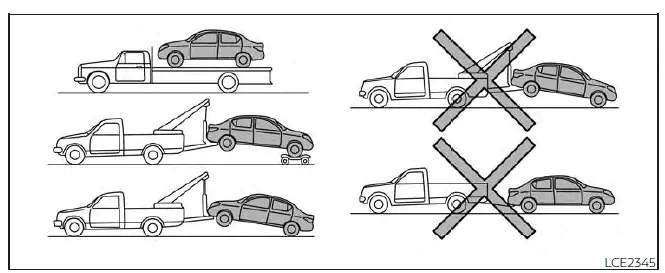
Two-Wheel Drive models with Continuously Variable Transmission (CVT)
NISSAN recommends that Nissan Sentra models equipped with a CVT be towed with the driving (front) wheels raised off the ground or transported on a flatbed tow truck, as illustrated.
CAUTION
- Never tow CVT-equipped Nissan Sentra vehicles with the front wheels on the ground or with all four wheels on the ground, either forward or backward, as this may cause severe and costly transmission damage. If towing with the rear wheels raised is unavoidable, always use towing dollies under the front wheels.
- When towing CVT models with the rear wheels on the ground or on towing
dollies:
- Place the ignition switch in the OFF position and secure the steering
wheel in a straight-ahead position using a rope or similar device.
Never secure the steering wheel by placing the ignition switch in the LOCK position. Doing so may damage the steering lock mechanism on models equipped with this feature.
- Place the ignition switch in the OFF position and secure the steering
wheel in a straight-ahead position using a rope or similar device.
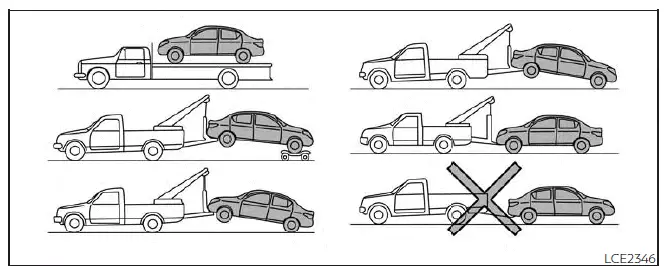
Two-Wheel Drive models with manual transmission
For Nissan Sentra models equipped with a manual transmission, NISSAN recommends using towing dollies or transporting the vehicle on a flatbed tow truck as shown.
If a pull-behind tow truck must be used, place the manual transmission in N (Neutral) before towing.
The towing speed of your Nissan Sentra should never exceed 60 mph (97 km/h).
After every 500 miles (805 km) of towing, start the engine and allow it to idle for approximately two minutes with the transmission in N (Neutral). Failure to idle the engine at these intervals may cause internal transmission damage.
CAUTION
Failure to follow these towing guidelines can result in severe and permanent transmission damage.
- If manual transmission Nissan Sentra models must be towed with the rear
wheels on the ground (without towing dollies) or with all four wheels on the
ground:
- Always release the parking brake.
- Shift the transmission into the N (Neutral) position.
- Observe the following limitations strictly:
Maximum speed: below 60 mph (97 km/h)
Maximum distance: less than 500 miles (805 km)
When towing over long distances or at speeds exceeding 60 mph (97 km/h), remove the propeller shaft before towing to prevent transmission damage. For detailed instructions and assistance, it is recommended that you visit an authorized NISSAN dealer.
Vehicle recovery (freeing a stuck vehicle)
WARNING
To avoid vehicle damage, serious injury, or death when recovering a stuck Nissan Sentra:
- Contact a professional towing or recovery service if there is any uncertainty regarding the recovery procedure.
- Attach tow chains or cables only to the main structural members of the vehicle.
- Do not use vehicle tie-down points to tow or recover a stuck vehicle.
- Use only recovery equipment specifically designed for vehicle recovery and follow the manufacturer’s instructions.
- Always pull the recovery device straight out from the front of the vehicle.
Never pull the vehicle at an angle.
If your Nissan Sentra becomes stuck in sand, snow, mud, or similar conditions, use a tow strap or other recovery device that is specifically designed for vehicle recovery. Always carefully follow the recovery device manufacturer’s instructions to avoid damage to the vehicle or personal injury.
Rocking a stuck vehicle
WARNING
- Stand well clear of the vehicle while it is being rocked.
- Do not spin the tires at high speed. Excessive wheel spin can cause the tires to explode, resulting in serious injury. In addition, drivetrain components of your Nissan Sentra may overheat and sustain damage.
If your Nissan Sentra is stuck in sand, snow, mud, or similar terrain, use the following procedure to attempt recovery:
1. Turn off the Vehicle Dynamic Control (VDC) system.
2. Ensure that the area in front of and behind the vehicle is completely clear of people, obstacles, and debris.
3. Turn the steering wheel fully to the right and left to help clear space around the front tires.
4. Slowly rock the vehicle forward and backward.
- Shift back and forth between R (Reverse) and D (Drive) on Continuously Variable Transmission (CVT) models, or between 1st (Low) and R (Reverse) on manual transmission models.
- Apply the accelerator pedal gently and only as much as necessary to maintain a smooth rocking motion.
- Release the accelerator pedal completely before shifting between R (Reverse) and D (Drive) on CVT models, or between 1st (Low) and R (Reverse) on manual transmission models.
- Do not allow the tires to spin faster than 35 mph (55 km/h).
5. If the Nissan Sentra cannot be freed after several attempts, stop immediately and contact a professional towing or recovery service to remove the vehicle safely.
Other materials:
Front Camera Unit
Values on the Diagnosis Tool
Values On The Diagnosis Tool
Note:
The following table includes information (items)
inapplicable to this Nissan Sentra vehicle. For information (items) applicable to this
vehicle, refer to CONSULT display items.
...
B20bd-96 Battery Current Sensor
Dtc Description
DTC Description
DTC DETECTION LOGIC
DTC No.
CONSULT screen items
(Trouble diagnosis content)
DTC Detection Condition
...
Door Lock Function
System Diagram
System Diagram
System Description
System Description
Only when pressing the door request switch it is
possible to lock and unlock the door by carrying the Intelligent
Key.
INPUT SIGNAL AND OUTPUT SIGNAL
...