
Nissan Sentra B18 (2020-2025) Service Manual: Symptom Table
|
Gauge indication |
Refrigerant cycle |
Probable cause |
Corrective action |
|---|---|---|---|
|
Both high and low pressure sides are too high. 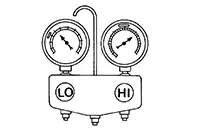
|
The pressure returns to normal soon after sprinkling water on condenser. |
Overfilled refrigerant. |
Collect all refrigerant, evacuate refrigerant cycle again, and then refill it with the specified amount of refrigerant. |
|
Air flow to condenser is insufficient. |
Insufficient condenser cooling performance.
|
|
|
|
When A/C compressor is stopped, a high-pressure reading quickly drops by approximately 196 kPa (2 kg/cm2, 28 psi). It then gradually decreases. |
Air mixed in refrigerant cycle. |
Collect all refrigerant, evacuate refrigerant cycle again, and then refill it with the specified amount of refrigerant. |
|
|
Expansion valve opened too much (excessive flow of refrigerant). |
Replace expansion valve. |
|
|
High-pressure side is excessively high and low-pressure side is too low. 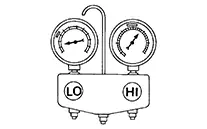
|
High-pressure pipe and upper side of condenser become hot, however, liquid tank does not become so hot. |
Clogged or crushed high-pressure pipe located between A/C compressor and condenser. |
Repair or replace the malfunctioning parts. |
|
High-pressure side is too low and low-pressure side is too high. 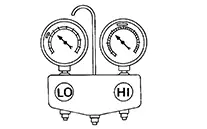
|
|
Malfunction in A/C compressor system (insufficient A/C compressor pressure operation).
|
Replace A/C compressor. |
|
Both high and low pressure sides are too low. 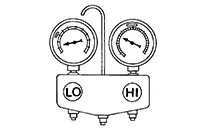
|
|
Clogged expansion valve.
|
Eliminate foreign material from expansion valve or replace it. |
|
Malfunction in inner liquid tank (clogged strainer). |
Replace liquid tank. |
|
|
Evaporator becomes frosted. |
Clogged or crushed low-pressure pipe. |
Repair or replace malfunctioning parts. |
|
|
Malfunction in intake air temperature sensor. |
Check intake sensor system. Refer to Diagnosis Procedure (automatic A/C) or Component Inspection (manual A/C). |
||
|
There is a small temperature difference between the high and low pressure pipes for refrigerant cycle. |
|
|
|
|
Low-pressure side sometimes becomes negative. 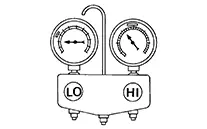
|
|
|
|
|
Hunting in high-pressure side. |
There is no temperature difference between high- and low-pressure sides. |
Malfunctioning variable valve in A/C compressor. |
|
 Trouble Diagnosis for Unusual Pressure
Trouble Diagnosis For Unusual Pressure
Diagnose using a manifold gauge whenever
system’s high and/or low side pressure(s) is/are unusual. The
marker above the gauge scale in the following ...
 Noise
Noise
...
Other materials:
P1526 Vehicle Speed Sensor
Dtc Description
DTC Description
DTC DETECTION LOGIC
DTC
CONSULT screen terms
(Trouble diagnosis
content)
DTC detection
condition
...
Wiring diagram
Intelligent key system/engine start function
Wiring diagram
Nissan vehicle immobilizer systemnats
Wiring Diagram
Vehicle security system
Wiring diagram
...
Front Auxiliary Input Jacks
Removal and Installation
Removal and Installation
REMOVAL
Remove
cluster lid C. Refer to Removal and Installation.
Using a
suitable tool, release pawls on the front auxiliary input jacks
(1), then remove from the front of cluster lid C (2).
...
