Nissan Sentra B18 (2020-2025) Owner's Manual: Recommended fluids/lubricants and capacities
The following values represent approximate capacities for the Nissan Sentra. Actual refill quantities may vary slightly depending on engine condition and service method. When refilling any fluid, always follow the procedures described in the "Do-it-yourself" section of this manual to determine the correct refill capacity.
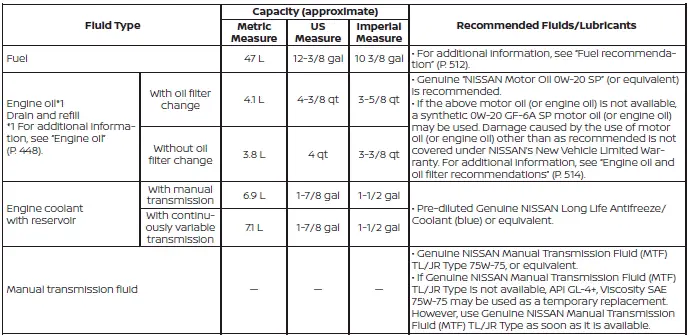
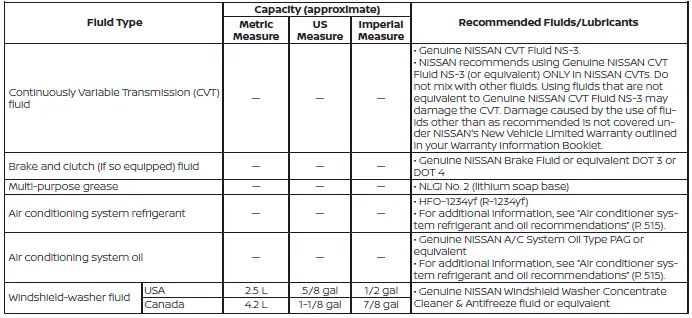
Fuel recommendation
Use unleaded regular gasoline with an octane rating of at least 87 AKI (Anti-Knock Index), which corresponds to a Research Octane Number (RON) of 91. This fuel grade is recommended to ensure optimal performance, fuel efficiency, and emissions control for your Nissan Sentra.
CAUTION
- Only vehicles equipped with an E-85 filler door label are approved to operate on E-85 fuel. Serious fuel system or engine damage may occur if E-85 is used in vehicles not designed for this fuel.
- Using any fuel other than the specified type may adversely affect the emission control system and could also impact warranty coverage for your Nissan Sentra.
- Under no circumstances should leaded gasoline be used, as it will permanently damage the three-way catalytic converter.
- Do not use E-15 or E-85 fuel in your vehicle. The Nissan Sentra is not designed to operate on these fuel blends. Use of E-15 or E-85 can negatively affect emission control devices and systems. Damage caused by such fuel is not covered by the NISSAN New Vehicle Limited Warranty.
- Do not use gasoline containing the octane booster methylcyclopentadienyl
manganese tricarbonyl (MMT).
Use of fuel containing MMT may reduce vehicle performance and increase exhaust emissions. Fuel pumps may not always be labeled to indicate MMT content; consult your fuel retailer if unsure. Federal and California regulations prohibit the use of MMT in reformulated gasoline.
- U.S. government regulations require ethanol dispensing pumps to be clearly identified with a small square orange and black label indicating the ethanol content for that region.
Gasoline specifications
NISSAN recommends gasoline that meets World-Wide Fuel Charter (WWFC) specifications where available. These standards were developed by multiple automobile manufacturers to enhance engine cleanliness, emissions system durability, and overall vehicle performance. Ask your service station manager whether the gasoline meets WWFC standards.
Reformulated gasoline
Some fuel suppliers offer reformulated gasoline, which is specifically engineered to reduce harmful vehicle emissions.
NISSAN supports initiatives aimed at improving air quality and encourages the use of reformulated gasoline whenever it is available and compatible with your Nissan Sentra.
Gasoline containing oxygenates
Certain fuel suppliers sell gasoline blends containing oxygenates such as ethanol,
Methyl Tert-butyl Ether (MTBE), or methanol, with or without clear labeling.
NISSAN does not recommend using fuels whose oxygenate content or compatibility with your Nissan Sentra cannot be clearly verified. If uncertain, consult your fuel provider before refueling.
If oxygenate-blend gasoline is used, observe the following precautions, as improper fuel composition may lead to reduced performance or fuel system damage.
- The fuel must be unleaded and meet or exceed the minimum octane rating recommended for standard unleaded gasoline.
- Oxygenate blends other than methanol should contain no more than
10% oxygenate.
(MTBE may be used in concentrations of up to 15%.)
- E-15 fuel contains more than 10% oxygenate and must not be used.
E-15 can damage emission control systems and related components. Such damage is not covered by the NISSAN New Vehicle Limited Warranty.
- If methanol-blend fuel is used, it must contain no more than 5%
methanol (methyl alcohol or wood alcohol) and include appropriate cosolvents
and corrosion inhibitors.
Improperly formulated methanol blends may cause fuel system damage or driveability issues. At this time, sufficient data is not available to confirm that all methanol blends are suitable for use in NISSAN vehicles.
If driveability issues such as engine stalling, hesitation, or difficult hot starting occur after using oxygenate-blend gasoline, immediately switch to a non-oxygenated fuel or a gasoline with a low MTBE blend that meets the recommended specifications for your Nissan Sentra.
Take care not to spill gasoline during refueling.
Gasoline containing oxygenates may cause damage to painted surfaces if spilled.
E-15 fuel
E-15 fuel is a blend consisting of approximately 15% ethanol and 85% unleaded gasoline.
E-15 fuel may only be used in vehicles specifically designed and certified to operate on E-15. Do not use E-15 fuel in your Nissan Sentra. U.S. government regulations require ethanol fuel dispensing pumps to be identified by a small, square, orange and black label displaying the appropriate ethanol percentage for that region.
E-85 fuel
E-85 fuel is a mixture of approximately 85% ethanol and 15% unleaded gasoline.
E-85 fuel may only be used in Flexible Fuel Vehicles (FFV). The Nissan Sentra is not designed to operate on E-85 fuel, and its use may result in damage to the fuel system or engine.
U.S. government regulations require ethanol fuel pumps to display a clearly visible orange and black label identifying the ethanol content.
Fuel containing MMT
MMT (methylcyclopentadienyl manganese tricarbonyl) is an octane-enhancing fuel additive.
NISSAN does not recommend the use of fuels containing MMT. Such fuels may negatively affect engine performance and may damage the emission control system of your Nissan Sentra. Because not all fuel dispensers clearly identify MMT content, it may be necessary to consult your gasoline retailer for additional information.
Aftermarket fuel additives
NISSAN does not recommend the use of aftermarket fuel additives such as fuel injector cleaners, octane boosters, or intake valve deposit removers. Many of these commercially available products contain active solvents or similar chemicals that may be harmful to the fuel system, engine components, or emission control devices.
Octane rating tips
Using unleaded gasoline with an octane rating lower than recommended may cause persistent and heavy spark knock, which is a metallic rattling sound. Severe spark knock can lead to engine damage. If heavy spark knock occurs even when using gasoline of the specified octane rating, or if steady spark knock is heard while cruising at a constant speed on level roads, have the condition corrected by a NISSAN dealer. Failure to correct this condition is considered misuse of the vehicle, and NISSAN is not responsible for resulting damage.
Incorrect ignition timing can also result in spark knock, engine after-run, or overheating, which may cause excessive fuel consumption or engine damage. If any of these symptoms are noticed, have your Nissan Sentra inspected as soon as possible. It is recommended that you visit a NISSAN dealer for service.
Occasionally, light spark knock may be heard for a brief moment during acceleration or when driving uphill. This is normal and not a cause for concern, as light spark knock under heavy engine load can improve fuel efficiency.
Engine oil and oil filter recommendations
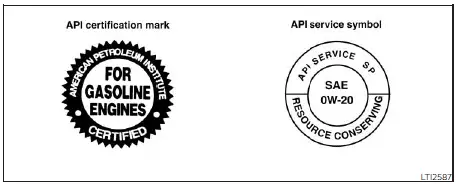
Selecting the correct oil
Selecting the proper engine oil grade, viscosity, and quality is critical to ensuring long engine life and reliable performance of your Nissan Sentra.
For additional details, refer to “Recommended fluids/lubricants and capacities.� NISSAN recommends using an energy-conserving engine oil to help improve fuel economy and maintain optimal engine efficiency.
Use only engine oils that meet the American Petroleum Institute (API) certification or the International Lubricant Standardization and Approval Committee (ILSAC) certification, and that comply with the appropriate SAE viscosity standards.
Approved oils display the API certification mark on the container. Oils without this certification should not be used, as they may cause premature engine wear or damage.
Oil additives
NISSAN does not recommend the use of oil additives. When the correct oil type is used and recommended maintenance intervals are followed, additional oil additives are unnecessary.
Engine oil that contains contaminants or has been previously used must not be reused in your Nissan Sentra.
Oil viscosity
Engine oil viscosity changes with temperature. It is important to select the appropriate oil viscosity based on the expected operating temperatures before the next oil change interval. Using oil with a viscosity other than that recommended may result in serious engine damage.
Selecting the correct oil filter
Your Nissan Sentra is factory-equipped with a high-quality Genuine NISSAN oil filter. When replacing the oil filter, use a Genuine NISSAN oil filter or an equivalent filter that meets NISSAN specifications, as described in the “Change intervals� section.
Change intervals
The oil and oil filter change intervals for your engine are determined based on the use of specified-quality oils and filters. Using oils or filters that do not meet NISSAN specifications, or exceeding recommended change intervals, may significantly reduce engine life.
Engine damage caused by improper maintenance or the use of incorrect oil or filter quality and viscosity is not covered by the NISSAN New Vehicle Limited Warranty.
Your Nissan Sentra engine is factory-filled with high-quality engine oil during assembly. There is no need to replace the engine oil before the first recommended service interval. Oil and oil filter change intervals vary depending on driving habits, operating conditions, and overall vehicle usage.
Driving under the following conditions may require more frequent engine oil and oil filter replacement to maintain optimal performance and engine longevity in your Nissan Sentra:
- repeated short-distance driving in cold outside temperatures
- operation in dusty or sandy environments
- extended engine idling
- frequent stop-and-go commuting in heavy traffic
For additional details regarding oil service intervals, refer to the “Maintenance and schedules� section of this Nissan Sentra Owner’s Manual.
Air conditioner system refrigerant and oil recommendations
The air conditioning system in your Nissan Sentra must be charged exclusively with HFO-1234yf (R-1234yf) refrigerant and NISSAN A/C system oil Type PAG, or exact approved equivalents.
CAUTION
Using any refrigerant or oil other than those specified may cause severe damage to the air conditioning system and will require replacement of all A/C system components.
The HFO-1234yf (R-1234yf) refrigerant used in your Nissan Sentra does not harm the earth’s ozone layer. Although it has minimal environmental impact, government regulations require that refrigerant be properly recovered and recycled during air conditioning system service.
Servicing the air conditioning system should only be performed by trained and certified technicians (SAE J2845) to ensure safe and proper operation. A NISSAN dealer has the specialized equipment and certified technicians required to recover and recycle refrigerant correctly. Only new and SAE J2842-certified evaporators may be used as replacement parts.
A damaged or leaking air conditioning evaporator must never be repaired or replaced with a used or salvaged component. To maintain system integrity and safety, only new SAE J2842-certified evaporators should be installed. It is strongly recommended that you visit a NISSAN dealer for any air conditioning service on your Nissan Sentra.
Other materials:
Diagnosis System (bose Amp.)
Consult Function
CONSULT Function
CONSULT FUNCTIONS
CONSULT performs the following functions via
communication with the Bose speaker amp.:
Diagnosis Mode
CGW Status
...
License Plate Lamp
Component Inspection
Component Inspection
CHECK LICENSE PLATE LAMP 1
Ignition switch OFF.
Disconnect license plate lamp connector.
Check continuity b ...
Low Tire Pressure Location Indicator Does Not Display
Symptom Description
Symptom Description
When there is low tire pressure, the low tire
location indicator does not display even though the low tire
pressure warning lamp turns ON.
Diagnosis Procedure
Diagnosis Procedure
Note:
The Signal Tech II Tool [– (NI-50190)] can be used
to ...