Nissan Sentra B18 (2020-2025) Service Manual: Brake Fluid
Inspection
Inspection
BRAKE FLUID LEVEL
-
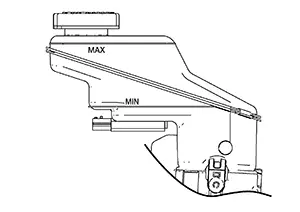
Make sure that the brake fluid level in the master cylinder reservoir tank is between the MAX and MIN lines.
-
Visually check around the master cylinder reservoir tank for brake fluid leaks.
-
If the brake fluid level is excessively low, check the brake system for leaks.
-
If brake warning lamp remains illuminated after parking brake lever is released, check the brake system for brake fluid leaks.
Draining
Draining
CAUTION:
-
Before working, place the ignition switch in the OFF position and disconnect the harness connector from the ABS actuator and electric unit (control unit) or the negative battery terminal. Refer to Battery Disconnect.
-
Do not spill or splash brake fluid on painted surfaces. Brake fluid may damage paint. If brake fluid is splashed on painted areas, wash it away with water immediately.
-
Do not operate the brake pedal with the reservoir cap removed. Failure to do this may cause a discharge of brake fluid from the reservoir cap opening.
-
Check that there is no foreign material in the master cylinder reservoir tank.
-
Do not allow oils other than brake fluid to enter the master cylinder reservoir tank.
-
Do not reuse drained brake fluid.
-
Do not operate the brake pedal excessively during the work procedure.
DRAINING
Place the ignition switch in the OFF position and disconnect the harness connector from the ABS actuator and electric unit(control unit) or the negative battery terminal. Refer to Battery Disconnect.
Connect a vinyl tube to the bleeder valve.
Depress the brake pedal and loosen the bleeder valve.
Depress the brake pedal several times and gradually discharge brake fluid.
CAUTION:
Do not allow the master cylinder reservoir tank to empty as this may cause damage to the master cylinder internal components.
Refilling
Refilling
CAUTION:
-
Before working, place the ignition switch in the OFF position and disconnect the harness connector from the ABS actuator and electric unit (control unit) or the negative battery terminal. Refer to Battery Disconnect.
-
Do not spill or splash brake fluid on painted surfaces. Brake fluid may damage paint. If brake fluid is splashed on painted areas, wash it away with water immediately.
-
Do not operate the brake pedal with the reservoir cap removed. Failure to do this may cause a discharge of brake fluid from the reservoir cap opening.
-
Check that there is no foreign material in the master cylinder reservoir tank.
-
Do not allow oils other than brake fluid to enter the master cylinder reservoir tank.
-
Do not reuse drained brake fluid.
-
Monitor the brake fluid level in the master cylinder reservoir tank while performing the refilling.
-
Refill the brake system with new brake fluid. Refer to Fluids and Lubricants.
-
Do not operate the brake pedal excessively during the work procedure.
REFILLING
Make sure the ignition switch is OFF and the harness connector from the ABS actuator and electric unit (control unit) is disconnected or the negative battery terminal is disconnected. Refer to Battery Disconnect.
Make sure that there is no foreign material in the master cylinder reservoir tank, and refill with new brake fluid. Refer to Fluids and Lubricants.
Connect a vinyl tube to the bleeder valve.
Depress the brake pedal.
Loosen the bleeder valve.
Slowly depress the brake pedal to 2/3 of the brake pedal full stroke.
Tighten the bleeder valve with the brake pedal depressed.
Repeat this procedure at intervals of two or three seconds until all old brake fluid is discharged. Add new brake fluid to the master cylinder reservoir tank frequently.
CAUTION:
Do not allow the master cylinder reservoir tank to empty as this may cause damage to the master cylinder internal components.
Bleed the air out of the brake system. Refer to Bleeding Brake System.
Bleeding Brake System
Bleeding Brake System
CAUTION:
-
Before working, place the ignition switch in the OFF position and disconnect the harness connector from the ABS actuator and electric unit (control unit) or the negative battery terminal. Refer to Battery Disconnect.
-
Do not spill or splash brake fluid on painted surfaces. Brake fluid may damage paint. If brake fluid is splashed on painted areas, wash it away with water immediately.
-
Do not operate the brake pedal with the reservoir cap removed. Failure to do this may cause a discharge of brake fluid from the reservoir cap opening.
-
Check that there is no foreign material in the master cylinder reservoir tank.
-
Do not allow oils other than brake fluid to enter the master cylinder reservoir tank.
-
Do not reuse drained brake fluid.
-
Monitor the brake fluid level in the master cylinder reservoir tank while performing the air bleeding.
-
Refill the brake system with new brake fluid. Refer to Fluids and Lubricants.
-
Do not operate the brake pedal excessively during the work procedure.
BLEEDING BRAKE SYSTEM
Place the ignition switch in the OFF position and disconnect the harness connector from the ABS actuator and electric unit(control unit) or the negative battery terminal. Refer to Battery Disconnect.
If equipped with a manual transmission, bleed the clutch system. Refer to Air Bleeding.
Connect a vinyl tube to the front (RH) brake caliper bleeder valve.
Depress the brake pedal 4 or 5 times.
With the brake pedal depressed, loosen the bleeder valve to bleed air in the brake line, and then tighten it immediately.
Repeat steps 4 and 5 until all of the air is out of the brake line.
Tighten the bleeder valve to the specified torque. Refer to Exploded View for the front brake caliper bleeder valve, or to Exploded View for the rear wheel cylinder bleeder valve, or to Exploded View for the rear brake caliper bleeder valve.
Repeat steps 3 through 7 with the master cylinder reservoir tank filled at least halfway. Bleed the air in the following order: front (RH) —> front (LH) —> rear (RH) —> rear (LH).
Other materials:
Automatic Emergency Braking (AEB) with Pedestrian Detection
WARNING
Failure to carefully follow all warnings and instructions for proper use of
the Automatic Emergency Braking (AEB) with Pedestrian Detection system could result
in serious injury or death.
The AEB with Pedestrian Detection system on the Nissan Sentra is a supplemental
driver assis ...
Component Parts
Ipdm E/r (intelligent Power Distribution Module Engine Room)
Component Parts Location
Component Parts
Location
A.
Engine compartment LH
...
Starting System. Symptom Diagnosis. Starting System. Symptom Table
Starting System. Symptom Table
Symptom Table
Symptom Table
Symptom
Reference
No normal cranking
Refer to Work Flow (With 165-DSS–5 ...