
Nissan Sentra Service Manual: Steering gear and linkage
Inspection
INSPECTION AFTER DISASSEMBLY
BOOT
-
Check boot for cracks. Replace if any damage is found.
STEERING GEAR ASSEMBLY HOUSING
-
Check steering gear assembly housing for damage and scratches. Replace if there are any abnormal conditions.
OUTER SOCKET AND INNER SOCKET
Ball joint swinging torque
-
Hook a spring balance to the ball stud and inner socket measuring point (*) and pull the spring balance. Make sure that the spring balance reads the specified value when ball stud and inner socket start to move. Replace outer socket and inner socket if they are outside the specification.
Tool number : � (J-44372)
Swinging torque : Refer to ST-19, "Power Steering Gear".

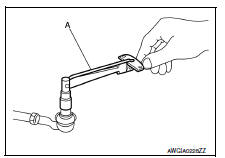
Ball joint rotating torque
-
Make sure that the reading is within the following specified range using Tool. Replace outer socket if the reading is outside the specification.
Tool number (A) : ST3127S000 (J-25765-A)
Rotating torque : Refer to ST-19, "Power Steering Gear".
INSPECTION AFTER INSTALLATION
-
Check if steering wheel turns smoothly when it is turned several times fully to the end of the left and right.
-
Check the steering wheel play, neutral position steering wheel, steering wheel turning force, and front wheel turning angle.
-
Steering wheel play: Refer to ST-5, "Inspection".
-
Neutral position steering wheel, steering wheel turning force, and front wheel turning angle: Refer to ST-5, "Inspection".
 Steering column
Inspection
STEERING COLUMN ASSEMBLY
Check each part of steering column assembly for damage or
other malfunctions. Replace entire steering column
assembly if any parts are damaged.
Me ...
 Symptom diagnosis
Noise, vibration and harshness (NVH) troubleshooting
NVH Troubleshooting Chart
Use the chart below to find the cause of the symptom. If
necessary, repair or replace these parts.
×: Appl ...
Other materials:
The illumination control switch is inoperative
Description
If any of the following malfunctions is found for the illumination control
switch operation.
All switches are inopera
The specified switch cannot be operated
Diagnosis procedure
1.Check illumination control switch signal circuit
Check the illumination control switch signal ...
iPod®* player operation without Navigation System (if so equipped)
Connecting iPod®
WARNINGDo not connect, disconnect or operate the
USB device while driving. Doing so can be
a distraction. If distracted you could lose
control of your vehicle and cause an accident
or serious injury.
CAUTION
Do not force the USB device into the
U ...
Low tire pressure warning lamp does not turn on
Low Tire pessure Warning Lamp Does Not Come On When Ignition Switch Is
Turned On
Note:
The Signal Tech II Tool (J-50190) can be used to perform the following
functions. Refer to the Signal Tech II
User Guide for additional information.
Activate and display TPMS transmitter IDs
Display t ...
